Your Money Your Goals: A Financial Empowerment Toolkit
    Author: Consumer Financial Protection Bureau
    Program Level: Professional Development
    Material Type: Collection
    Language: English
    License: (CC BY-NC-ND 4.0) For license summary click here

    Abstract:

    Your Money, Your Goals is a set of financial empowerment materials to help people meet their financial goals by increasing their knowledge, skills, and resources.
    Publication Year
    2016
    The Your Money, Your Goals toolkit brings together information, tools, and links to other resources that those who work directly with low-income or economically vulnerable people can use to help the people they serve become financially empowered. The toolkit is divided into two sections: Section 1: A four-part Introduction that helps instructors prepare to use the toolkit. Section 2: Modules on the following topics:
    • Module 1: Setting goals and planning for large purchases
    • Module 2: Saving for emergencies, bills, and goals
    • Module 3: Tracking and managing income and benefits
    • Module 4: Paying bills and other expenses
    • Module 5: Getting through the month
    • Module 6: Dealing with debt
    • Module 7: Understanding credit reports and scores
    • Modue 8: Money services, cards, accounts, and loans: Finding what works for you
    • Module 9: Protecting your money
    Section 2 is a toolbox of flexible resources that can be used in a wide range of situations. Each module has a set of tools and resources that can be used depending on the situation.
    Benefits and Uses
    The toolkit is a collection of important financial empowerment information and tools instructors can choose from based on the needs and goals of their students. As a toolkit, it is different from a financial education curriculum. A curriculum generally has a specific set of goals, and you usually work through most or all of the material in the order it’s presented. The toolkit is designed so that instructors don’t need to start with Module 1 and work all the way through the toolkit. Instructors should only go over one or two tools at a time, beginning with a key topic and the tools that align with instructional goals. Receiving all the tools at once may be overwhelming.
    Resource Notice
    This site includes links to information created by other public and private organizations. These links are provided for the user’s convenience. The U.S. Department of Education does not control or guarantee the accuracy, relevance, timeliness, or completeness of this non-ED information. The inclusion of these links is not intended to reflect their importance, nor is it intended to endorse views expressed, or products or services offered, on these non-ED sites. Please note that privacy policies on non-ED sites may differ from ED’s privacy policy. When you visit lincs.ed.gov, no personal information is collected unless you choose to provide that information to us. We do not give, share, sell, or transfer any personal information to a third party. We recommend that you read the privacy policy of non-ED websites that you visit. We invite you to read our privacy policy.

    Yes You Can! Savings Tips for People with Disabilities
    Author: Michael R. Rousch, Chris Rodriguez, and Lindsay Ferguson
    Program Level: Professional Development
    Material Type: Collection
    Language: English
    License: (CC BY-NC-ND 4.0) For license summary click here

    Abstract:

    This webinar describes savings options available to individuals with disabilities that do not jeapordize public benefits.
    Publication Year
    2017
    A webinar hosted by the National Disability Institute on programs that encourage individuals with disabilities to develop money saving habits. Chris Rodriguez, Senior Public Policy Advisor with the National Disability Institute, provides overviews of:
    • The Stephen Beck, Jr. Achieving a Better Life Experience (ABLE) Act
    • Individual Development Accounts (IDAs)
    • Plan for Achieving Self-Support (PASS)
    The Stephen Beck, Jr. Achieving a Better Life Experience (ABLE) Act, is a saving option for some people with disabilities and their families that protects their eligibility for public benefits. Up to $14,000 a year from multiple sources can be contributed to an ABLE account for qualified disability related expenses. Estimates are that over 10 million people are participating in a program. The ABLE National Resource Center is a collaborative of organizations that share the goal of accelerating the design and availability of ABLE accounts for the benefit of individuals with disabilities and their families. Individual Development Accounts (IDAs) are special bank accounts that help low income individuals and families save for things like education, purchasing a first home or starting a business. Workers use earnings from their work to set up an approved bank account for an IDA. Contributions may be matched with funds from State TANF (Temporary Assistance for Needy Families) programs or from special funds called "demonstration project" money. Over the last decade, more than 85,000 IDAs have been opened in programs administered by more than 1,100 sites across the country. The impact of this initiative has resulted in more than 9,400 new homeowners, 7,200 educational purchases and 6,400 small business start-ups and expansion purchases. Plan for Achieving Self-Support (PASS) allows a person with a disability to set aside otherwise countable income and/or resources for a specific period of time in order to achieve a work goal. A PASS account can be used for supplies to start a business, school expenses, equipment and tools, transportation, uniforms and other items or services needed to reach an employment goal. Under PASS, persons with disabilities can set aside money for purchases, installment payments, or down payments for things like a vehicle, wheelchair, or a computer if needed to achieve their work goal. America Saves, a national campaign that uses the principles of social marketing and behavioral economics to motive and support low to moderate income households to save money, reduce debt, and build wealth, is reviewed. Motivational and information resources information are available.
    What the experts say
    As increasing numbers of adults with disabilities participate in K-12 career and technical and adult/postsecondary education, there has been an increase in the number of adults with disabilities in the workforce. Consequently, adults with disabilities are becoming increasingly responsible for managing benefits and general savings plans. The information and support offered in Yes You Can! provides important information about savings plans for individuals with disabilities and care takers. The presenters discuss the information from both a formal and a practical perspective providing adult education programs with valuable resources to support students. It is particularly valuable for adult education programs that combine traditional adult education with workforce training and community supports. This resource presents useful information for those with diagnosed disabilities. The webinar clears up many misconceptions about savings accounts for individuals with disablities and their families. For instance, many people think that if they build up a savings account that they may lose benefits. The charts and other visuals in Yes You Can! are very good. The visual titled "America Saves Research" could be used in a discussion with students about how they should set money aside for savings. Instructors could also incorporate the Motivational Resources" into lesson plans or they could simply share them with students. Yes You Can! is a useful financial literacy resource especially in the arena of savings. It can be used to complement curriculum emphasizing savings as a tool for financial independence. The presenters provide great resources about the savings plans and cite laws that are in place to assist in savings. It would be of value to instructors who are planning lessons on the topic of finances and have students with diagnosed disabilities. The resource could also be used in teacher professional development.
    Resource Notice
    This site includes links to information created by other public and private organizations. These links are provided for the user’s convenience. The U.S. Department of Education does not control or guarantee the accuracy, relevance, timeliness, or completeness of this non-ED information. The inclusion of these links is not intended to reflect their importance, nor is it intended to endorse views expressed, or products or services offered, on these non-ED sites. Please note that privacy policies on non-ED sites may differ from ED’s privacy policy. When you visit lincs.ed.gov, no personal information is collected unless you choose to provide that information to us. We do not give, share, sell, or transfer any personal information to a third party. We recommend that you read the privacy policy of non-ED websites that you visit. We invite you to read our privacy policy.
    How to Choose a Financial Education Curriculum
    Author: Assets for Independence Resource Center
    Program Level: Professional Development
    Material Type: Collection
    Language: English
    License: (CC BY-NC-ND 4.0) For license summary click here

    Abstract:

    This resource offers guidelines to help teachers choose a financial literacy curriculum for their classroom.
    Publication Year
    2017
    This resource provides a clear process for evaluating financial education curricula. There are suggestions and examples for setting goals and thinking about the characteristics and prior knowledge of students. Readers are advised to give consideration to intended audience of the curriculum, topics covered, and outcomes or competencies that students will achieve through the curriculum. There is also a section that explains each category of the Financial Education Curriculum Evaluation Worksheet which can be used to compare various financial literacy curricula.
    Benefits and Uses
    This resource was written for Assets for Independence (AFI) projects, but adult education classroom teachers will find the information and suggestions useful for selecting a financial literacy curriculum to meet their students’ needs. How to Choose a Financial Education Curriculum is organized into two parts. Part 1: “Start with Your Participants” helps staff assess and understand the particular needs of their students by taking a look at their commonalities and differences. Part 1 also has staff consider what outcomes they would like to achieve with a financial literacy curriculum. Part 2: “Steps to Evaluating a Financial Education Curriculum“ provides guidelines and helpful hints for evaluating the strengths and weaknesses of the financial education curricula under consideration. It includes a Financial Education Curriculum Evaluation Worksheet with sections to review key aspects of the curricula's materials, content, approach, and organization. There are questions to consider for each section to help guide teachers in their decision on a financial literacy curriculum.
    Resource Notice
    This site includes links to information created by other public and private organizations. These links are provided for the user’s convenience. The U.S. Department of Education does not control or guarantee the accuracy, relevance, timeliness, or completeness of this non-ED information. The inclusion of these links is not intended to reflect their importance, nor is it intended to endorse views expressed, or products or services offered, on these non-ED sites. Please note that privacy policies on non-ED sites may differ from ED’s privacy policy. When you visit lincs.ed.gov, no personal information is collected unless you choose to provide that information to us. We do not give, share, sell, or transfer any personal information to a third party. We recommend that you read the privacy policy of non-ED websites that you visit. We invite you to read our privacy policy.
    Smart About Money
    Author: National Endowment for Financial Education
    Program Level: Professional Development
    Material Type: Collection
    Language: English
    License: (CC BY-NC-ND 4.0) For license summary click here

    Abstract:

    A collection of in-depth personal finance, courses, articles, calculators, and tips for money managment.
    Publication Year
    2018
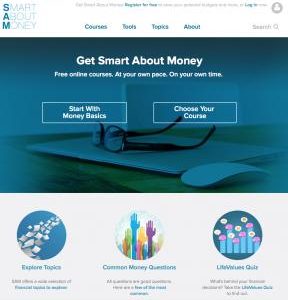
    Smart About Money is an online, comprehensive site regarding financial literacy.  While it is not strictly from an adult education framework, it is designed to address many different scenarios, for as many students as possible. The site is divided into three sections: Courses, Tools, and Topics. The Courses and Topics sections cover most of the basic content areas associated with personal finance and financial literacy. Both present information in one-page chunks that use short sentences and common vocabulary. Some pages have graphics that help to convey the content. The self-selected, self-paced courses help users make empowered decisions to improve their financial literacy. These in-depth guided learning experiences take approximately 45 minutes to complete and include tools and resources (e.g., worksheets, calculators and quizzes). Smart About Money allows users to explore collections of resources (e.g., informational articles, calculators, graphics, videos, and tools) organized by topics such as: crisis and fraud, education and career, family and finances, holidays and money, housing and transportation, insurance and taxes, retirement and aging, saving and investing, and spending and borrowing. Users can also easily find materials available in Spanish in the Topics section. The Tools section has worksheets, questionnaires, and frequently asked questions that would be helpful tools for a teacher developing learning activities around this content. Tools includes a new resource, Common Money Questions, which provides guidance on common scenarios, including what to do in times of transition and crisis. All of the resources are available without registration; however, registration is free and allows a user to save personal budgets and other worksheets.  
    What the experts say
    Smart About Money is a 21st Century financial literacy resource with the capacity to support adult learners at every step in their financial education. Aligning with financial literacy supports to assist adult education trainers in strengthening students foundational knowledge, as well as the ability to provide continued learning opportunities for students, it provides easy to navigate, well-presented financial literacy training for educators and their students. The ease of design and use in Smart About Money is what makes it so helpful.  It's easy to navigate, search, and find what is specific to the individual, while allowing them to see what else may be of interest at a later time or next in their learning. The Money Basics course is a good place to start for individuals who might not be sure where to begin. Alternatively, individuals can search on their own to find courses of interest. Smart About Money is an excellent content resource for adult education practitioners who wish to use authentic materials to teach financial literacy and related concepts. It has a user-friendly interface with a clean design/layout and clear, intuitive navigation. The content is directly relevant to the needs and situations of participants in adult education programs (and the teachers, too) and provides many helpful tools such as worksheets and calcularors, and encourages users to continue to explore and develop their knowledge on their own.
    Resource Notice
    This site includes links to information created by other public and private organizations. These links are provided for the user’s convenience. The U.S. Department of Education does not control or guarantee the accuracy, relevance, timeliness, or completeness of this non-ED information. The inclusion of these links is not intended to reflect their importance, nor is it intended to endorse views expressed, or products or services offered, on these non-ED sites. Please note that privacy policies on non-ED sites may differ from ED’s privacy policy. When you visit lincs.ed.gov, no personal information is collected unless you choose to provide that information to us. We do not give, share, sell, or transfer any personal information to a third party. We recommend that you read the privacy policy of non-ED websites that you visit. We invite you to read our privacy policy.
    NEFE Financial Education Evaluation Online Toolkit
    Author: National Endowment for Financial Education
    Program Level: Professional Development
    Material Type: Collection
    Language: English
    License: (CC BY-NC-ND 4.0) For license summary click here

    Abstract:

    This online evaluation toolkit is designed to help financial educators understand evaluation concepts and efficiently apply them to document the impact their educational programs have on students.
    Publication Year
    2018
    The NEFE Financial Education Evaluation Online Toolkit helps financial educators document the impact of their financial education programs on learners. Evaluation allows educators, administrators and funding agencies to make decisions about their programs based on objective data. It not only provides information about areas for improvement, but also demonstrates the impact of a course or program on participants.
    After creating a free login account, teachers can create and save course evaluations. Users select what kind of evaluation to conduct and the type of impact indicators to include (e.g., Attitudinal, Knowledge). Instructors can create their own questions or select from over 800 questions from a question bank. The assessments can be printed out or instructors can send students a link to take it online. Completed assessments are automatically scored and teachers can view the results online or download them as an Excel spreadsheet. Teachers can create as many evaluations as they like and each can be saved and accessed later.
    What the experts say
    The NEFE Financial Education Evaluation Toolkit is an invaluable tool to financial literacy educators and financial literacy programs. The framework supports all financial literacy training resources, and allows for pre-, post- and multi-assessments. It provides step by step instructions to ensure instructors understand the need for conducting evaluations and how to create a valid assessment. Because it’s web-based, instructors can use the content as is or remix and modify it. Results are automatically compiled and graded under the instructor’s account. This feature allows the instructor to analyze individual learner results to ensure they’re understanding the concepts being presented.
    Resource Notice
    This site includes links to information created by other public and private organizations. These links are provided for the user’s convenience. The U.S. Department of Education does not control or guarantee the accuracy, relevance, timeliness, or completeness of this non-ED information. The inclusion of these links is not intended to reflect their importance, nor is it intended to endorse views expressed, or products or services offered, on these non-ED sites. Please note that privacy policies on non-ED sites may differ from ED’s privacy policy. When you visit lincs.ed.gov, no personal information is collected unless you choose to provide that information to us. We do not give, share, sell, or transfer any personal information to a third party. We recommend that you read the privacy policy of non-ED websites that you visit. We invite you to read our privacy policy.
    Educational Methodologies of Personal Finance
    Author: National Financial Educators Council
    Program Level: Professional Development
    Material Type: Collection
    Language: English
    License: (CC BY-NC-ND 4.0) For license summary click here

    Abstract:

    This guide presents research-based design principles for developing financial literacy instructional materials.
    Issue Brief: Financial Literacy
    Author: Susan Sharkey
    Program Level: Professional Development
    Material Type: Collection
    Language: English
    License: (CC BY-NC-ND 4.0) For license summary click here

    Abstract:

    This brief explains what financial literacy skills are and why they are important.
    Money Smart for Older Adults
    Author: Consumer Financial Protection Bureau and Federal Deposit Insurance Corporation
    Program Level: Professional Development
    Material Type: Collection
    Language: English
    License: (CC BY-NC-ND 4.0) For license summary click here

    Abstract:

    Money Smart for Older Adults is an instructor-led training developed to teach older adults and caregivers of older adults about elder financial exploitation and why they may be at risk.