
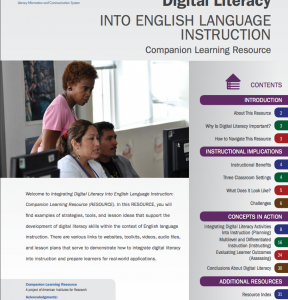
- The variety of technology integration options in ESL instruction
- The role of digital literacy instruction in reducing the digital divide
- The role technology can play in problem-based learning
- The benefits of using technology to support learner-centered instruction at all levels of ESL and in various learning environments
- to tested Public Lessons presented to children and groups of observing teachers;
- to guided tours of reflective mathematics practice, identifying what makes teaching, learning, and improving instruction in mathematics a difficult enterprise;
- resources for teachers to improve their practice;
- to mathematics teaching and learning tools and resources to support the daily practices of classroom teachers, math coaches, and administrators; and
- to a professional learning community in which you are invited to open your own classroom and engage in conversation about teaching and learning.
- Tools for educators;
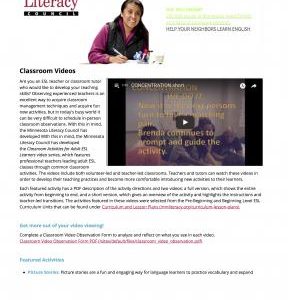
- Classroom videos;
- Common core resources;
- Problems of the month; and
- Performance assessment tasks.
- Break instruction and activities into short modules with opportunities for feedback, checks for understanding, and encouragement. Cognitive research has shown students process more efficiently and learn more effectively with short lessons followed by focused activities that require them to apply and reflect on what they have learned. Not only do adults learn more with short lessons, they are also more engaged because short lessons provide regular feedback and a sense of success.
- Build in tools and opportunities to help adult learners visualize information and concepts. Just as short lessons take advantage of how the brain learns best, visual, or graphic, organizers mimic how the brain records and organizes information. Learning is the process of creating or strengthening connections between neurons that form the map that is the brain. Visual organizers replicate this map for learners, helping them understand and therefore strengthen the patterns being formed between old and new information. The more learners can manipulate the visuals themselves, the more effective the tool or activity will be for cognitive development.
- Provide clear, simple ways for adult learners to access a large bank of resources for practice. The more resources and activities available, the more opportunities there are for adult learners to deepen their learning. Adult learners need access to resources of many types. Digital products are the perfect vehicle for support resources because they can store all types of content (documents, PDFs, videos, sound files, etc.). The more resources and activities available, the more opportunities there are for multiple ways of learning. In addition, adult learners need easy ways to access these resources. Research has shown that students who feel they have strong support when learning online are more likely to stick with it.
- Design in multiple ways for learners and instructors to communicate outside of class time. The more support adult learners have from their teachers, the more they believe they can overcome obstacles and succeed as learners. Technology can provide multiple modes of learner-teacher communication: reflective activities (blogs, emails, videos), regular feedback (emails, discussion threads, videos), and “office hour” chats (written, video). Technology can also help deepen connections between learners and teachers by happening outside of class time, in turn building learners’ confidence and helping them progress more quickly. technology can provide anytime communication. Learners have control over time with digital learning, as they can use the learning tool whenever they want.
- Design in tools and opportunities for peer-to-peer interactions as well. By learning from and with peers, adult learners not only deepen their learning but also develop an additional support system for managing their learning. Working with others increases the social-emotional memories of a learning experience, thus increases the learning. For adult learners, these social and emotional connections also add to their confidence because they are learning with and from others who are also managing all that comes with being an adult learner. As with learner-instructor connections, digital tools are a perfect match for providing peer-to- peer interaction that goes beyond face-to-face.
- Proposes which math content deserves the most attention and which can play a supporting role at each of the three highest levels;
- Organizes that content coherently within and across the three levels so that mathematical ideas build logically and connect naturally to one another; and
- Prioritizes the content so that students will have opportunities to learn the most critical concepts and hone their mathematical skills through solving well-crafted problems.
- a PDF version of the lesson plan;
- a full version of the video ranging in length from 8 to 35 minutes that shows the entire activity from beginning to end; and
- a shorter 3- to 16-minute version that gives an overview of the activity and highlights the instructions and teacher-led transitions.
You must be logged in to download this resource. Register now if you don't have an account.
Abstract:

You must be logged in to download this resource. Register now if you don't have an account.
Abstract:

You must be logged in to download this resource. Register now if you don't have an account.
Abstract:

You must be logged in to download this resource. Register now if you don't have an account.
Abstract:

You must be logged in to download this resource. Register now if you don't have an account.
Abstract:
You must be logged in to download this resource. Register now if you don't have an account.
Abstract:
You must be logged in to download this resource. Register now if you don't have an account.
Abstract:
You must be logged in to download this resource. Register now if you don't have an account.
Abstract: