Career Pathways Toolkit: A Guide for System Development
    Author: Bonnie Elsey, Laura Lanier, and Jessie Stadd
    Program Level: Professional Development
    Material Type: Collection
    Language: English
    License: (CC BY-NC-ND 4.0) For license summary click here

    Abstract:

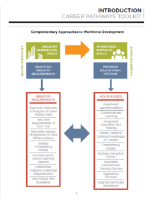
    This revised Career Pathways Toolkit: A Guide for System Development features Six Key Elements of Career Pathways that help to guide local and state teams through the essential components necessary for developing a comprehensive career pathways system.
    Publication Year
    2015
    The Revised Career Pathways Toolkit: A Guide for System Development features Six Key Elements of Career Pathways that help to guide local and state teams through the essential components necessary for developing a comprehensive career pathways system. The components under each element are not sequential and may occur in any order. Likewise, multiple partners can engage in the components simultaneously to carry out the mission of the career pathways system. The six elements are:
    1. Build cross-agency partnerships and clarify roles
    2. Identify industry sectors and engage employers
    3. Design education and training programs
    4. Identify funding needs and sources
    5. Align policies and programs
    6. Measure system change and performance
    Benefits and Uses
    This revised Toolkit continues the spirit of the original Career Pathways Toolkit: to provide the workforce system with a framework, resources, and tools for states and local partners to develop, implement, and sustain career pathways systems and programs. This revised Toolkit acknowledges many of the U.S. Department of Labor’s strategic investments to create and sustain a demand-driven employment and training system as part of a larger national effort. This version also maintains the original six key elements framework but reflects substantial gains in knowledge and experience as well as reflects the system’s new guiding legislation, the Workforce Innovation and Opportunity Act. The original toolkit was published in 2011.
    Resource Notice
    This site includes links to information created by other public and private organizations. These links are provided for the user’s convenience. The U.S. Department of Education does not control or guarantee the accuracy, relevance, timeliness, or completeness of this non-ED information. The inclusion of these links is not intended to reflect their importance, nor is it intended to endorse views expressed, or products or services offered, on these non-ED sites. Please note that privacy policies on non-ED sites may differ from ED’s privacy policy. When you visit lincs.ed.gov, no personal information is collected unless you choose to provide that information to us. We do not give, share, sell, or transfer any personal information to a third party. We recommend that you read the privacy policy of non-ED websites that you visit. We invite you to read our privacy policy.
    Author: Student Achievement Partners
    Program Level: Professional Development
    Material Type: Collection
    Language: English
    License: (CC BY-NC-ND 4.0) For license summary click here

    Abstract:

    Achievethecore.org is a Student Achievement Partners website full of content designed to help educators understand and implement the Common Core State Standards (CCSS) and other college and career ready (CCR) standards
    Publication Year
    2015
    Achievethecore.org is a Student Achievement Partners website full of content designed to help educators understand and implement the Common Core State Standards (CCSS) and other college and career ready (CCR) standards. Many of the resources are applicable to adult educators and seven resources in particular have been selected. All seven resources help adult educators address CCR standards’ Key Advance One (regular practice with complex text and its academic language), Key Advance 2 (reading, writing, and speaking are grounded in evidence from text), and Key Advance 3 (building knowledge).
    1. Text Complexity Collection: http://achievethecore.org/page/642/text-complexity-collection
    2. Academic Word Finder (AWF): http://achievethecore.org/academic-word-finder
    3. Annotated-Mini Assessments: http://achievethecore.org/dashboard/300/search/1/1/0/1/2/3/4/5/6/7/8/9/10/11/12/page/1035/annotated-mini-assessments-list-pg
    4. Text Set Project: http://achievethecore.org/page/1112/text-set-project-building-knowledge-and-vocabulary
    5. Fluency Packet for the 9-10 Grade Band: http://achievethecore.org/page/1022/fluency-packet-for-the-9-10-grade-band
    Benefits and Uses
    Achieve the Core has a wealth of resources which support College and Career Ready (CCR) standards-based instruction. These specific resources represent a selection of tools and information that are particularly relevant for adult education.
    • Key Advance One: Text complexity collection and Academic Word Finder
    • Key Advances One and Two: Mini-assessments
    • Key Advance Three: Text set project
    • Reading and foundational skills: 9-10th grade fluency packet
    The text complexity collection focuses on measuring and describing the complexity of instructional texts, and meeting the demands of Key Advance One.  It provides all of the tools and resources available to understand and successfully address text complexity. Some of the resources directly refer to K-12 grades, but still hold some value for adult educators. The Academic Word Finder is designed to build the capacity of teachers and students alike to identify, understand, and effectively use academic vocabulary (tier two vocabulary) in complex text. This tool supports teachers and students to use level-appropriate complex texts in their lessons. The mini-assessments showcase sample assessments that illustrate the instructional shifts required by CCR standards for English language arts/literacy. “These mini-assessments are designed for teachers to use either in the classroom, for self-study, or in professional development settings.”  They demonstrate text-dependent questions which require close reading of texts. The text set project is designed to build students’ knowledge through reading a variety of literary and information texts at varying Lexile levels. The supplemental materials provided in each text set, such as the rolling vocabulary journal, glossary, and “learning worth remembering” graphic organizer allow students to compare texts, understand the main idea of text, and find the deeper meaning in words, sentence structure, and phrases. In the 9-10th grade fluency packet, students are tasked with repetitiously reading passages of a similar genre. Students exercise their ability to understand spoken word, decode and employ phonics, and read with accuracy. The vocabulary and checking for understanding at the end of the passage reinforces the idea that students should still be able to comprehend what they have read. The text complexity collection presents resources that provide the background information on why text complexity is important, how to measure and assess complex texts, and how to use them in the classroom. The tools can be used to verify that texts used for instruction are appropriately complex. The primary audience for this resource is teachers who are responsible for providing instruction aligned to CCR standards. The resource would also find an audience with professional developers responsible for teaching instructors how to implement CCR standards. Some adult educators will be familiar with the qualitative and quantitative text complexity tools, for example, those who have used The Instructional Advances in English Language Arts/Literacy online resources. However, these supplemental resources encourage adult educators to dive more deeply into text complexity and all its facets. The Academic Word Finder supports the tools available in the text complexity collection. It is not intended to “replace teacher judgment; rather it helps to support the teacher and identify the most useful academic words” in texts they are teaching. The primary target audience is practicing classroom teachers and those who support classroom instruction in adult education programs. Curriculum developers and publishers may also find this a useful tool for planning purposes. The mini-assessments are designed for teachers to use in the classroom, for self-learning, or in professional development settings. The assessments can be used immediately by adult educators and serve as models for the selection and analysis of complex texts and the development of related assessments.  The assessments offer an opportunity for students to do a close reading in a way that simulates a standardized testing experience. They are also useful for instructors to be able to see how well their students do with CCR standards aligned texts and tasks that are designed as a test simulation. No adaptation of these materials is needed. Some texts, however, may not be appropriate for adult education students. The mini-assessments for grades 6-12 are probably the most relevant for adults. Text sets are designed for teachers who are responsible for providing instruction aligned to CCR standards. Each text set centers on a single topic and includes a variety of sources including books, articles, videos, websites, infographics. The sets include suggested activities which build content knowledge and vocabulary and assess students’ comprehension. The fluency packets work to increase student fluency. The fluency packets can be used as supplemental materials, intervention work, homework assignments, or direct instruction. Each fluency packet includes high-quality texts, a focus on vocabulary, and comprehension questions. The text complexity collection provides a thorough and complete explanation of all aspects of text complexity. The quantitative and qualitative tools for text complexity as well as the research on text complexity are all helpful features of the resource.  The quick reference chart and guide to online complexity tools along with the qualitative scales are all extremely useful. This is a valuable selection of resources because text complexity is such a key component of implementing the CCR standards. The Academic Word Finder (AWF) itself is a very useful instructional tool. After opening a free account, users can upload texts to the AWF which then highlights the most useful academic vocabulary words from a given text. The tool identifies below, at, and above learning level tier two words and includes definitions for various contextual meanings and parts of speech. Learning levels are associated with k-12 grade levels, and adult educators will need to choose the corresponding CCR level. The quantitative assessment tool and AWF, used together, establish the quantitative complexity and corresponding CCR level of a text, and the academic vocabulary below, at, and above the CCR level. The text sets and fluency packets for higher grade levels will be most applicable for adult students.
    Resource Notice
    This site includes links to information created by other public and private organizations. These links are provided for the user’s convenience. The U.S. Department of Education does not control or guarantee the accuracy, relevance, timeliness, or completeness of this non-ED information. The inclusion of these links is not intended to reflect their importance, nor is it intended to endorse views expressed, or products or services offered, on these non-ED sites. Please note that privacy policies on non-ED sites may differ from ED’s privacy policy. When you visit lincs.ed.gov, no personal information is collected unless you choose to provide that information to us. We do not give, share, sell, or transfer any personal information to a third party. We recommend that you read the privacy policy of non-ED websites that you visit. We invite you to read our privacy policy.
    Application of Lincoln Tech’s Early College HS Program amongst Alternative and Adult Education Programs.
    Author: Nicholaus Sutherland
    Program Level: Adult Basic Education
    Language: English
    License: (CC BY-NC-ND 4.0) For license summary click here

    Abstract:

    By participating in this webinar, attendees will learn about Lincoln Tech's High School Share model, which is a pay per course model available at each of its 22 Campuses in 10 States. This Program model is currently being applied at the YALE School in New Jersey, where adults engaged in an one year diploma completion program are able to take Skilled Trades Education Courses in HVAC as they earn their diploma. Original webinar date: June 26, 2026 Webinar recording link: https://youtu.be/WO9yK8vZtwQ
    Standards-in-Action: Mathematics Foundational Units to Fulfill the Instructional Shifts
    Author: StandardsWork, Inc.
    Program Level: Professional Development
    Material Type: Collection
    Language: English
    License: (CC BY-NC-ND 4.0) For license summary click here

    Abstract:

    These foundational-level Standards-in-Action (SIA) resources and professional development provide educators with practical knowledge about the key shifts in instruction required to align with college and career readiness (CCR) standards in mathematics.
    Author(s)
    StandardsWork, Inc.
    Author(s) Organizational Affiliation
    StandardsWork, Inc.
    Publication Year
    2016
    Resource Type
    Informational Material
    Abstract
    The College and Career Readiness (CCR) Standards Math Foundational Units 1 – 4 were produced by StandardsWork Inc. as part of the Implementing CCR Standards in Adult Education project, under contract to the U.S. Department of Education (Contract # ED-VAE-13-C-0066). The activities that make up Units 1 – 4 will help participants explore what it means to implement CCR standards for mathematics in adult education. Participants will receive a practical and transferable understanding of the fundamental shifts in instruction embedded in CCR standards—including in your state standards—crucial to preparing adult students to meet the real-world demands of college and careers. At the heart of the instructional shifts is a careful examination of the critical content and processes that fuel mastery in mathematics, including the coherent progression from level to level and pursuing conceptual understanding, procedural skill and fluency, and application with equal intensity. 
    • Foundational Unit 1 Focusing on the Major Work of the Levels addresses the most critical concepts and skills that students must master to be prepared for college and careers.
    • Foundational Unit 2Thinking Across Levels to Connect Learning, concentrates on the concept of coherence and its central role in the CCR standards.
    • Foundational Unit 3 Engaging the Three Components of Rigor investigates what it means to create a rigorous mathematics curriculum.
    • Foundational Unit 4, Connecting Standards for Mathematical Practice to Content, provides techniques to enrich instruction by integrating the eight Standards for Mathematical Practice with content-specific standards.
    Each ready-to-use unit includes a facilitator’s guide, an annotated PowerPoint presentation, and participant materials. While training is not required before using this resource, fundamental awareness of the CCR standards for mathematics is recommended. Experienced SIA trainers are available to provide this training to states and programs. For more information, please email the LINCS Technical Assistance Center at training@lincs.ed.gov.
    Benefits and Uses
    This resource supports state and program efforts to implement adult education content standards aligned with college and career readiness to support rigorous, high-quality instruction. Usage of the Math Foundational Units 1 – 4 will strengthen the capacity of adult educators to implement CCR standards to better prepare adult students for success in college and careers. These activities provide the field with opportunities to dig into the CCR standards and explore what it means to adopt CCR-aligned standards in classrooms and how to do so sustainably. Understanding how CCR standards differ from previous sets of standards—and the necessary shifts or advances they call for—is essential to implementing CCR standards well. Engagement in these four units of activities will enable adult educators to identify the most significant elements of CCR standards for mathematics and to determine how best to integrate them into instruction and curriculum. The goal of Units 1 - 4 is for participants to leave with specific ideas, resources, and actions they can implement immediately. Designed primarily for group use, these units also support independent study. The four units should be worked through sequentially. The units can be facilitated during a single daylong training or multiple trainings over several weeks or months. Each ready-to-use unit contains all the materials required to facilitate these training activities, including a facilitator’s guide, an annotated PowerPoint Presentation, and a packet of participant materials. The participant materials include directions, charts, worksheets, answer keys, and other resource materials that guide the use of each unit. The PowerPoint presentations are a digital aid for presenters/facilitators who lead the mathematics training activities. Notes are provided within the PowerPoint presentations to help you prepare for each session. This information accompanies the information offered in the facilitator guides—including the research base, rationale, advice, and other guidelines—to provide the support and guidance you may require.
    Resource Notice
    This site includes links to information created by other public and private organizations. These links are provided for the user’s convenience. The U.S. Department of Education does not control or guarantee the accuracy, relevance, timeliness, or completeness of this non-ED information. The inclusion of these links is not intended to reflect their importance, nor is it intended to endorse views expressed, or products or services offered, on these non-ED sites. Please note that privacy policies on non-ED sites may differ from ED’s privacy policy. When you visit lincs.ed.gov, no personal information is collected unless you choose to provide that information to us. We do not give, share, sell, or transfer any personal information to a third party. We recommend that you read the privacy policy of non-ED websites that you visit. We invite you to read our privacy policy.
    Teaching the Core
    Author: Teachingthecore.org
    Program Level: Professional Development
    Material Type: Collection
    Language: English
    License: (CC BY-NC-ND 4.0) For license summary click here

    Abstract:

    A collection of classroom videos and associated lesson materials to implement the instructional shifts required by the Common Core State Standards.
    Publication Year
    2016
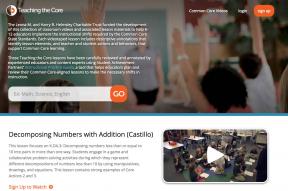
    The Leona M. and Harry B. Helmsley Charitable Trust funded the development of this collection of classroom videos and associated lesson materials to help K-12 educators implement the instructional shifts required by the Common Core State Standards. Each videotaped lesson includes descriptive annotations that identify lesson elements, and teacher and student actions and behaviors, that support Common Core learning. These Teaching the Core lessons have been carefully reviewed and annotated by experienced educators and content experts using Student Achievement Partners’ Instructional Practice Guide, a tool that helps educators plan and review their Common Core-aligned lessons to make the necessary shifts in instruction.
    Benefits and Uses
    The Teaching the Core video lessons demonstrate standards-based instruction at different grade levels. After opening a free account, use the search feature to find videos by subject and/or grade level. Each video is accompanied by a teacher interview, lesson plan, instructional materials, and student work. The lessons are K-12, so some adjustments and contextualization would need to be made for adult learners. The higher grade levels will be most appropriate for adult educators. Use the Teaching the Core videos for independent study or as part of a professional learning community or professional development program. The most useful feature of the actual videos is the timestamp feature, which allows viewers to go to certain sections of each video and watch for specific teacher and student moves. You may find the following ELA Teaching the Core videos very helpful: “Author’s Message with Multiple Texts” (10th grade) http://www.teachingthecore.org/view/51 and “Connotation & Exile” (9th grade) http://www.teachingthecore.org/view/20.
    Resource Notice
    This site includes links to information created by other public and private organizations. These links are provided for the user’s convenience. The U.S. Department of Education does not control or guarantee the accuracy, relevance, timeliness, or completeness of this non-ED information. The inclusion of these links is not intended to reflect their importance, nor is it intended to endorse views expressed, or products or services offered, on these non-ED sites. Please note that privacy policies on non-ED sites may differ from ED’s privacy policy. When you visit lincs.ed.gov, no personal information is collected unless you choose to provide that information to us. We do not give, share, sell, or transfer any personal information to a third party. We recommend that you read the privacy policy of non-ED websites that you visit. We invite you to read our privacy policy.
    Standards-in-Action: English Language Arts/Literacy Foundational Units to Fulfill the Instructional Shifts
    Author: StandardsWork, Inc.
    Program Level: Professional Development
    Material Type: Collection
    Language: English
    License: (CC BY-NC-ND 4.0) For license summary click here

    Abstract:

    These foundational-level Standards-in-Action (SIA) resources and professional development provide educators with practical knowledge about the key shifts in instruction required to align with college and career readiness standards in English language arts (ELA)/literacy.
    Author(s)
    StandardsWork, Inc.
    Author(s) Organizational Affiliation
    StandardsWork, Inc.
    Publication Year
    2016
    Resource Type
    Informational Material
    Abstract
    The College and Career Readiness (CCR) Standards ELA/Literacy Foundational Units 1-4 were produced by StandardsWork Inc. as part of the Implementing CCR Standards in Adult Education project, under contract to the U.S. Department of Education (Contract # ED-VAE-13-C-0066). The activities that make up Units 1 – 4 will help participants explore what it means to implement CCR standards for ELA/literacy in adult education. Participants will receive a practical and transferable understanding of the fundamental shifts in instruction embedded in CCR standards—including in your state standards—crucial to preparing adult students to meet the real-world demands of college and careers. At the heart of the instructional shifts is carefully examining the texts that students read and the questions students should address as they write and speak about them.
    • Foundational Unit 1 Connecting CCR Standards to Key Advances explores the fundamental elements, structure, and meaning of the CCR standards.
    • Foundational Unit 2 Selecting Texts Worth Reading introduces text complexity, its central role in the CCR standards, and the complex texts students need to read.
    • Foundational Unit 3, Identifying Questions Worth Answering focuses on the value of building students’ ability to draw evidence from texts and teachers’ ability to use text-based questions.
    • Foundational Unit 4 Creating High-Quality Prompts teaches instructors how to build a culminating writing assignment that assesses student knowledge.
    Each ready-to-use unit includes a facilitator’s guide, an annotated PowerPoint presentation, and participant materials. While training is not required before using this resource, fundamental awareness of the CCR standards for ELA/literacy is recommended. Experienced SIA trainers are available to provide this training to states and programs. For more information, please email the LINCS Technical Assistance Center at training@lincs.ed.gov.
    Benefits and Uses
    This resource supports state and program efforts to implement adult education content standards aligned with college and career readiness to support rigorous and high-quality instruction. Usage of the ELA/Literacy Foundational Units 1-4 will strengthen the capacity of adult educators to implement CCR standards to better prepare adult students for success in college and careers. These activities provide the field with opportunities to dig into the CCR standards and explore what it means to adopt CCR-aligned standards in classrooms and how to do so sustainably. Understanding how CCR standards differ from previous sets of standards—and the necessary shifts or advances they call for—is essential to implementing CCR standards well. Engagement in these four units of activities will enable adult educators to identify the most significant elements of CCR standards for ELA/literacy and to determine how best to integrate them into instruction and curriculum. The goal of Units 1 - 4 is for participants to leave with specific ideas, resources, and actions they can implement immediately. Designed primarily for group use, these units also support independent study. The four units should be worked through sequentially. The units can be facilitated during a single daylong training or multiple trainings over several weeks or months. Each ready-to-use unit contains all the materials required to facilitate these training activities, including a facilitator’s guide, an annotated PowerPoint Presentation, and a packet of participant materials. The participant materials include directions, charts, worksheets, answer keys, and other resource materials that guide the use of each unit. The PowerPoint presentations are a digital aid for presenters/facilitators who lead CCR ELA/literacy training activities. Notes are provided within the PowerPoint presentations to help you prepare for each session. This information accompanies the information offered in the facilitator guides—including the research base, rationale, advice, and other guidelines—to provide the support and guidance you may require.
    Resource Notice
    This site includes links to information created by other public and private organizations. These links are provided for the user’s convenience. The U.S. Department of Education does not control or guarantee the accuracy, relevance, timeliness, or completeness of this non-ED information. The inclusion of these links is not intended to reflect their importance, nor is it intended to endorse views expressed, or products or services offered, on these non-ED sites. Please note that privacy policies on non-ED sites may differ from ED’s privacy policy. When you visit lincs.ed.gov, no personal information is collected unless you choose to provide that information to us. We do not give, share, sell, or transfer any personal information to a third party. We recommend that you read the privacy policy of non-ED websites that you visit. We invite you to read our privacy policy.
    Realizing Opportunities for English Language Learners (ELLs) Through State Academic Content Standards Webinar
    Author: StandardsWork, Inc.
    Program Level: Professional Development
    Material Type: Collection
    Language: English
    License: (CC BY-NC-ND 4.0) For license summary click here

    Abstract:

    Archive of September 14, 2016 webinar.
    Publication Year
    2016
    Realizing Opportunities for English Language Learners (ELLs) Through State Academic Content Standards was produced by StandardsWork, Inc. as part of the CCR Standards-in-Action (CCR SIA) project. Facilitated by Susan Pimentel, lead CCR SIA content expert, the webinar concentrates on meeting the needs of English-language learners (ELLs). It discusses the necessary shifting away from traditional teaching theories that encourage language instruction in isolation from other academic disciplines. Specifically, the webinar showcases research-tested strategies on how ELLs can realize opportunities through new state-level academic standards in reading, writing, speaking and listening, and language. The webinar highlights a series of research findings on how best to realize opportunities for ELLs in reading, writing, speaking and listening, and language. Ms. Pimentel discusses pedagogical shifts for language acquisition and ten steps adult educators can take to re-envision ELL education in their programs. In the final portion of the webinar, she responds to attendees’ questions.
    Benefits and Uses
    This Webinar was created for College and Career Readiness Standards In Action (CCR SIA) project for adult educators from 12 states, who requested information on how CCR standards can be implemented for ELLs. This Webinar responds to their questions. The Webinar content, demonstration video, and links to further resources all provide essential information for you to use as you re-envision ELL education in your states. Use this resource to help plan ways to implement CCR academic content in classrooms with ELLs. View it individually, as part of a professional learning community, or a professional development workshop. In addition to providing essential information about teaching ELLs, it could fuel a discussion of different strategies and approaches to implementing CCR standards. The webinar includes a classroom video demonstration that is particularly useful in conjunction with Ms. Pimentel’s summary of research on reading, writing, speaking and listening, and language (slides 17-28). The slides which articulate the pedagogical shifts in teaching ELLs (slides 29-30) provide a concise statement of the new direction for ELL instruction afforded by the CCR standards. The PowerPoint slides are available a stand-alone resource.
    Required Training
    A fundamental awareness of the CCR Standards for English Language Arts/Literacy is recommended.
    Resource Notice
    This site includes links to information created by other public and private organizations. These links are provided for the user’s convenience. The U.S. Department of Education does not control or guarantee the accuracy, relevance, timeliness, or completeness of this non-ED information. The inclusion of these links is not intended to reflect their importance, nor is it intended to endorse views expressed, or products or services offered, on these non-ED sites. Please note that privacy policies on non-ED sites may differ from ED’s privacy policy. When you visit lincs.ed.gov, no personal information is collected unless you choose to provide that information to us. We do not give, share, sell, or transfer any personal information to a third party. We recommend that you read the privacy policy of non-ED websites that you visit. We invite you to read our privacy policy.
    CLASP Webinar: Integrated Education and Training Practice and Policy
    Author: Judy Mortrude, Anson Green, Sue Liu, Sara Hastings, Andy Nash, Carol Clymer, Blaire Toso, Amanda Bergson-Shilcock
    Program Level: Professional Development
    Material Type: Collection
    Language: English
    License: (CC BY-NC-ND 4.0) For license summary click here

    Abstract:

    This webinar recording features a panel of leading experts from around the country who discuss how IET models are being implemented and provide real examples of the opportunities (and lessons learned) for administrators and practitioners to develop quality IET models.
    Publication Year
    2016
    CLASP recorded a webinar on Integrated Education and Training (IET). Experts from around the country discussed how IET is being implemented and opportunities for practitioners to develop quality IET models.
    Benefits and Uses
    IETs are a core educational strategy for career pathways jointly developed between WIOA partners. This webinar highlights the many ways that states and individual programs have interpreted the definition and core elements of IETs and in turn used them to develop IETs as a strategy across all levels of service delivery in Title II of the Adult Education and Family Literacy Act (AEFLA). The panel, comprised of nationally recognized leaders in their field, provides easy-to-understand information starting with what an IET is to the ways data is collected and reported, and how partnerships can be formed.
    Resource Notice
    This site includes links to information created by other public and private organizations. These links are provided for the user’s convenience. The U.S. Department of Education does not control or guarantee the accuracy, relevance, timeliness, or completeness of this non-ED information. The inclusion of these links is not intended to reflect their importance, nor is it intended to endorse views expressed, or products or services offered, on these non-ED sites. Please note that privacy policies on non-ED sites may differ from ED’s privacy policy. When you visit lincs.ed.gov, no personal information is collected unless you choose to provide that information to us. We do not give, share, sell, or transfer any personal information to a third party. We recommend that you read the privacy policy of non-ED websites that you visit. We invite you to read our privacy policy.