
- Multiple entry points are needed so that adults with skills gaps and lower levels of education can enroll in career pathways classes. Providers should consider what entry requirements are needed for students to understand the course material, complete the program, and prepare for postsecondary education or employment. Similarly, programs should track how entry-level students are advancing through the course sequence, from ESL, ABE, or GED® classes to occupational or career and technical education (CTE) classes.
- Programs should ensure that counselors, coaches, case workers, and other support staff have manageable caseloads. Funders and policy makers should consider increasing the funding for support services that address students’ non-academic concerns. These supports should help increase persistence and program completion.
- For careeer pathways to be effective, organizations need measures that capture interim outcomes toward longer-term goals such as completing a degree or obtaining a job. Interim outcomes are especially important for showing the achievements of students with greater barriers to education or employment. Policymakers and funders should support the development and use of interim outcome measures.
- To minimize problems such as gaps in services, duplication, and competition for students, funders and policy makers should support the creation of groups, events, or initiatives that help career pathways providers coordinate their efforts. Funders and policy makers can play a key role in helping workforce and adult education entities collaborate in providing career pathways programs.
- College readiness assessments
- Assessment cut scores
- Multiple measures for course placement
- Innovative course models
- Reporting requirements
- ABE/ASE Curriculum
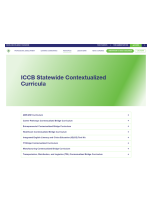
- Career Pathways Contextualized Bridge Curriculum
- Entrepreneurial Contextualized Bridge Curriculum
- Healthcare Contextualized Bridge Curriculum
- IT Bridge Contextualized Curriculum
- Manufacturing Contextualized Bridge Curriculum
- Transportation, Distribution and Logistics (TDL) Contextualized Bridge Curriculum
- Strategies for achieving career success
- Educational pathways in the field of law
- Licensing and certification requirements in law
- Alternative career pathways
- Helpful resources in the field of law

You must be logged in to download this resource. Register now if you don't have an account.
Abstract:
You must be logged in to download this resource. Register now if you don't have an account.
Abstract:
You must be logged in to download this resource. Register now if you don't have an account.
Abstract:
You must be logged in to download this resource. Register now if you don't have an account.
Abstract:
This webinar recording defines and describes the Integrated Education and Training (IET) model and aligns it to the Illinois Integrated Career and Academic Preparation System (ICAPS). This webinar recording provides a deep dive into the various workforce training models. Although it is specific to Illinois program requirements, the two ICAPS models both align to WIOA requirements, and the webinar includes pertinent WIOA definitions that are applicable to all states. Benefits and Uses The resource helps to define the components of the Illinois ICAPS/IET (Integrated Career and Academic Preparation System/Integrated Education and Training) Model One and Model Two in Illinois. Although it is specific to Illinois program requirements, the two ICAPS models both align to WIOA requirements, and the webinar includes pertinent WIOA definitions that are applicable to all states. A PDF of the webinar slides is available to view and download. Resource Notice This site includes links to information created by other public and private organizations. These links are provided for the user’s convenience. The U.S. Department of Education does not control or guarantee the accuracy, relevance, timeliness, or completeness of this non-ED information. The inclusion of these links is not intended to reflect their importance, nor is it intended to endorse views expressed, or products or services offered, on these non-ED sites. Please note that privacy policies on non-ED sites may differ from ED’s privacy policy. When you visit lincs.ed.gov, no personal information is collected unless you choose to provide that information to us. We do not give, share, sell, or transfer any personal information to a third party. We recommend that you read the privacy policy of non-ED websites that you visit. We invite you to read our privacy policy.
You must be logged in to download this resource. Register now if you don't have an account.
Abstract:
You must be logged in to download this resource. Register now if you don't have an account.
Abstract:
You must be logged in to download this resource. Register now if you don't have an account.
Abstract:
Illinois Community College Board, Division of Adult Education & Literacy, has designed several comprehensive model contextualized curricula, which includes instructions for use, supplemental materials, lesson plans, and related resources. Illinois Community College Board, Division of Adult Education & Literacy, has designed several comprehensive model contextualized curricula, which include:
You must be logged in to download this resource. Register now if you don't have an account.
Abstract: