
- The workforce system will be characterized by three critical hallmarks of excellence:
- The needs of business and workers drive workforce solutions;
- One-Stop Centers (or American Job Centers) provide excellent customer service to jobseekers and employers and focus on continuous improvement; and
- The workforce system supports strong regional economies and plays an active role in community and workforce development.
- Across the system, continuous improvement is supported through evaluation, accountability, identification of best practices, and data driven decision making.
- Career Pathways
- Employer engagement
- Work-based learning
- Sector strategies
- Partnerships
- Integrated Service Delivery
- Data Systems
- Performance measurement
- WIOA Performance Regulations were published jointly by the Department of Labor and Department of Education. The three rules are identical.
- 20 CFR part 677
- 34 CFR part 361
- 34 CFR part 463
- See Federal Register, Vol. 81, No. 161
- WIOA Information Collection Requests
- Joint Requirements (OMB No. 1205-0526)
- Participant Individual Record Layout (PIRL) for jointly used data elements (ETA-9170)
- Annual Report template for states and local areas (ETA-9169)
- Reporting cohorts for each indicator
- Eligible Training Provider data element definitions (ETA-9171) – Title I only
- Effectiveness in Serving Employers specifications
- DOL Reporting Requirements (OMB No. 1205-0521)
- RSA Reporting Requirements
- AEFLA Reporting Requirements
- WIOA Annual Statewide Performance Report template
- AEFLA NRS Reporting Tables (OMB No. 1830-0027) – includes AEFLA tables, Narrative Report, Financial Report, and Data Quality Checklist
- Reports are available at:
- ETA Performance Reporting (Department of Labor)
- National Reporting System (Department of Education, OCTAE)
- Joint Requirements (OMB No. 1205-0526)
- Employment Rate 2nd Quarter after Exit (Education/Employment for youth)
- Employment Rate 4th Quarter after Exit (Education/Employment for youth)
- Median Earnings in the 2nd Quarter after Exit
- Credential Attainment Rate
- 5 Types of Measurable Skills Gains
- Secondary diploma/equivalent
- Secondary of post-secondary transcript
- Educational funding level gain
- Progress toward milestones
- Passing technical/occupational knowledge based exam
- Effectiveness in Serving Employers (states choose 2)
- Retention with the same employer in the 2nd and 4th quarters after exit
- Employer Penetration Rate
- Repeat Business Customer Rate
- Required Reports
- WIOA State Annual Performance Report
- WIOA Local Area Performance Report (Title I programs)
- Submission of individual records (PIRL for Titles I and III; RSA-911 for Title IV); submission of NRS aggregate tables for Title II
- NRS data quality checklist for Title II
- Eligible Training Provider Reports (Title I programs)
- DOL Narrative Report; Title II Narrative Report
- Reporting Timeframes
- Quarterly reports are due 45 days after the end of the quarter
- Annual reports are due October 15
- The annual and quarterly report templates can be found at ETA Performance Reporting
- Data Availability
- Program Year 2017 is the first year of full WIOA data
- Workforce Integrated Performance System (DOL)
- Will allow states/grantees to submit an individual record file OR support case management systems
- Uniform quarterly/annual reports will be automatically generated
- DOL-Only PIRL
-
- The Joint PIRL (ETA 9170) contains 76 data elements common to ED and DOL WIOA core programs
- States will NOT submit individual records using the Joint PIRL (ETA-9170)
- States will collect and report data as required by the DOL specific PIRL ETA-9172 (DOL-only PIRL)
-
- RSA Data Reporting
- RSA-911
- AEFLA-NRS
- The AEFLA-only NRS reporting tables (OMB No. 1830-0027) collect aggregate data and contain common data elements found in the Joint PIRL.
- Period of Participation
- Date of Program Entry (PIRL element 900), tracks the Date of Program Entry by requiring the initial service delivery date.
- Negotiations – WIOA requires 4 elements to be considered during performance level negotiations
- How the levels involved compare with the adjusted levels of performance established for other states
- An objective statistical adjustment model
- The extent to which the levels involved promote continuous improvement
- The extent to which the levels involved will assist the state in meeting goals established in accordance with the Government Performance and Results Act
- Statistical Adjustment Model
- The Departments have developed a fixed effect model to estimate State level performance outcomes.
- A summary of the model is in Attachment II of TEGL 26-15
- Sanctions
- Financial sanctions based on performance failure will be applied to states if, for 2 consecutive years, the state fails to meet:
- 90 percent of the overall State program score for the same core program;
- 90 percent of the overall State indicator score for the same primary indicator; or
- 50 percent of the same indicator score for the same program.
- Financial sanctions based on performance failure will be applied to states if, for 2 consecutive years, the state fails to meet:
- Failure to report the WIOA State annual report and/or state ETP report may also lead to financial sanction
- Determination of sanctions will be “phased in,” based on data availability
- Performance Guidance Review
- Employment and Training Administration
- For questions regarding performance reporting, contact the Office of Policy Development and Research at ETAperforms@dol.gov
- The Performance and Results Web Site will assist you in understanding how performance is measured, reported, and evaluated at ETA.
- The WIOA Resource Page provides information and resources for States, local areas, non-profits and other grantees, and other stakeholders to assist with implementation of the Act.
- Office of Career, Technical, and Adult Education
- For questions related to WIOA implementation, email AskAEFLA@ed.gov
- OCTAE's WIOA webpage has information on: announcements; laws and guidance; information collection requests; state plan resources; resources, technical assistance and events; and WIOA partners.
- Rehabilitation Services Administration
- Each state has a state liaison that can answer questions about the Rehabilitation Act and WIOA.
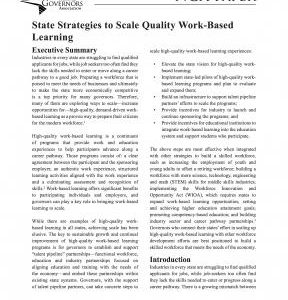
- Elevate the state vision for high-quality work- based learning;
- Implement state-led pilots of high-quality work- based learning programs and plan to evaluate and expand them;
- Build an infrastructure to support talent pipeline partners’ e orts to scale the programs;
- Provide incentives for industry to launch and continue sponsoring the programs; and
- Provide incentives for educational institutions to integrate work-based learning into the education system and support students who participate.
- Funding. States can provide funding to local IET programs or partnerships through grants or formula funds, using state or federal resources.
- Program Initiatives. States can authorize the provision of IET via program initiatives that are part of a state adult education and workforce strategy.
- Program Requirements. States can go beyond merely authorizing IET by actively requiring the provision of IET.
- Reviewed state adult education, community college, and/or workforce board websites;
- Reviewed relevant sections of state code; and
- Conducted follow-up calls and emails with key informants to answer questions and confirm findings.
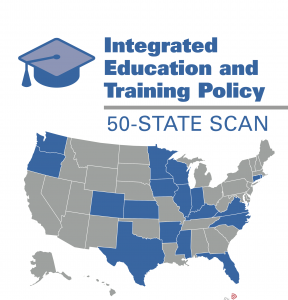
- At least 12 state provide funding for IET.
- At least 18 states have launched program initiatives using an IET model.
- No state has established policies requiring IET, although several states have longstanding initiatives that function as de facto requirements.
- Twenty-one percent had not yet started IET programming, while 42% have been doing IET for more than two years. Only 69% feel certain that their program meets all of the IET requirements.
- The majority of survey respondents are implementing or planning IET with Integrated English Language Civics Education (IELCE), WIOA section 243 funds. Twenty-nine percent offer IET outside of section 243 funds, demonstrating a willingness to provide IET with general funds.
- Many types of organizations provide the workforce training component: 39% are community and technical colleges, 14% are local workforce one-stop contractors, and 13% are local school districts.
- Health care occupations dominate IET program offerings—over half of all IET programs reported preparing students for the Certified Nursing Assistant (CNA) credential.
- Adult educators are targeting industries in multiple high-demand areas. Fifty-six percent offer IET programs in in-demand industries as defined by local workforce development boards, while 17% get their industry information from community and technical colleges.
- Forty-one percent of IET programs use state grant funds for the workforce training component, while 37% are designed to utilize federal financial aid.
- Forth-two percent of respondents didn’t know if their IET program is part of their state’s Eligible Training Provider List (ETPL). WIOA title I Adult and Dislocated Worker funds can be used to fund adult education and literacy services when bundled in an IET model
- Single, clear and statewide definition of various work-based learning experiences.
- High-quality career awareness and exploration beginning in the elementary and middle grades.
- Funds to support deployment of all activities at the state, regional, and local levels.
- Development and dissemination of a state framework for work-based learning.
- Non-elective graduation credit for approved work-based learning experiences.
You must be logged in to download this resource. Register now if you don't have an account.
Abstract:
You must be logged in to download this resource. Register now if you don't have an account.
Abstract:

You must be logged in to download this resource. Register now if you don't have an account.
Abstract:
You must be logged in to download this resource. Register now if you don't have an account.
Abstract:

You must be logged in to download this resource. Register now if you don't have an account.
Abstract:
You must be logged in to download this resource. Register now if you don't have an account.
Abstract:

You must be logged in to download this resource. Register now if you don't have an account.
Abstract:

You must be logged in to download this resource. Register now if you don't have an account.
Abstract: