

You must be logged in to download this resource. Register now if you don't have an account.
Abstract:
Adult educators will learn effective strategies to improve retention, persistence and motivation. Participants will understand the factors that affect adult learning including individual learning preferences, styles, and stressors. ABE instructors will gain practical and innovative learning strategies in an interactive workshop to encourage and engage learner participation to incorporate in the ABE/GED ® classroom or workplace. ATTACHMENTS: ABEfinalpresentationcoabetalaedallastexasapril2016
You must be logged in to download this resource. Register now if you don't have an account.
Abstract:
Presenters will provide information about a program designed to provide intensive support to low level developmental students. Participates will gain an understanding of specific strategies to plan, develop, and implement similar programs on their own campuses. The program's student success rates will also be shared. ATTACHMENTS: COABE Presentation PPT Final Version
You must be logged in to download this resource. Register now if you don't have an account.
Abstract:
HSE Foundations is a bridge course developed in response to data showing that many students were exiting the program shortly after completing our Student Success Seminar (SSS). Anecdotal evidence for their leaving included students reporting feeling as though there were no clear program plan and feeling lost upon entering classes that were already in progress. Additionally, CBP instructors faced the difficulty of working to shore up the knowledge and skills of incoming students while simultaneously providing stimulating lessons for existing students in order for them to continue progressing. In developing HSE Foundations, the team used location data in conjunction with principles of adult learning theory. The four-week course incorporates primarily in-class instruction along with a hybrid element created by working in Pearson's MyFoundationsLab and is intended to start students off on solid footing. Following completion of SSS, students progress as a cohort through the four-week course which consists of 24 hours of language arts instruction followed by 24 hours of mathematics instruction, creating a closed system- in which the 40-hour state requirement for post-testing is met. Because students remain in a cohort for a total of five weeks, this model also builds a sense of community, providing an academic support system to students beyond that offered by staff. After piloting HSE Foundations at one location in 2014-2015, a refined version was implemented at all program locations in August 2015. Early data since launch has shown outcomes that are on track to far surpass the goals of increasing post-testing by 5% and educational gains by 3%. With several sites having completed eight cohorts of Foundations, there has been a post-test rate of between 90 and 95%, and an educational gain rate of approximately 65%. The initial outcomes are a great improvement from past years' data, and student retention has increased since the implementation of the course. Due to this success, CBP lead HSE instructors are working collaboratively to create a standardized, standards-aligned curriculum for all HSE I courses. The first of its kind in Rio Salado College's College Bridge Pathways program, as well as in Arizona adult education on the whole, HSE Foundations incorporates a standardized syllabus of competencies aligned with Arizona College and Career Ready Standards. HSE Foundation's in-class instruction, along with the addition of MyFoundationsLab, creates a hybrid learning experience that is a major step in standardizing HSE curriculum in the program. ATTACHMENTS: Closing the Loop 1You must be logged in to download this resource. Register now if you don't have an account.
Abstract:
The National Education Technology Plan and the College and Career Readiness Standards present the field with a new way to think about requirements for student success and meeting the ever-changing demands of the workforce and education systems. In this interactive session, participants will work together to combine expertise with cutting edge technology that supports them to meet the need for new types of learning materials and instructional approaches. This can be achieved through open educational resources (OER). OER are free, adaptable, and sharable materials that can be created to develop student centered materials for the classroom, distance learning, and flipped classrooms. OER are significant for adult English language educators because they are free and sharable, able to be remixed and revised to meet learner needs, and customizable. Participants will do hands-on activities to: determine if a resource is open, integrate OER into instruction, and create and share OER. By creating OER teachers can increase student engagement while preparing them to be life-long learners and increase their 21st century skills. Through a project funded by the office of Career, Technical, and Adult Education (OCTAE), two groups of Adult ESL Teachers engaged in all of these activities. Their successes and challenges will be used to demonstrate real world application. Participants are encouraged to bring laptops to fully engage in the learning experience. ATTACHMENTS: FINAL_Teachers are Experts_COABE2016
You must be logged in to download this resource. Register now if you don't have an account.
Abstract:
Performance improvement and accountability are hallmarks of service delivery under the Workforce Innovation and Opportunity Act. Texas initiated a statewide quality model for local AEFLA provider program management after the state adult education program transferred to the Texas Workforce Commission in 2013. This slide show explains how the state and local programs collaborate to drive increased student success using a data-driven approach across educational, and postsecondary transition and employment outcomes. The presentation describes organizational roles in a system approach that includes monthly local performance and expenditure reporting, state office provider support, professional development linked to program improvement, monthly executive staff briefing, external monitoring and evaluation, and corrective action and continuous improvement support.+ ATTACHMENTS: ContinuousImprovementandAccountabilityTexasStyle_COABE2016
You must be logged in to download this resource. Register now if you don't have an account.
Abstract:
Developing a Fast-Track Curriculum for Accelerating Students Through GED ® Preparation Have the digital and common core skills required to successfully navigate GED ®preparation stalled your students? Let us help you tailor our Fast Track curriculum to fit your program. By identifying students by TABE scores and classroom performance, they can be taught a three-hour Math Fast Track and a three-hour RLA Fast Track to gain perspective in preparation for the GED Readyâ„¢ and GED ® tests. Presented by: Diane Kelly, Thomas Dube, Sandra Singleton, and Phyllis Lynn Educational Focus: Adult Basic Education ATTACHMENTS: Developing a Fast Track Curriculum for Accelerating Students Through GED Preparation Hardin County Student Checklist TEACHER CHECKLIST FOR GED 5 Step Student Checklist FOR GED GEDExpressPresentation211151 GEDExpressOverallGraphicROAD 2 GEDExpressOverallGraphicROAD 1 GEDExpressGreenPath GEDExpressYellowPath GEDExpressRedPath
You must be logged in to download this resource. Register now if you don't have an account.
Abstract:
LINKS TO PBS LEARNINGMEDIA WORKPLACE RESOURCES: Advanced Manufacturing https://ket.pbslearningmedia.org/shared/63652/4511512/ Construction https://ket.pbslearningmedia.org/shared/63652/4511650/ Healthcare https://ket.pbslearningmedia.org/shared/63652/4511647/ IT/Tech https://ket.pbslearningmedia.org/shared/63652/4511649/ Transportation/Logistics https://ket.pbslearningmedia.org/shared/63652/4511648/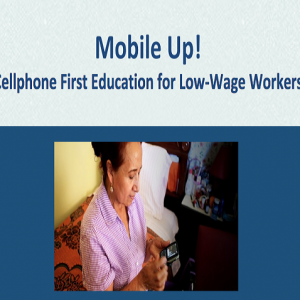
You must be logged in to download this resource. Register now if you don't have an account.
Abstract:
Conference presentation on how industry sector partnerships in California are piloting cell-phone first approaches to basic education and career coaching with low-wage service workers