Illinois Community College Board Statewide Contextualized Curricula
    Author: Illinois Community College Board
    Program Level: Professional Development
    Material Type: Collection
    Language: English
    License: (CC BY-NC-ND 4.0) For license summary click here

    Abstract:

    Illinois Community College Board, Division of Adult Education & Literacy, has designed several comprehensive model contextualized curricula, which includes instructions for use, supplemental materials, lesson plans, and related resources. Illinois Community College Board, Division of Adult Education & Literacy, has designed several comprehensive model contextualized curricula, which include:
    • ABE/ASE Curriculum
    • Career Pathways Contextualized Bridge Curriculum
    • Entrepreneurial Contextualized Bridge Curriculum
    • Healthcare Contextualized Bridge Curriculum
    • IT Bridge Contextualized Curriculum
    • Manufacturing Contextualized Bridge Curriculum
    • Transportation, Distribution and Logistics (TDL) Contextualized Bridge Curriculum
    Each set of materials includes instructions for use, supplemental materials, lesson plans, and related resources. All are designed to include academic skill development in reading, writing, math, science, and social studies while building learners' understanding of workplace and/or industry-specific concepts. Additionally, this set of resources includes an Integrated English Literacy and Civics Education (IELCE) Toolkit, designed to support programs in mapping out IELCE-aligned features offered within their programming. Benefits and Uses The materials focus on contextualized lessons to support learners in several high-growth industry areas across multiple learner levels and populations. These materials do contain some Illinois-specific content but can easily be modified to other states’ requirements. The site includes links to PDFs and websites for students to work in independently or as a whole class. Many aspects of the material could be adapted to be suitable for an Integrated Education and Training program or a bridge program that prepares students for entry into several industries. Resource Notice This site includes links to information created by other public and private organizations. These links are provided for the user’s convenience. The U.S. Department of Education does not control or guarantee the accuracy, relevance, timeliness, or completeness of this non-ED information. The inclusion of these links is not intended to reflect their importance, nor is it intended to endorse views expressed, or products or services offered, on these non-ED sites. Please note that privacy policies on non-ED sites may differ from ED’s privacy policy. When you visit lincs.ed.gov, no personal information is collected unless you choose to provide that information to us. We do not give, share, sell, or transfer any personal information to a third party. We recommend that you read the privacy policy of non-ED websites that you visit. We invite you to read our privacy policy.
    Publication Year
    2020
    Building a Digitally Resilient Workforce: Creating On-Ramps to Opportunity
    Author: Digital US
    Program Level: Professional Development
    Material Type: Collection
    Language: English
    License: (CC BY-NC-ND 4.0) For license summary click here

    Abstract:

    This report from the Digital US coalition is the result of a six-month landscape analysis and strategic planning period, laying the groundwork for a new collective impact approach to support both on-ramps to digital skills as well as pathways to new opportunities.
    Compendium of Innovative Practices: Adult Education Bridge Programs and Integrated Education and Training (IET) Programs
    Author: Judith Alamprese and I-Fang Cheng
    Program Level: Professional Development
    Material Type: Collection
    Language: English
    License: (CC BY-NC-ND 4.0) For license summary click here

    Abstract:

    This compendium describes five innovative practices in bridge and integrated education and training (IET) programs as selected by the  Advancing Innovation in Adult Education project.
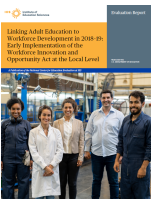
    Linking adult education to workforce development in 2018–19: Early implementation of the Workforce Innovation and Opportunity Act at the local level (NCEE 2023-001r)
    Author: Stephanie Cronen, Anne Diffenderffer, and Rebecca Medway
    Subject Area: LINCS Resources, WIOA, Workforce
    Program Level: Professional Development
    Material Type: Collection
    Language: English
    License: (CC BY-NC-ND 4.0) For license summary click here

    Abstract:

    This report from a national evaluation of Title II examines the extent to which local adult education providers' instructional approaches and coordination with other agencies in 2018–19 reflected the link between adult education and the overall workforce development system
    Publication Year
    2023
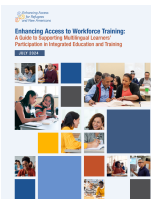
    Enhancing Access to Workforce Training: A Guide to Supporting Multilingual Learners’ Participation in Integrated Education and Training
    Author: Jessie Stadd and Laura Rasmussen Foster
    Program Level: Professional Development
    Material Type: Collection
    Language: English
    License: (CC BY-NC-ND 4.0) For license summary click here

    Abstract:

    This guide supports the development of workforce training programs, including Integrated Education and Training (IET), that maximizes accessibility for multilingual learners. To prepare multilingual learners for success in the workforce, adult education programs can develop workforce training programs, including IET, that maximizes accessibility for multilingual learners, helping them to access and succeed in these programs. The guide describes the required components of IET, potential barriers for multilingual learners, and, strategies for supporting their participation and success in education and workforce training. The strategies focus on four key topics:
    • program design,
    • partnerships,
    • navigation and advising, and
    • instructional approaches.
    For each strategy, the guide summarizes actions to take and additional resources to explore. The guide also provides tips for using a learner-centered approach within each of these strategies.
    Benefits and Uses
    This guide is designed for adult education providers who are already offering IET programming or connections to IET programs. Program designers and staff can help use the strategies described in the guide to help learners build the language skills and workforce knowledge they need to participate and be successful in IET and other education and training opportunities. By using a learner-centered approach and intentionally connecting multilingual learners with IET programs, adult educators can leverage learners’ assets to address their linguistic, academic, workforce, and basic needs barriers and bring learner voice into program design. These practices can help multilingual learners access and succeed in workforce training programs, preparing them for good jobs that enable their economic integration into their communities.
    Resource Notice
    This site includes links to information created by other public and private organizations. These links are provided for the user’s convenience. The U.S. Department of Education does not control or guarantee the accuracy, relevance, timeliness, or completeness of this non-ED information. The inclusion of these links is not intended to reflect their importance, nor is it intended to endorse views expressed, or products or services offered, on these non-ED sites. Please note that privacy policies on non-ED sites may differ from ED’s privacy policy. When you visit lincs.ed.gov, no personal information is collected unless you choose to provide that information to us. We do not give, share, sell, or transfer any personal information to a third party. We recommend that you read the privacy policy of non-ED websites that you visit. We invite you to read our privacy policy.
    Publication Year
    2024
    How Simulation Expanded Capacity and Improved Safety in Heavy Equipment Education at Alfred State College
    Author: Jeffrey Stevens and Alan Limoges
    Subject Area: Workforce
    Program Level: Adult Basic Education
    Language: English
    License: (CC BY-NC-ND 4.0) For license summary click here

    Abstract:

    Limited access to equipment and ensuring apprentice safety remain two of the most persistent challenges facing vocational institutions, and the Heavy Equipment Operation course at Alfred State was no exception. While the program itself was thriving, instructors struggled to provide every student with sufficient hands-on time on live equipment. This webinar will examine Alfred State College’s decision-making process, implementation considerations, and resulting outcomes, providing a real-world example of how simulation can complement hands-on equipment training in vocational education. Join Jeffrey Stevens, dean of the School of Applied Technologies at Alfred State College, and Alan Limoges, manager of Product Growth at CM Labs, as they share how simulation-based training evolved from concept to impact, reducing training time by up to 30%, expanding institutional capacity, and giving students more opportunities to practice safely and effectively. Key takeaways: -Key considerations Alfred State College evaluated when integrating simulation into its curriculum -Why simulation has proven effective in improving safety, capacity, and training outcomes -How heavy equipment vocational programs can apply a similar approach to support student engagement and jobsite readiness Original webinar date: February 19, 2026 Webinar recording link: https://youtu.be/G2GKJidO72c Webinar resource link: https://hubs.la/Q041p3XW0
    NEW Construction Training Grant Opportunity
    Author: Cathy Tyler, Kaylene Smith, Melissa Perkins, Robert Moore, and Sharon Bonney
    Subject Area: Workforce
    Program Level: Adult Basic Education
    Language: English
    License: (CC BY-NC-ND 4.0) For license summary click here

    Abstract:

    Discover how adult education can open doors to high-demand, high-wage careers in the construction industry. Join COABE and our national partner, the National Center for Construction Education and Research (NCCER), for an inspiring information session highlighting a newly launched grant opportunity designed specifically for COABE members. This session will explore how to start—or revitalize—a construction education program using NCCER’s nationally recognized curriculum and credentials, and how those credentials can strengthen alignment with local, state, and federal funding priorities. With construction among the most in-demand industries nationwide, this opportunity offers learners a pathway to meaningful careers with strong earning potential, upward mobility, and long-term stability. Participants will gain a clear understanding of program accreditation, curriculum options, instructor training, and the robust ongoing support available. We’ll also walk through what’s included in the start-up bundle, as well as program expectations and outcome requirements. Ample time will be provided for questions and discussion. Whether you are ready to launch a new construction training program or looking to reenergize trades training in your community, this grant opportunity represents a powerful chance to expand impact, meet workforce needs, and transform lives through education and skills training. Original webinar date: January 9, 2026 Webinar recording link: https://youtu.be/bIGbix7JfcM  

    Building Talent Pipelines: How Adult Education and Employers Can Partner for Workforce Success
    Author: Bryan Seck
    Subject Area: ESL/ELL, Workforce
    Program Level: Adult Basic Education
    Language: English
    License: (CC BY-NC-ND 4.0) For license summary click here

    Abstract:

    Adult education programs are uniquely positioned to serve as a powerful talent pipeline for today’s employers. By equipping learners with industry-relevant skills and providing onsite training—such as English as a Second Language (ESL) instruction directly at the workplace—adult education strengthens businesses while opening doors for workers to advance. In this webinar, we’ll explore practical strategies for building effective partnerships between employers and adult education programs. Featuring insights from Bryan Seck, former Kawasaki executive and now Executive Director of Lincoln Literacy in Nebraska, participants will learn how collaboration can address workforce shortages, enhance retention, and create opportunities for learners. This webinar draws on lessons from COABE’s Invest in the Midwest tour, offering both inspiration and actionable ideas for programs looking to engage employers as partners in workforce development. Original webinar date: December 2, 2025 Webinar recording link: https://youtu.be/5XFUZ8amxKQ