
You must be logged in to download this resource. Register now if you don't have an account.
Abstract:
Research shows that incorporating games into instruction can lead to more engagement and motivation. Games are also a great tool for differentiation and grouping. Presenters will discuss the role games can play and methods for creating and incorporating games. Participants will explore several games they can use in their classrooms.
You must be logged in to download this resource. Register now if you don't have an account.
Abstract:
Under the Workforce Innovation and Opportunity Act, improving adult learners’ ability to attain a job with family-sustaining wages is a high priority. One vehicle to achieve this is Integrated Education and Training (IET) programs set within career pathways. While there are several professional development (PD) resources that introduce IET concepts and program models, many adult educators struggle as they put policy into practice and during the implementation phase. In particular, adult education and literacy instructors and technical skills instructors are challenged to create a single set of learning objectives. Program administrators likewise need guidance in supporting IET teachers effectively. This presentation will highlight recent, innovative approaches of the American Institutes for Research to support IET implementation among AEFLA providers across California. The co-presenters will describe PD strategies used in their implementation clinic and lessons learned. Participants will experience an interactive activity from the clinic and receive additional PD resources.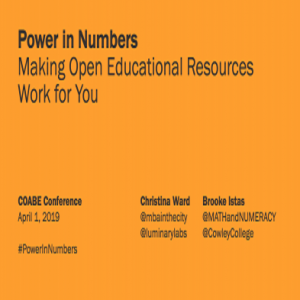
You must be logged in to download this resource. Register now if you don't have an account.
Abstract:
This presentation is aimed at adult learning educators and administrators interested in exploring open educational resources (OER) for the adult classroom. For those new to OER, we will introduce and explain the benefits of their use in adult education, and provide resource recommendations and advice for how to get started. For the experienced OER user, we will discuss insights from our research and efforts curating and testing OER resources. The insights are drawn from the experiences of educators who hail from 21 states and a variety of classroom types—including community colleges, community centers, correctional facilities, and local education agencies.
You must be logged in to download this resource. Register now if you don't have an account.
Abstract:
In this training, participants will learn how their program and students can take advantage of national developments in digital literacy and access. In this training, participants will watch demos of helpful resources, websites, and tools to get teachers, tutors, and students “connected.” Participants should bring their own device (BYOD) to get a hands-on experience.
You must be logged in to download this resource. Register now if you don't have an account.
Abstract:
Most adult basic skills (including ESL/ESOL) learners now have smartphones, yet few know that free or low-cost apps can help them learn, as a supplement to what they are learning in class, or while waiting for a class or a tutor. David J. Rosen will present models for “onboarding” adult learners to have access to a suitable education app, feel comfortable and competent in using it, and begin acquiring online learning skills they will need for their learning throughout their lives. The models are suitable for adult basic skills (including ESL/ESOL) programs and for public libraries.
You must be logged in to download this resource. Register now if you don't have an account.
Abstract:
In this session participants will learn about metacognitive skills. They will also recognize their importance in educational environments, careers, and daily life. They will understand how developing these skills will support all students, including those with special learning needs. The terms metacognition and metacognitive skills will be discussed as well as the importance of teaching students to develop those skills. Through activities, some techniques and strategies will be shared. In general participants will learn how metacognitive skills support students in all facets of their lives.
You must be logged in to download this resource. Register now if you don't have an account.
Abstract:
Additional Resource to support Growth vs. Fixed Mindsets - https://mindsetonline.com/testyourmindset/step1.php
You must be logged in to download this resource. Register now if you don't have an account.
Abstract:
Recently, cognitive science has broadened and deepened our understanding of how the human brain learns. This session is intended to share the science, and demonstrate its practice in teaching. The presenter will give an overview of recent research on the role of student “elaboration” and why having students express themselves and make their own connections is essential to lasting and transferable learning. We will explore several simple and engaging activities to connect our curricular material to students’ prior knowledge and their lives beyond our program walls.