Energy Literacy: Essential Principles and Fundamental Concepts for Energy Education
    Author: U.S. Global Change Research Program Partner Agencies
    Subject Area: LINCS Resources, Science
    Program Level: Professional Development
    Material Type: Collection
    Language: English
    License: (CC BY-NC-ND 4.0) For license summary click here

    Abstract:

    Also available in Spanish: http://energy.gov/eere/energia
    Publication date
    2014
    Energy Literacy: Essential Principles and Fundamental Concepts for Energy Education is an interdisciplinary approach to teaching and learning about energy. The framework identifies seven Essential Principles and a set of Fundamental Concepts to support each principle. The guide does not seek to identify all areas of energy understanding, but rather to focus on those that are essential for all citizens K-Gray. It presents energy concepts that, if understood and applied, will help individuals and communities make informed energy decisions. Also available in Spanish: http://energy.gov/eere/energia
    Benefits and Uses
    Energy Literacy looks at energy through the lens of natural science as well as social science. Energy issues require an understanding of civics, history, economics, sociology, psychology, and politics in addition to science, technology, engineering and mathematics. A comprehensive study of energy and curriculum designed using Energy Literacy should be interdisciplinary and use a systems-based approach to fully appreciate the complexities of energy issues. The intended audience for the Energy Literacy document is anyone involved in energy education. Intended use of the document as a guide includes, but is not limited to, formal and informal energy education, standards development, curriculum design, assessment development, and educator trainings. Educators: Find out about the Energy Literacy: Essential Principles and Fundamental Concepts for teaching energy through this free online webcast and presentation. The webcast and presentation highlight energy education resources including lesson plans, curriculum alignment tools and how to use the Energy Literacy Framework in your classroom today. Learn more by visiting the Education and Workforce Development website.
    Resource Notice
    This site includes links to information created by other public and private organizations. These links are provided for the user’s convenience. The U.S. Department of Education does not control or guarantee the accuracy, relevance, timeliness, or completeness of this non-ED information. The inclusion of these links is not intended to reflect their importance, nor is it intended to endorse views expressed, or products or services offered, on these non-ED sites. Please note that privacy policies on non-ED sites may differ from ED’s privacy policy. When you visit lincs.ed.gov, no personal information is collected unless you choose to provide that information to us. We do not give, share, sell, or transfer any personal information to a third party. We recommend that you read the privacy policy of non-ED websites that you visit. We invite you to read our privacy policy.
    The CUNY HSE Curriculum Framework–Science: Matter & Energy
    Author: Rebecca Leece, Eric Appleton, Erna Golden, and Shirley Miller
    Subject Area: LINCS Resources, Science
    Program Level: Professional Development
    Material Type: Collection
    Language: English
    License: (CC BY-NC-ND 4.0) For license summary click here

    Abstract:

    This framework aims to help students learn basic science content knowledge while developing their reading, writing, and analytical skills.
    Publication Year
    2015
    New versions of the high school equivalency (HSE) test place a greater emphasis on content knowledge in basic science concepts than previous versions of the GED. In order to do well, test-takers will have to use background knowledge in conjunction with strategic reading and test-taking skills. This science curriculum map is intended to help students develop foundational content knowledge in concepts in matter and energy that underlie all of the physical sciences. This curriculum is intended to help students learn basic science content knowledge while developing their reading, writing, and analytical skills. The curriculum is intended for use by teachers who don’t have a background in science. We provide background information for each lesson and resources for more information. This curriculum may also be used as a separate introduction to science for students who are transitioning into college to study majors that require science: nursing, dental technician, engineering, radiology, etc. Some of the big ideas explored include:
    • How can science help explain recognizable phenomena in the world?
    • How do we evaluate scientific responses to questions about the observable world? Examples include: What causes lightning? Why do helium balloons float? Where do the beads of water on the outside of a cold drink come from? Why is the ocean salty?
    • What are our common misconceptions about how the world works and how can we straighten them out?
    The subjects that make up and connect the daily lessons are rooted in essential questions. Each lesson is linked to previous lessons through embedded review, so that students build a network of ideas and knowledge. Opportunities for reflection on how each lesson fits into previous understandings (or doesn’t fit and requires a restructuring of understanding) are also built in.
    What the experts say
    This is a very well written science curriculum developed for adult education instructors without science background. The lessons are clear, appropriate, and interesting. Adult education instructors interested in teaching science could pick this up and start planning very easily. This is an excellent model for lesson planning and also an excellent curriculum itself. It has very comprehensive and clear scaffolding for teachers, who are presumed to not have extensive knowledge of scientific concepts. This seems as if would be very non-threatening to those who may feel unprepared to teach science, and provides good support to teach the concepts successfully. One support for teachers is an introduction to each lesson that explains the overall goals for not just the content in the lesson, but also for the ways in which it is meant to encourage student engagement and confidence. There are also very useful notes along the way to help with logistics of implementing the lesson plan and background knowledge to help respond to questions and discussions. There are also resources for learning more about the topics addressed in the curriculum. The style of teaching presented in the resource is very much in keeping with accepted best practices of adult education. The activities are designed to promote a lot of engagement, discussion and interaction of students, and focus on using their own questions and past experience to guide the learning. There is also an emphasis on synthesizing known and recently learned concepts with the new ones being presented along the way. This curriculum is very clear that it is “meant to connect the often abstract study of science with concrete, recognizable phenomena relevant to students’ lives.” And it presents a realistic and important view of what science is. The authors express the “….hope that this curriculum offers a more humane view of the field—that science is just the (often flawed and limited) current understanding of how things work in our world.”
    Resource Notice
    This site includes links to information created by other public and private organizations. These links are provided for the user’s convenience. The U.S. Department of Education does not control or guarantee the accuracy, relevance, timeliness, or completeness of this non-ED information. The inclusion of these links is not intended to reflect their importance, nor is it intended to endorse views expressed, or products or services offered, on these non-ED sites. Please note that privacy policies on non-ED sites may differ from ED’s privacy policy. When you visit lincs.ed.gov, no personal information is collected unless you choose to provide that information to us. We do not give, share, sell, or transfer any personal information to a third party. We recommend that you read the privacy policy of non-ED websites that you visit. We invite you to read our privacy policy.
    Reaching Students: What Research Says About Effective Instruction in Undergraduate Science Education
    Author: Linda Kober
    Subject Area: LINCS Resources, Science
    Program Level: Professional Development
    Material Type: Collection
    Language: English
    License: (CC BY-NC-ND 4.0) For license summary click here

    Abstract:

    This meta-analysis review from the field of discipline-based education research contains insights on how students learn science and engineering and how to design instructional strategies that build on these insights.
    Publication Year
    2015
    The undergraduate years are a turning point in producing scientifically literate citizens and future scientists and engineers. Evidence from research about how students learn science and engineering shows that teaching strategies that motivate and engage students will improve their learning. So how do students best learn science and engineering? Are there ways of thinking that hinder or help their learning process? Which teaching strategies are most effective in developing their knowledge and skills? And how can practitioners apply these strategies to their own courses or suggest new approaches within their departments or institutions? Reaching Students strives to answer these questions. Reaching Students presents the best thinking to date on teaching and learning undergraduate science and engineering. Focusing on the disciplines of astronomy, biology, chemistry, engineering, geosciences, and physics, this book is an introduction to strategies to try in your classroom or institution. Concrete examples and case studies illustrate how experienced instructors and leaders have applied evidence-based approaches to address student needs, encouraged the use of effective techniques within a department or an institution, and addressed the challenges that arose along the way. The research-based strategies in Reaching Students can be adopted or adapted by instructors and leaders in all types of public or private higher education institutions. They are designed to work in introductory and upper-level courses, small and large classes, lectures and labs, and courses for majors and non-majors. And these approaches are feasible for practitioners of all experience levels who are open to incorporating ideas from research and reflecting on their teaching practices. This book is an essential resource for enriching instruction and better educating students.
    What the experts say
    Reaching Students: What Research Says About Effective Instruction in Undergraduate Science and Engineering contains a valuable message for those interested in refocusing instruction by experimenting with new ways to reach students. These approaches and strategies use research-based components for effective teaching and learning. Although written for a higher education audience, the examples and methodologies are applicable to adult education classes. With the interest in moving more adult learners on to postsecondary education and adult learner interest in STEM careers, it is important to help adult learners develop deeper conceptual and practical background in science. One major drawback is that the resource assumes that the instructor has the science knowledge needed to help students address misconceptions and areas of confusion.  This resource was not designed to directly develop adult educators’ science background, a need for many adult educators.  It does, however, answer another pressing concern:  helping adult learners prepare for high school equivalency tests.  The shift to student-centered strategies mirrors the most pressing concerns noted by groups, such as the GED Testing Service:  (1) pulling specific evidence from a written source to support a finding or conclusion; (2) expressing scientific information or findings in words; and (3) understand and apply scientific models, theories, and processes.
    Resource Notice
    This site includes links to information created by other public and private organizations. These links are provided for the user’s convenience. The U.S. Department of Education does not control or guarantee the accuracy, relevance, timeliness, or completeness of this non-ED information. The inclusion of these links is not intended to reflect their importance, nor is it intended to endorse views expressed, or products or services offered, on these non-ED sites. Please note that privacy policies on non-ED sites may differ from ED’s privacy policy. When you visit lincs.ed.gov, no personal information is collected unless you choose to provide that information to us. We do not give, share, sell, or transfer any personal information to a third party. We recommend that you read the privacy policy of non-ED websites that you visit. We invite you to read our privacy policy.
    Humor and Games in the Adult Education Classroom
    Author: Emma Berg
    Program Level: Adult Basic Education
    Language: English
    License: (CC BY-NC-ND 4.0) For license summary click here

    Abstract:

    Are you looking for creative lesson ideas for the adult education classroom? This webinar will provide you with teacher-tested math and science lesson ideas for the correctional classroom. Join me as we discover fun ways to connect with students and get them engaged in math and science skills. Original webinar date: March 18, 2022 Webinar recording link: https://youtu.be/z7grYlnvIRE
    How to Learn Science through Open Resources!
    Author: Leecy Wise
    Subject Area: Science
    Program Level: Adult Basic Education
    Language: English
    License: (CC BY-NC-ND 4.0) For license summary click here

    Abstract:

    OER are increasingly being developed and adopted by educational programs and institutions. OER save money, but they also provide ideal learning tools. In science, a process-oriented field, students benefit from free access to well-developed instructions, illustrations, games, and animations showing how things work. In open classrooms, students learn to modify and republish those sources for others to emulate. (We learn what we teach!) Using OER creates win-win scenarios, and this webinar will show you how! Original webinar date: August 19, 2020 Webinar recording link: https://youtu.be/_JzWiQOL4uk  
    Balancing Chemical Equations for Non-Chemists
    Author: Shana Friend
    Subject Area: Science
    Language: English
    License: (CC BY-NC-ND 4.0) For license summary click here

    Abstract:

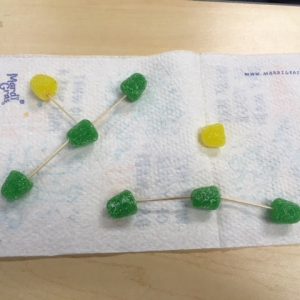
    Includes the presentation PowerPoint, Teacher Plan, and student handout.
    Experimenting with Science
    Author: Heidi Schuler-Jones
    Subject Area: Science
    Language: English
    License: (CC BY-NC-ND 4.0) For license summary click here

    Abstract:

    The provided materials were used for a workshop at the 2018 COABE Conference. The session was designed to familiarize participants with the scientific method by exploring how it plays out in experiments that can be conducted in any classroom, regardless of science lab materials.  For example, data from the participants’ ruler drop experiment were used to analyze the reaction time of fighter pilots.  We also examined how to identify the control, independent variable, and dependent variables, as well as draw a conclusion, in various scenarios from The Simpsons cartoon.  We looked at content problems similar to what might be on the HSE test, and explored strategies and resources for teaching this content to students.  Resources include exploring www.CK12.org and the National Institutes of Health Curriculum Supplement Series (https://science.education.nih.gov/customers/WebPages/CSHome.html).  Both of these free resources are easily adaptable to a classroom, as well as online, and encourage students to interact and discover the scientific process along the way.
    The NYSED Teacher Leader Project: Lessons Learned in Teacher Development
    Author: Mark Trushkowsky, Eric Appleton, Patricia Helmuth
    Language: English
    License: (CC BY-NC-ND 4.0) For license summary click here

    Abstract:

    Since 2014, the CUNY Adult Literacy/HSE Program has collaborated with the NYS Department of Education to create the NYSED Teacher Leader Initiative. This project has developed a community of teacher leaders across the state, dedicated to improving teaching practice in our field. These teacher leaders bring our training to educators in their regions, and develop resources and projects of their own. This workshop provides an overview and answers questions about the initiative. We'll use the voices of the NYSED Teacher Leaders themselves to reflect on the lessons we've learned about effective, ongoing, and engaging teacher development. This workshop is for teachers, administrators, state education directors - anyone interested in the resources developed and the lessons learned through this initiative. All materials from this workshop are available at bit.ly/COABE2018CUNY