
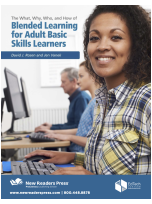
- How can blended learning help with what and who is taught?
- Why use a blended learning approach?
- How can a program get started?
- What does blended learning look like?
- What online resources work with blended learning?
- What are some common challenges in implementing blended learning?
You must be logged in to download this resource. Register now if you don't have an account.
Abstract:

You must be logged in to download this resource. Register now if you don't have an account.
Abstract:
You must be logged in to download this resource. Register now if you don't have an account.
Abstract:
This session will help address some of the common challenges that teachers may encounter during the initial stages of implementation of TABE® 11 & 12 such as where to start, what materials to use, and how to help students succeed in this more rigorous test. This session will focus on teaching strategies and resources that align with the technology-enhanced items and format of the test. In addition, teachers will also explore how to allow students to take full advantage of all the available technology tools on the test. Lastly, teachers will walk away with a wealth of online teaching tools and resources aligned to the TABE® 11 & 12 Assessment Blueprints.
You must be logged in to download this resource. Register now if you don't have an account.
Abstract:
Did you know that there are mathematicians that spend their entire life trying to solve one math problem? These are highly educated men and women who see mathematics as creative and open. They are not confined by rules – they MAKE their own rules! But isn’t it unfortunate that in the adult education classrooms mathematics is thought to be a subject of rules and procedures? That it isn’t something that is creative. This webinar will explore the powerful idea of mathematical freedom and change mathematics for learners so that mathematics becomes about learning instead of performing. Participants should expect to be engaged in thinking about problems in an open and creative manner, to begin to see the world deeper, but not necessarily faster.You must be logged in to download this resource. Register now if you don't have an account.
Abstract:
Did you know...in 2019, there will be 6 million job openings for information security professionals—but only 4.5 million security professionals to fill those roles? It is time to bridge the confidence gap. Alamo Colleges has developed the Cyber Core-4 Pathway to help adult education students bridge the confidence gap and complete a suite of 4 CompTIA Certificates in less than a year. Alamo I-BEST started the journey by posing as CompTIA instructors and attending the national conference. Over 50 completed students later, it is time to share the surprising things they learned. Let’s bridge the cyber confidence gap together. Alamo Colleges will share the truths, myths, and best practices.
You must be logged in to download this resource. Register now if you don't have an account.
Abstract:
Are you teaching your students to think about their thinking? Are you giving them opportunities to build their critical thinking skills to problem solve? Let’s have fun together discovering metacognition activities, strategies, and lessons to build important thinking skills for success in class and in life. Teaching critical thinking is good for ALL students and especially important in reaching those with learning difficulties.
You must be logged in to download this resource. Register now if you don't have an account.
Abstract:
The attached slides show the overview of the C3's Professional Development Initiative for the state of New Mexico Adult Education programs. See the innovative, research based practices used in a blended learning environment to elevate AE programs in our state. If you are interested in viewing the entire document, please go to: https://tinyurl.com/y2vpcyvb
You must be logged in to download this resource. Register now if you don't have an account.
Abstract:
This presentation is aimed at adult learning educators and administrators interested in exploring open educational resources (OER) for the adult classroom. For those new to OER, we will introduce and explain the benefits of their use in adult education, and provide resource recommendations and advice for how to get started. For the experienced OER user, we will discuss insights from our research and efforts curating and testing OER resources. The insights are drawn from the experiences of educators who hail from 21 states and a variety of classroom types—including community colleges, community centers, correctional facilities, and local education agencies.