
You must be logged in to download this resource. Register now if you don't have an account.
Abstract:
Are you teaching your students to think about their thinking? Are you giving them opportunities to build their critical thinking skills to problem solve? Let’s have fun together discovering metacognition activities, strategies, and lessons to build important thinking skills for success in class and in life. Teaching critical thinking is good for ALL students and especially important in reaching those with learning difficulties.
You must be logged in to download this resource. Register now if you don't have an account.
Abstract:
The attached slides show the overview of the C3's Professional Development Initiative for the state of New Mexico Adult Education programs. See the innovative, research based practices used in a blended learning environment to elevate AE programs in our state. If you are interested in viewing the entire document, please go to: https://tinyurl.com/y2vpcyvb
You must be logged in to download this resource. Register now if you don't have an account.
Abstract:
The Open Door Collective is a national group of adult educators and others committed to reducing poverty and income inequality. We will describe the Open Door Collective's efforts and invite discussion about community partnerships that support adult basic skills, community health, libraries and safety net services advocacy.
You must be logged in to download this resource. Register now if you don't have an account.
Abstract:
Additional Resource to support Growth vs. Fixed Mindsets - https://mindsetonline.com/testyourmindset/step1.php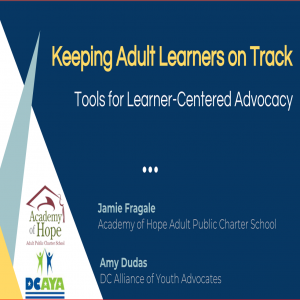
You must be logged in to download this resource. Register now if you don't have an account.
Abstract:
Adult learners face a number of barriers as they return to and attempt to remain in school. In Washington, DC, adult and alternative learners identified the high cost of transportation as one of those barriers and decided to do something about it. Over the course of three years, Academy of Hope Adult Public Charter School and the DC Alliance of Youth Advocates led a coalition of learners, volunteers and partners from across the city to build an evidence-based, inclusive, and learner-centered advocacy campaign that resulted in a $1.98 million per year investment in transportation subsidies for adult learners and alternative youth enrolled in school. Join us for a conversation about best practices for engaging adult and alternative learners in direct advocacy.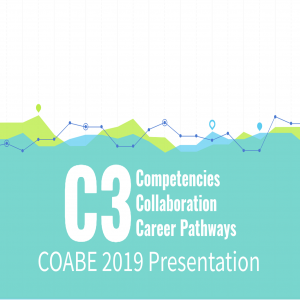
You must be logged in to download this resource. Register now if you don't have an account.
Abstract:
New Mexico ranks among the worst in the nation in educational attainment, poverty, violence, substance abuse, and suicide. With the advent of the WIOA legislation, a group of New Mexico adult education (AE) practitioners rallied to the call of building career pathways out of poverty and launched a radically innovative professional development initiative for elevating New Mexico to stand among our nation's top performers. Our C3 Initiative develops AE programs from "the inside out" to build Collaborations, Competency-Based Education, and Career Pathways programming. Design components include a three-year program commitment, a decision maker with two teachers from each program working for integrated change, program accountability with deliverables and increased responsibility, and the creation of a statewide professional learning community with a 33-week research-to-practice online curriculum. Our session shares knowledge and tools for supporting adult educators to unmask our brilliance and become leaders in the national career pathways movement. A pdf of the presentation has been uploaded for sharing. The Google Slides can be viewed by going to the link: https://docs.google.com/presentation/d/1ADlPv49Phieh1ZTD67Hkxd1klzJugmccE9raOCYIIl4/edit?usp=sharing.
You must be logged in to download this resource. Register now if you don't have an account.
Abstract:
This session provides an overview of first language (L1) use in Ready to Work, a government funded program that combines English language instruction with digital literacy and case management to help beginning level immigrants and refugees gain job readiness skills and explore pathways to college and career success. The presenters review research and literature regarding L1 use in multilingual settings, offer examples from the Ready to Work ESOL classes and ask attendees to consider the role of home language inclusion in creating a collaborative and linguistically appropriate environment for immigrant and refugee students. The session also shares strategies to incorporate students’ L1 knowledge into administrative processes such as intake, registration and advising. Ultimately, the presenters argue, L1 inclusion plays an important role in challenging ideologically rooted monolingual principles and acts as a crucial part of dismantling English-language supremacy and “English Only” mentalities in ESOL settings.
You must be logged in to download this resource. Register now if you don't have an account.
Abstract:
How do urban adult education providers design and implement career pathways (CP)? This presentation highlights findings from in-depth, qualitative case studies of six CP programs offered by community colleges, CBOs, and a school district in Chicago, Houston, and Miami. Key features of CP programs are described and compared, including their goals, instructional components, instructor expertise, staffing, support services, and access for lower-level students, among others. Salient factors that contribute to student success are also discussed, including wraparound supports, partnerships, bridge classes, and more.