Integrated Education and Training: Implementing Programs in Diverse Contexts
    Author: Andy Nash and Ellen Hewett
    Program Level: Professional Development
    Material Type: Collection
    Language: English
    License: (CC BY-NC-ND 4.0) For license summary click here

    Abstract:

    This guide profiles an array of integrated education and training (IET) programs providing inspiration, models, and lessons for adult educators as they plan or strengthen their own IET programs.
    Publication Year
    2017
    The federal Workforce Investment and Innovation Act (WIOA) has changed the landscape of adult education, focusing the field squarely on workforce development outcomes and programming that supports the integration of education and training (IET) and career pathways. This guide emerged from efforts to learn how eight adult education programs around the country have been integrating education and training. Many of these programs are making adjustments to conform to WIOA requirements and activities; others are using WIOA as an opportunity to forge new workforce collaborations. Across the board, there is much to learn from what they are doing effectively, what hasn’t worked well, and what they are thinking about going forward. Despite their wide range of contexts, all IET programs face some common realities. One is that the world of work is constantly evolving. New jobs require updated technological skills and a comfort with digital tools; employers are modernizing with green technologies and practices; and industries may rise, fall, or relocate. IET programs need to be nimble in responding to these realities. Illustrated in this guide are programs that continue to revamp their services, employ sectoral approaches that focus on technical skills that transfer across job categories, or rotate their job trainings so that they don’t over-saturate the market with workers who are then left without strong employment options. Another universal reality for IET programs is that this integration of services requires building relationships with and engaging new partners, and collaborating in new ways. The expanded team involved in such a collaboration needs to figure out how to work together and best utilize the strengths of each partner. The profiles in this guide offer a wide array of approaches both in who the adult education programs partner with (e.g. career and technical education (CTE) departments within a college or technical high school, WIOA-authorized training providers, or in-house technical training instructors) and how they collaborate in those partnerships to develop an integrated curriculum. The programs profiled are:
    • Asian-American Civic Association (Boston, MA)
    • Community Action, Inc. of Central Texas (Austin, TX)
    • Eastern Aroostook Adult and Community Education (Caribou, ME)
    • Genesis Center (Providence, RI)
    • Johnson County Community College (Johnson County, KS)
    • LaGuardia Community College (Queens, NY)
    • Northeast Mississippi Community College (Booneville, MS)
    • Southwest Regional Adult and Continuing Education (Southwest VA)
    What the experts say
    Practitioners are looking for IET examples that can be used as models in developing their own programs. This resource fulfills this need by providing simple and precise examples of workforce development in adult education in the following areas: health care, rural communities, urban areas, culinary arts, building maintenance, entrepreneurship, and curriculum development. This resource builds awareness of model IET program across a wide diversity of contexts. It would be useful for those developing local programs, studying the national context, or doing more research. Individual case studies include core information presented in a question and answer format. In particular, the design and funding portions of each case study are significant for practitioners, administrators, and policy-makers.
    Resource Notice
    This site includes links to information created by other public and private organizations. These links are provided for the user’s convenience. The U.S. Department of Education does not control or guarantee the accuracy, relevance, timeliness, or completeness of this non-ED information. The inclusion of these links is not intended to reflect their importance, nor is it intended to endorse views expressed, or products or services offered, on these non-ED sites. Please note that privacy policies on non-ED sites may differ from ED’s privacy policy. When you visit lincs.ed.gov, no personal information is collected unless you choose to provide that information to us. We do not give, share, sell, or transfer any personal information to a third party. We recommend that you read the privacy policy of non-ED websites that you visit. We invite you to read our privacy policy.
    Integrated Education and Training: A Career Pathways Policy & Practice
    Author: Judy Mortrude
    Subject Area: IET, LINCS Resources, Workforce
    Program Level: Professional Development
    Material Type: Collection
    Language: English
    License: (CC BY-NC-ND 4.0) For license summary click here

    Abstract:

    Results of a national survey of adult education providers to learn more about Integrated Education and Training (IET) models, funding mechanisms, and partnerships across the country.
    Publication Year
    2017
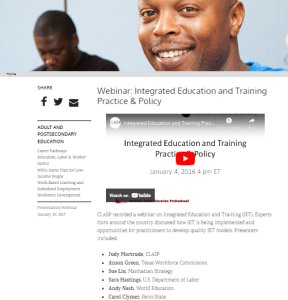
    Integrated Education and Training (IET) is a research-proven educational practice based in adult learning theory. The Center for Law and Social Policy (CLASP) and the Texas Workforce Commission conducted a national survey of adult education providers to learn more about IET models, funding mechanisms, and partnerships across the country. Two hundred sixty-five people from 43 states took the survey, which consisted of 31 questions. All results are included in the appendix. Highlighted results from the survey include:
    • Twenty-one percent had not yet started IET programming, while 42% have been doing IET for more than two years. Only 69% feel certain that their program meets all of the IET requirements.
    • The majority of survey respondents are implementing or planning IET with Integrated English Language Civics Education (IELCE), WIOA section 243 funds. Twenty-nine percent offer IET outside of section 243 funds, demonstrating a willingness to provide IET with general funds.
    • Many types of organizations provide the workforce training component: 39% are community and technical colleges, 14% are local workforce one-stop contractors, and 13% are local school districts.
    • Health care occupations dominate IET program offerings—over half of all IET programs reported preparing students for the Certified Nursing Assistant (CNA) credential.
    • Adult educators are targeting industries in multiple high-demand areas. Fifty-six percent offer IET programs in in-demand industries as defined by local workforce development boards, while 17% get their industry information from community and technical colleges.
    • Forty-one percent of IET programs use state grant funds for the workforce training component, while 37% are designed to utilize federal financial aid.
    • Forth-two percent of respondents didn’t know if their IET program is part of their state’s Eligible Training Provider List (ETPL). WIOA title I Adult and Dislocated Worker funds can be used to fund adult education and literacy services when bundled in an IET model
    What the experts say
    Integrated Education and Training: A Career Pathways Policy and Practice is well designed to promote continuous improvement at various levels in the field. A single provider could use it as study material for staff to compare its offerings with the field at large and assess the extent to which its own programs meet research-based standards such as the “tipping point.” WIOA providers in a region could use the IET publication as its title suggests: to review its career pathways policy and practice for improvement. For example, the resource provides several suggestions and strategies to move away from one-off special funding to regular program funds and describes the relevant WIOA regulations to support that move (see page 9). There is significant value to an analysis of the extent of the field’s adoption of the IET approach. This report will be valuable both to practitioners who are considering adding an IET component to their offerings as well as to those seeking guidance on how to strengthen already existing programs. The format is easy to follow and the language is clear. Since IET is an important component of WIOA, many adult education practitioners will be interested in reviewing the results of this survey. At this juncture, this is a helpful overview document both for programs that are already implementing IET as well as for those who are just getting started.
    Resource Notice
    This site includes links to information created by other public and private organizations. These links are provided for the user’s convenience. The U.S. Department of Education does not control or guarantee the accuracy, relevance, timeliness, or completeness of this non-ED information. The inclusion of these links is not intended to reflect their importance, nor is it intended to endorse views expressed, or products or services offered, on these non-ED sites. Please note that privacy policies on non-ED sites may differ from ED’s privacy policy. When you visit lincs.ed.gov, no personal information is collected unless you choose to provide that information to us. We do not give, share, sell, or transfer any personal information to a third party. We recommend that you read the privacy policy of non-ED websites that you visit. We invite you to read our privacy policy.
    Integrated Education and Training (IET)
    Author: Mariann Fedele-McLeod, Sudie Whalen, Anestine Hector Mason, and Carolyn McGavock
    Program Level: Professional Development
    Material Type: Collection
    Language: English
    License: (CC BY-NC-ND 4.0) For license summary click here

    Abstract:

    This policy brief summarizes Integrated Education and Training (IET), which is a combination of education and job skills training that is used to transition adult learners beyond adult basic education and through a career pathway that can offer them job training and eventual gainful employment.
    Publication Year
    2017
    This brief presents the Integrated Education and Training (IET) model as a way to support adults in gaining the skills needed to enter a career pathway that leads to living wage jobs. IET programs combine adult basic skills education and job skills training to offer adult learners a streamlined opportunity to transition from adult basic education classes to employment and/or postsecondary educational opportunities.  This brief overviews different teaching models for offering an IET (e.g., co-teaching and alternating teaching).  They then delve into a more refined description of each of these teaching models, indicating the benefits and possible drawbacks of each teaching model. The authors also identify key components and considerations when planning, developing, and offering an IET (e.g., data collection to monitor implementation and engage in continuous improvement, funding sources). Embedded in the brief are descriptions of two successful IET programs that offer concrete examples of this model and the resulting student outcomes.  The authors note that delivering an IET may require a larger investment due greater implementation costs; however, higher rates of student outcomes and greater transitions to employment and education may make the investment worthwhile.
    What the experts say
    This CALPRO Brief is what a good brief ought to be: succinct, concise, clear, and helpful for users. It provides a basic overview explaining how the components of Integrated Education and Training (IET) can be delivered concurrently and contextually and builds a case for states and programs to implement integrated education and training.  It is short and easy to read and provides a good starting point for discussions around the benefits of IET and considerations to think about when developing an IET. Specific examples are given to explain different ways occupational skills training and basic skills instruction can be integrated using co-teaching and alternating teaching models. A list of ten possible funding sources for IETs is included. One caution for users – it is dated 2017, which makes it several years out of date.  Users may want to seek current data on, for example, correlations between poverty and academic skill levels.
    Resource Notice
    This site includes links to information created by other public and private organizations. These links are provided for the user’s convenience. The U.S. Department of Education does not control or guarantee the accuracy, relevance, timeliness, or completeness of this non-ED information. The inclusion of these links is not intended to reflect their importance, nor is it intended to endorse views expressed, or products or services offered, on these non-ED sites. Please note that privacy policies on non-ED sites may differ from ED’s privacy policy. When you visit lincs.ed.gov, no personal information is collected unless you choose to provide that information to us. We do not give, share, sell, or transfer any personal information to a third party. We recommend that you read the privacy policy of non-ED websites that you visit. We invite you to read our privacy policy.
    Developing Basic Skills Curriculum for an IET
    Author: Institute for the Study of Adult Literacy (ISAL), The Pennsylvania State University
    Program Level: Professional Development
    Material Type: Collection
    Language: English
    License: (CC BY-NC-ND 4.0) For license summary click here

    Abstract:

    This resource provides templates, guidance, and tools that will help practitioners plan, design, and implement the basic skills component of an IET curriculum.
    Publication Year
    2017
    Integrated Education and Training (IET) has become a useful strategy to help adult education students and others improve their basic and occupational skills while meeting local workforce development requirements and needs. The resource provides templates, guidance, and tools that will help practitioners plan, design, and implement the basic skills component of an IET curriculum. The resource is designed to enable Title II providers and their training partners to adapt existing curriculum and/or develop new basic skills curriculum to help adult education students successfully complete occupational skills training and move forward on a career path. The focus of this guide is on basic skills rather than occupational skills training curriculum.
    Benefits and Uses
    The resource may provide support for those developing an IET as it provides guidance on the development of contextualized basic skills curriculum. The resource includes examples, instructional approaches, and templates that could be used for IET planning or for professional development.
    Resource Notice
    This site includes links to information created by other public and private organizations. These links are provided for the user’s convenience. The U.S. Department of Education does not control or guarantee the accuracy, relevance, timeliness, or completeness of this non-ED information. The inclusion of these links is not intended to reflect their importance, nor is it intended to endorse views expressed, or products or services offered, on these non-ED sites. Please note that privacy policies on non-ED sites may differ from ED’s privacy policy. When you visit lincs.ed.gov, no personal information is collected unless you choose to provide that information to us. We do not give, share, sell, or transfer any personal information to a third party. We recommend that you read the privacy policy of non-ED websites that you visit. We invite you to read our privacy policy.
    ICAPS: Illinois Integrated Education and Training Models One & Two: An Introduction
    Author: Bevan Gibson, Sarah Goldammer, and Aime'e Julian, Ph.D.
    Program Level: Professional Development
    Material Type: Collection
    Language: English
    License: (CC BY-NC-ND 4.0) For license summary click here

    Abstract:

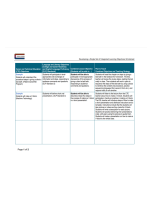
    This webinar recording defines and describes the Integrated Education and Training (IET) model and aligns it to the Illinois Integrated Career and Academic Preparation System (ICAPS). This webinar recording provides a deep dive into the various workforce training models. Although it is specific to Illinois program requirements, the two ICAPS models both align to WIOA requirements, and the webinar includes pertinent WIOA definitions that are applicable to all states. Benefits and Uses The resource helps to define the components of the Illinois ICAPS/IET (Integrated Career and Academic Preparation System/Integrated Education and Training) Model One and Model Two in Illinois. Although it is specific to Illinois program requirements, the two ICAPS models both align to WIOA requirements, and the webinar includes pertinent WIOA definitions that are applicable to all states. A PDF of the webinar slides is available to view and download. Resource Notice This site includes links to information created by other public and private organizations. These links are provided for the user’s convenience. The U.S. Department of Education does not control or guarantee the accuracy, relevance, timeliness, or completeness of this non-ED information. The inclusion of these links is not intended to reflect their importance, nor is it intended to endorse views expressed, or products or services offered, on these non-ED sites. Please note that privacy policies on non-ED sites may differ from ED’s privacy policy. When you visit lincs.ed.gov, no personal information is collected unless you choose to provide that information to us. We do not give, share, sell, or transfer any personal information to a third party. We recommend that you read the privacy policy of non-ED websites that you visit. We invite you to read our privacy policy.
    Publication Year
    2019
    CK-12 Adult Education FlexBooks
    Author: CK-12 Foundation and Outreach and Technical Assistance Network
    Subject Area: Health, IET, LINCS Resources, Workforce
    Program Level: Professional Development
    Material Type: Collection
    Language: English
    License: (CC BY-NC-ND 4.0) For license summary click here

    Abstract:

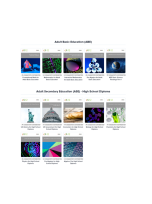
    This library of CK-12’s interactive FlexBooks was developed by the Outreach and Technical Assistance Network specifically to support adult educators and learners. The library includes FlexBooks for Adult Basic Education, Adult Secondary Education, English as a Second Language, High School Equivalency, and Career and Technical Education courses. All textbooks are interactive and include instruction, interactive media (including videos), and knowledge checks.
    This library of open-source textbooks can be beneficial to support on-ramp, bridge, or integrated education and training programming, and it can be used for Adult Basic Education, Adult Secondary Education, English as a Second Language, High School Equivalency, and Career and Technical Education courses. All textbooks are interactive and include instruction, interactive media (including videos), and knowledge checks. Three of the textbooks are relevant to health science careers, including a detailed course for home health aides. Given that these resources were developed on the CK-12 platform, they are designed to be easily reused with licensing that allows instructors to adapt and remix the content to be used in different contexts.
    Resource Notice
    This site includes links to information created by other public and private organizations. These links are provided for the user’s convenience. The U.S. Department of Education does not control or guarantee the accuracy, relevance, timeliness, or completeness of this non-ED information. The inclusion of these links is not intended to reflect their importance, nor is it intended to endorse views expressed, or products or services offered, on these non-ED sites. Please note that privacy policies on non-ED sites may differ from ED’s privacy policy. When you visit lincs.ed.gov, no personal information is collected unless you choose to provide that information to us. We do not give, share, sell, or transfer any personal information to a third party. We recommend that you read the privacy policy of non-ED websites that you visit. We invite you to read our privacy policy.
    Publication Year
    2019
    CALPRO/CASAS IET Webinar: Introduction to Designing a Single Set of Learning Objectives
    Author: Catherine Green and Amy Dalsimer
    Program Level: Professional Development
    Material Type: Collection
    Language: English
    License: (CC BY-NC-ND 4.0) For license summary click here

    Abstract:

    This webinar provides viewers with an overview of Integrated Education and Training (IET) through the lens of Integrated English Literacy and Civics Education (IELCE) in California.
    Compendium of Innovative Practices: Secondary Credentialing Programs for Adults
    Author: Judith Alamprese and I-Fang Cheng
    Subject Area: IET, LINCS Resources
    Program Level: Professional Development
    Material Type: Collection
    Language: English
    License: (CC BY-NC-ND 4.0) For license summary click here

    Abstract:

    This compendium describes the four innovative practices in secondary credentialing selected from the Round 1 Advancing Innovation in Adult Education applications.
    This compendium describes four innovative practices selected by the Advancing Innovation in Adult Education project. The four adult education practices highlighted in the compendium were drawn from round 1 applicants and illustrate innovative approaches for adult learners to attain a secondary credential while developing skills for career readiness, earning college credits, or obtaining an occupational certificate in a career pathway.
    Benefits and Uses
    Adult education State staff, program administrators, instructors and staff, workforce development staff, federal agency staff, and adult education researchers can use the Compendium of Innovative Practices to learn about new and enhanced approaches for adults to earn a secondary credential that include occupational training or earning of postsecondary credits as part of the credentialing option, and that involve web-based delivery of a credentialing program.
    Resource Notice
    This site includes links to information created by other public and private organizations. These links are provided for the user’s convenience. The U.S. Department of Education does not control or guarantee the accuracy, relevance, timeliness, or completeness of this non-ED information. The inclusion of these links is not intended to reflect their importance, nor is it intended to endorse views expressed, or products or services offered, on these non-ED sites. Please note that privacy policies on non-ED sites may differ from ED’s privacy policy. When you visit lincs.ed.gov, no personal information is collected unless you choose to provide that information to us. We do not give, share, sell, or transfer any personal information to a third party. We recommend that you read the privacy policy of non-ED websites that you visit. We invite you to read our privacy policy.
    Publication Year
    2020