
Download Resource
You must be logged in to download this resource. Register now if you don't have an account.
Abstract:
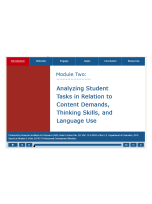
This module focuses on the task analysis process in relation to content demands, thinking skills, and language use.
“Analyzing Student Tasks in Relation to Content Demands, Thinking Skills, and Language Use” is the second in a three-part series of professional development modules about the English Language Proficiency (ELP) Standards for Adult Education. This training is intended for instructors, instructional leaders, administrators, and professional development providers who are learning to use the new ELP standards.
Module Two introduces the first two steps in a task analysis process. The content of the training responds to the following questions:
- What process can adult educators follow to understand the content knowledge, analytical skills, and language demands of an instructional task?
- What does task analysis reveal about the demands of instructional tasks in relation to academic content standards and language use?
Benefits and Uses
In order to successfully complete an instructional task (or activity), our English language learners (ELLs) must demonstrate certain content knowledge, analytical skills, and language use. In analyzing an instructional task, instructors determine what students need to know and be able to do with regard to these three components (or lens). Analyzing a task through these three lenses helps us to focus on all the various cognitive demands placed on students as they tackle an instructional task or project.
Task analysis helps us think more deeply about the structure and demands of an instructional task for ELLs—especially tasks we did not create ourselves. The task analysis process allows us to:
- Determine whether we are challenging students to produce the most rigorous, level-appropriate, standards-aligned activities;
- Identify roadblocks to students’ understanding; and
- Plan for scaffolding and supports to better meet our students’ needs.
- Understand the value of a task analysis process that examines what adult English Language Learners (ELLs) need to know and do around content knowledge, analytical skills, and language use to accomplish an instructional task; and.
- Use a task analysis process to analyze and reflect on instructional tasks for various levels and content areas.
- Download and print the module’s resources (which appear in the Resources tab beginning on slide 4) before you begin the training.
- Please turn off pop-up blockers in your browser for this module.
- Use the following instructions for navigating through this module using your keyboard and using JAWS assistive technology:
-
- Use the Tab key to move forward through each screen’s content. Press Shift + Tab to move backwards. A box surrounds the object that is currently selected.
- To select the skip navigation button and the navigation buttons that appear at the bottom of the screen (Play, Pause, Forward, Back, Volume, Closed Captions and Exit buttons), use the spacebar key.
- Press Shift + Enter to select a navigation button at the top of the screen or a hyperlink.
- For closed captioning select the “cc” button.
Required Training
Completion of Module One: Introduction to the English Language Proficiency Standards for Adult Education; an understanding of your state-adopted academic content standards.
Resource Notice
This site includes links to information created by other public and private organizations. These links are provided for the user’s convenience. The U.S. Department of Education does not control or guarantee the accuracy, relevance, timeliness, or completeness of this non-ED information. The inclusion of these links is not intended to reflect their importance, nor is it intended to endorse views expressed, or products or services offered, on these non-ED sites.
Please note that privacy policies on non-ED sites may differ from ED’s privacy policy. When you visit lincs.ed.gov, no personal information is collected unless you choose to provide that information to us. We do not give, share, sell, or transfer any personal information to a third party. We recommend that you read the privacy policy of non-ED websites that you visit. We invite you to read our privacy policy.
Publication Year
2018