The Language of Comparisons: Communicating about Percentages
    Author: Jessica Polito
    Program Level: Professional Development
    Material Type: Collection
    Language: English
    License: (CC BY-NC-ND 4.0) For license summary click here

    Abstract:

    This paper describes an approach used to explicitly teach students how to analyze arguments based on comparisons of numbers and percentages, and how to write such comparisons with the necessary precision.
    Author(s)
    Jessica Polito
    Author(s) Organizational Affiliation
    Wellesley College
    Publication Year
    2014
    Resource Type
    Product
    Number of Pages
    15
    Abstract
    While comparisons between percentages or rates appear frequently in journalism and advertising, and are an essential component of quantitative writing, many students fail to understand precisely what percentages mean, and lack fluency with the language used for comparisons. After reviewing evidence demonstrating this weakness, this experience-based perspective lays out a framework for teaching the language of comparisons in a structured way, and illustrates it with several authentic examples that exemplify mistaken or misleading uses of such numbers. The framework includes three common types of erroneous or misleading quantitative writing: the missing comparison, where a key number is omitted; the apples-to-pineapples comparison, where two subtly incomparable rates are presented; and the implied fallacy, where an invalid quantitative conclusion is left of the reader to infer.
    What the experts say
    This article gives teachers much to think about in terms of truly understanding percentages as they relate to comparisons. The author does an exemplary job of showing where student and teachers weaknesses are in analyzing and interpreting data sets. Some discovery methods of teaching mathematics rely almost completely on what the student brings to class in terms of problem-solving abilities and mathematical knowledge. This method helps students develop the ability to analyze and apply mathematics in a way that will help them both in future math classes and in the world outside the classroom. The implications for instruction in this resource stretch beyond the lessons in data and communicating about percentages. The way these lessons are taught will strengthen student awareness of data, mathematics, and real world analysis.
    Resource Notice
    This site includes links to information created by other public and private organizations. These links are provided for the user’s convenience. The U.S. Department of Education does not control or guarantee the accuracy, relevance, timeliness, or completeness of this non-ED information. The inclusion of these links is not intended to reflect their importance, nor is it intended to endorse views expressed, or products or services offered, on these non-ED sites. Please note that privacy policies on non-ED sites may differ from ED’s privacy policy. When you visit lincs.ed.gov, no personal information is collected unless you choose to provide that information to us. We do not give, share, sell, or transfer any personal information to a third party. We recommend that you read the privacy policy of non-ED websites that you visit. We invite you to read our privacy policy.

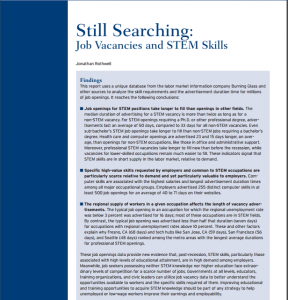
    Still Searching: Job Vacancies and STEM Skills
    Author: Jonathan Rothwell
    Subject Area: LINCS Resources
    Program Level: Professional Development
    Material Type: Collection
    Language: English
    License: (CC BY-NC-ND 4.0) For license summary click here

    Abstract:

    This report uses a unique database from the labor market information company Burning Glass and other sources to analyze the skill requirements and the advertisement duration time for millions of job openings.
    Author(s)
    Jonathan Rothwell
    Author(s) Organizational Affiliation
    Metropolitan Policy Program at Brookings Institution
    Publication Year
    2014
    Resource Type
    Research
    Number of Pages
    37
    Abstract
    Workers with skills in science, technology, engineering, and mathematics (STEM) play a hugely important role in driving innovation and economic growth. This report addresses a set of issues of increasing interest to policy makers, educators, businesses, and workers of all ages: What skills are most in demand and most likely to lead to a rewarding career? Is there a shortage of workers possessing the skills used in STEM occupations (i.e., STEM skills)? What skills and bodies of knowledge should schools and post-secondary institutions offer to teach students in order to provide them the best chances of economic success? The results show that skills common to STEM occupations are in short supply relative to demand and are valued more by employers. Moreover, companies located in regions with low unemployment rates for STEM workers have greater difficulty filling their openings, all else being equal. It follows that increased training in STEM fields like computer science and medicine will ease hiring for employers and lead to high-paying career paths for workers. While this is certainly not the first report to highlight the economic advantages that accrue to those with STEM skills, the data and analysis here are novel and useful in a few ways. First, unlike most reports on the STEM workforce or skill-shortage issues more broadly, this report draws on a database (developed by the labor market information company Burning Glass) that allows one to measure the duration of job vacancy advertisements—a measure of hiring difficulty. This is the first nationwide analysis of vacancy duration for the United States by occupation. This report also draws upon a uniquely large sample size: 1.1 million advertisements were used to calculate summary statistics for the first quarter of 2013, and 3.3 million were used in the formal statistical analysis, across 52,000 companies. There are three major conclusions:
    1. Job openings for STEM positions take longer to fill than openings in other fields.
    2. Specific high-value skills requested by employers and common to STEM occupations are particularly scarce relative to demand and yet particularly valuable to employers.
    3. The regional supply of workers in a given occupation affects the length of vacancy advertisements.
    What the experts say
    Until this research, there were, evidently, no comprehensive, reliable, and objective studies that reported on supply and demand in our US economy. According to its author, "this is by far the largest database of vacancy duration to be analyzed, and this is the first national research database of vacancy duration by skill level. In that respect, this report offers a powerful tool for understanding the supply and demand for skills, yet it touches on only a few of many research issues that the data can help address with new clarity and precision. The principle finding is that there is a relative shortage of U.S. workers with STEM skills. This study reveals irrefutable evidence relating to the high demand for STEM workers and the need to provide more and better training to prepare American workers to enter STEM-related careers. What a great resource for justifying the need for building a strong Career Pathways program in STEM related fields! This report has all the data any adult education administrator would need for writing a grant, meeting the needs of the WIOA  and marketing their current STEM programs. A great read!
    Resource Notice
    This site includes links to information created by other public and private organizations. These links are provided for the user’s convenience. The U.S. Department of Education does not control or guarantee the accuracy, relevance, timeliness, or completeness of this non-ED information. The inclusion of these links is not intended to reflect their importance, nor is it intended to endorse views expressed, or products or services offered, on these non-ED sites. Please note that privacy policies on non-ED sites may differ from ED’s privacy policy. When you visit lincs.ed.gov, no personal information is collected unless you choose to provide that information to us. We do not give, share, sell, or transfer any personal information to a third party. We recommend that you read the privacy policy of non-ED websites that you visit. We invite you to read our privacy policy.
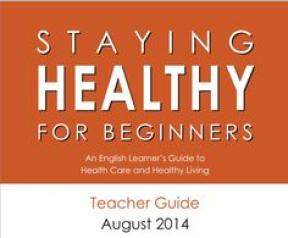
    Staying Healthy for Beginners (Student Workbook)
    Author: Sabrina Kurtz-Rossi, Claire Valier, and Gregory Smith
    Subject Area: ESL/ELL, Health, LINCS Resources
    Program Level: Professional Development
    Material Type: Collection
    Language: English
    License: (CC BY-NC-ND 4.0) For license summary click here

    Abstract:

    This is an English learner's guide to health care and healthy living.
    Author(s)
    Sabrina Kurtz-Rossi
    Claire Valier
    Gregory Smith
    Author(s) Organizational Affiliation
    Florida Literacy Coalition
    Publication Year
    2014
    Resource Type
    Informational Material
    Number of Pages
    168
    Product Type
    Abstract
    This guide is meant to be used directly with adult learners in adult education classrooms as instructional materials. It can also be used as a conversation starter for adult education professionals in thinking about issues/skills to introduce in classrooms, programs, and materials. This is ready-to-use in the classroom or a tutoring session. It can also be given to students for their own use. The Guide itself was designed for beginner level ESOL students and can be used with or without guidance. It is written at a 3-4 grade level and is supported by pictures, a glossary and a well-designed plain language format. The Staying Healthy for Beginners Teachers Guide supports teachers and/or tutors in using the Guide as a basis for a variety of particpatory teaching activities.
    Benefits and Uses
    Staying Healthy is an award-winning curriculum that is used throughout the United States. It is written at a 4th-5th grade reading level and is suitable for low intermediate level ESOL learners and above. The newly-released Staying Healthy for Beginners is written at a lower reading level, making it more accessible to learners at the high beginning level.
    What the experts say
    This is an important contribution to the adult education field. Staying Healthy for Beginners is a great way to build adult learner skills and to introduce conversations around personal health. This is a beautiful booklet that students can easily read and use to gain knowledge about taking care of their health and and confidence to interact with the healthcare system. Few resources known have this many colorful pictures and as "friendly" a design for lower level readers of English. Besides the information, the booklet includes things like dialogues, personal stories, simple charts, and interactive activities to engage the learner. There are some places that let them fill out real information that will help them with healthcare activities. The guide is something that students can keep at home and use even after the class is over, and many students have told teachers that they share the information with friends and family. There has been a big need for health literacy resources for beginner level students, and this fills that need. This is an addition to the earlier resource: Staying Healthy: An English Learner’s Guide to Health Care and Healthy Living. It uses the same principles as that first Guide, which has been used in programs all over the country to rave reviews. The original Guide was pilot tested and found to be effective at improving students' knowledge of health issues and intention to interact more fully with the health care system and their healthcare providers. Please see the ongoing discussion about this resource in the LINCS Health Literacy Community of Practice.
    Resource Notice
    This site includes links to information created by other public and private organizations. These links are provided for the user’s convenience. The U.S. Department of Education does not control or guarantee the accuracy, relevance, timeliness, or completeness of this non-ED information. The inclusion of these links is not intended to reflect their importance, nor is it intended to endorse views expressed, or products or services offered, on these non-ED sites. Please note that privacy policies on non-ED sites may differ from ED’s privacy policy. When you visit lincs.ed.gov, no personal information is collected unless you choose to provide that information to us. We do not give, share, sell, or transfer any personal information to a third party. We recommend that you read the privacy policy of non-ED websites that you visit. We invite you to read our privacy policy.
    State of Washington’s I-BEST Model
    Author: Washington State Board for Community and Technical Colleges
    Program Level: Professional Development
    Material Type: Collection
    Language: English
    License: (CC BY-NC-ND 4.0) For license summary click here

    Abstract:

    This resource provided by the State of Washington helps practitioners better understand career pathways programs and expand practioners’ professional knowledge.
    Author(s)
    Washington State Board for Community and Technical Colleges
    Publication Year
    2014
    Resource Type
    Product
    Key Words
    Abstract
    The state of Washington's Integrated Basic Education and Skills Training (I-BEST) program is nationally recognized as an evidence-based instructional model that supports career pathways. In an I-BEST program, two instructors are paired in the classroom - one to teach professional/technical or academic content; the other to teach basic skills in reading, math, writing or English language - so students can move through school and into jobs faster. The Washington State Board for Community and Technical Colleges offers an array of teaching tips, research findings, and planning tools for educators who want to learn more about I-BEST, including team teaching models, collaborative planning, and wrap-around support services. A series of videos is also available that explains the I-BEST model and demonstrates team teaching in action.
    Benefits and Uses
    Program developers and instructors will be able to begin the planning process for the creation of an I-BEST type bridge program.
    Resource Notice
    This resource was reviewed and vetted through the Designing Instruction for Career Pathways initiative of the U.S. Department of Education, Office of Vocational and Adult Education under Contract No. ED-CFO-10-A-0072/0001.
    Readworks.org
    Author: ReadWorks
    Program Level: Professional Development
    Material Type: Collection
    Language: English
    License: (CC BY-NC-ND 4.0) For license summary click here

    Abstract:

    ReadWorks is a non-profit organization which gives teachers the research-proven tools and support they need to improve the academic achievement of their students. The website provides lessons which are organized by skill and strategy units, comprehension units, and novel study units. Leveled non-fiction and literary reading passages are also provided. The ReadWorks materials are aligned to the Common Core State Standards (CCSS).  
    Benefits and Uses
    ReadWorks provides teachers with a large set of grade-level aligned complex literary and informational texts on a variety of topics. Many reading passages are accompanied by text-dependent questions, vocabulary student worksheets, and teacher notes. Each reading passage that comes with a question set identifies the specific CCSS encompassed in the activities. Reading passages are tagged by K-12 grade, Lexile level, subject domain, text types, and skill/strategy employed. Many of the reading passages are appropriate for adult education programs, and adult educators can use the Lexile information to select reading passages at an appropriate level for their learners. Teachers can use the resource to address College and Career Readiness (CCR) standards’ key advance one: regular practice with complex text and its academic language and key advance two: reading, writing, and speaking are grounded in evidence from text. Paired reading passages sets enable educators to select several reading passages on a topic or theme to address key advance three: building knowledge through content-rich nonfiction. Note: The site also provides lesson plans for grades K-6 which are aligned to the CCSS. The content of some of these lesson plans may not be appropriate for adult education students. ReadWorks might be used in the field of adult education to identify learning level appropriate texts and text-dependent tasks for classroom instructional use. The texts do not require any modification. Teachers can use text dependent questions and vocabulary resources as is or modify the text-dependent questions and develop writing prompts. The paired passages features may be used to build content knowedge in the classroom. Teachers would need to translate K-12 grade levels to their appropriate course level and review the grade-level CCSS to identify the CCR standards addressed by the materials. Professional developers could use the resource to prepare sample lessons using the text passages and questions. The reading passages are the most useful resources on the site. Users can use the filter functions to find appropriate texts for adult education students. The Text Type, Grade, and Lexile Level are all useful filters to find complex texts suitable for the learning level and content needs of adult education students. After opening a free account, users can download texts or save to “My Binder” for future access.  
    Resource Notice
    This site includes links to information created by other public and private organizations. These links are provided for the user’s convenience. The U.S. Department of Education does not control or guarantee the accuracy, relevance, timeliness, or completeness of this non-ED information. The inclusion of these links is not intended to reflect their importance, nor is it intended to endorse views expressed, or products or services offered, on these non-ED sites. Please note that privacy policies on non-ED sites may differ from ED’s privacy policy. When you visit lincs.ed.gov, no personal information is collected unless you choose to provide that information to us. We do not give, share, sell, or transfer any personal information to a third party. We recommend that you read the privacy policy of non-ED websites that you visit. We invite you to read our privacy policy.
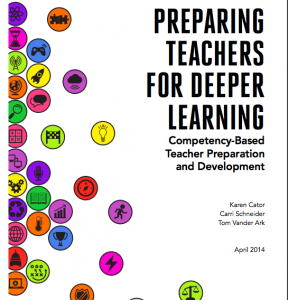
    Preparing Teachers for Deeper Learning: Competency-Based Teacher Preparation and Development
    Author: Karen Cator, Carri Schneider, and Tom Vander Ark
    Subject Area: LINCS Resources
    Program Level: Professional Development
    Material Type: Collection
    Language: English
    License: (CC BY-NC-ND 4.0) For license summary click here

    Abstract:

    The paper contains recommendations that will move the field toward a competency-based system and a call to action regarding the importance of better aligning teacher preparation and development with student Deeper Learning goals.
    Author(s)
    Karen Cator
    Carri Schneider
    Tom Vander Ark
    Author(s) Organizational Affiliation
    Digital Promise
    Getting Smart
    Publication Year
    2014
    Resource Type
    Research
    Number of Pages
    30
    Abstract
    This paper outlines the attributes of next-generation teacher preparation and makes recommendations to support the development of teacher preparation and development systems that will equip teachers to thrive in learning environments that develop Deeper Learning competencies. The paper begins with an introduction that situates the changing roles of teachers inside the broader shifts to personalized, blended, Deeper Learning for students. After summarizing the current state of teacher preparation, professional development and accreditation, the authors describe a new approach to high-quality teacher preparation and ongoing professional learning opportunities that would offer:
    • some element of teacher control over time, place, path and/or pace;
    • balance between teacher-defined goals, goals as defined by administration through teacher evaluation efforts, and school and district educational goals;
    • job-embedded and meaningful integration into classroom practice; and
    • competency-based progression.
    Drawing on examples from outside of the field of education as well as innovators in higher education and K-12, the next section builds the case for competency-based teacher education. This section defines the elements of a competency-based system and describes micro-credentialing in the context of teacher development. The authors conclude with recommendations that will move the field toward a competency based system and a call to action regarding the importance of better aligning teacher preparation and development with student Deeper Learning goals. An executive summary is also available, as well as a complementary infographic.
    What the experts say
    An outstanding resource for anyone interested in the effectiveness of competency-based professional development, microcredentialing and the best practices of Hybrid Professional Development. This is a MUST read for ANYONE interested in improving their Professional Development delivery system! This is an outstanding paper on the benefits of competency-based professional development, coupled with effective new tools, such as micro-credentialing and the effectiveness that hybrid professional development provides for adult educators. This has great relevance for adult basic skills professional development. There is great potential for competency-based teacher education and micro-credentials in adult basic education. The personalized learning advocated for teacher education in K-12 and higher education also applies very well to adult education.
    Resource Notice
    This site includes links to information created by other public and private organizations. These links are provided for the user’s convenience. The U.S. Department of Education does not control or guarantee the accuracy, relevance, timeliness, or completeness of this non-ED information. The inclusion of these links is not intended to reflect their importance, nor is it intended to endorse views expressed, or products or services offered, on these non-ED sites. Please note that privacy policies on non-ED sites may differ from ED’s privacy policy. When you visit lincs.ed.gov, no personal information is collected unless you choose to provide that information to us. We do not give, share, sell, or transfer any personal information to a third party. We recommend that you read the privacy policy of non-ED websites that you visit. We invite you to read our privacy policy.

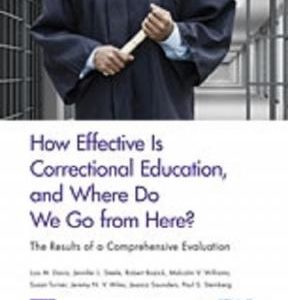
    How Effective Is Correctional Education, and Where Do We Go from Here? The Results of a Comprehensive Evaluation
    Author: Lois M. Davis, Jennifer L. Steele, Robert Bozic, Malcolm V. Williams, Susan Turner, Jeremy N. V. Miles, Jessica Saunders, and Paul S. Steinberg
    Program Level: Professional Development
    Material Type: Collection
    Language: English
    License: (CC BY-NC-ND 4.0) For license summary click here

    Abstract:

    This report presents a summary of the findings from an earlier literature review and meta-analysis on the effectiveness of correctional education programs for incarcerated adults, as well as a systematic review of correctional education programs for juveniles and the results of a national survey of state correctional education directors, which provide an up-to-date picture of what the field of correctional education looks like today in the United States and explores the use of computer technology, preparations for the new 2014 GED exam, and the impact of the 2008 recession. The report concludes with a set of recommendations for improvements needed to further the field of correctional education.
    Publication Year
    2014
    The Second Chance Act of 2007 (Pub. L. 110-199) is a historic piece of legislation designed to improve outcomes for and provide a comprehensive response to the increasing number of individuals who are released from prisons, jails, and juvenile residential facilities and returning to communities upon release. The Second Chance Act’s grant programs are funded and administered by the Office of Justice Programs within the U.S. Department of Justice. In 2010, for the first time, funding was set aside for a comprehensive study of correctional education. The Office of Justice Programs’ Bureau of Justice Assistance awarded the RAND Corporation a cooperative agreement to undertake a comprehensive examination of the current state of correctional education for incarcerated adults and juveniles, where it is headed, which correctional education programs are effective, and how effective programs can be implemented across different settings. Evaluating the Effectiveness of Correctional Education: A Meta-Analysis of Programs That Provide Education to Incarcerated Adults presented a comprehensive review of the scientific literature and a meta-analysis that synthesized the findings from multiple studies on the effectiveness of correctional education programs in helping to reduce recidivism and improve post-release employment outcomes for incarcerated adults (Davis et al., 2013). This final report to the U.S. Attorney General presents a summary of the findings from RAND's earlier literature review and meta-analysis on the effectiveness of correctional education programs for incarcerated adults. It also provides three new sections. The first of these is a systematic review of correctional education programs for juveniles. The second is the results of a national survey of state correctional education directors, which provide an up-to-date picture of what the field of correctional education looks like today in the United States and explores the use of computer technology, preparations for the new 2014 GED exam, and the impact of the 2008 recession. It concludes with a set of recommendations for improvements needed to further the field of correctional education. These results will be of interest to federal and state policymakers; administrators of state departments of corrections, public safety, and education; correctional educators and college educators; career technical training providers; and other organizations that provide educational services and training to the currently incarcerated or formerly incarcerated. These results will also be of interest to those in the U.S. Departments of Justice and Education who are committed to ensuring the availability and quality of correctional education programs for incarcerated adults and juveniles.  
    What the experts say
    The RAND study is based on a meta-analysis of the literature of correctional education.  It establishes a valuable map for what works in adult correctional education. It also examines use of technology and funding issues in the field.  This study is the most current and widely cited analyis of correctional education and a "must know" for those working in correctional education or considering policy related to the field. This study is a foundational work for administrators and faculty in the field of correctional education.  It is also a key citation for policy-makers in considering funding and resource allocation to the field. The resource addresses the effectiveness of correctional education programming in institutions and facilities for juveniles and adults in the areas of adult basic education, basic skills instruction, English language learners, high school equivalency/GED completion, vocational education or career technical education, training in general employment skills, and college level/postsecondary instruction. Information regarding literacy levels and rates resulting from the study are part of the underpinnings. This Meta-analysis is well-done, easy-to-read, and has strong recommendations attached.  The fact that it is current (2014) is a true bonus.  
    Resource Notice
    This site includes links to information created by other public and private organizations. These links are provided for the user’s convenience. The U.S. Department of Education does not control or guarantee the accuracy, relevance, timeliness, or completeness of this non-ED information. The inclusion of these links is not intended to reflect their importance, nor is it intended to endorse views expressed, or products or services offered, on these non-ED sites. Please note that privacy policies on non-ED sites may differ from ED’s privacy policy. When you visit lincs.ed.gov, no personal information is collected unless you choose to provide that information to us. We do not give, share, sell, or transfer any personal information to a third party. We recommend that you read the privacy policy of non-ED websites that you visit. We invite you to read our privacy policy.
    High School Equivalency Institute: Critical Thinking for GED 2014 – Depth of Knowledge Framework
    Author: Ben Merrion
    Program Level: Professional Development
    Material Type: Collection
    Language: English
    License: (CC BY-NC-ND 4.0) For license summary click here

    Abstract:

    This training focused on how to transition students, classrooms and teaching staff towardsthe new GED. The training provides specific tips and examples to bring more critical thinking skills into classrooms of all levels. Academy of Hope’s condensed manual on the new GED, examples of organizers, and other helpful material is included with the training.
    Publication Year
    2014
    This training is for teachers who are well versed in the components of the new GED test. We will not review the changes of the GED. This training focuses on how to transition students, classrooms and teaching staff towards the new GED. The training gives specific tips and examples to bring more critical thinking skills into classroomsof all levels. Academy of Hope’s condensed manual on the new GED, examples of organizers, and other helpfulmaterial is included with the training. This training can be accessed through a PDF. All handouts can be downloaded from: https://app.box.com/s/zymdrpflm56x5p7ytqan This training material was developed in a collaboration between the DC Public Library’s Adult Literacy Resource Center (ALRC) and the Academy of Hope. This training was presented live by Academy of Hope staff: Daquanna Harrison, Jayme Epstein and Meghan Snyder.
    What the experts say
    This resource explains Webb’s Depth of Knowledge very well. The videos included enhance the learning of the learner and allow them to feel like they are participating in live professional development. There are several suggested activities that practitioners can immediately take back into the classroom to use. The classroom activities are particularly strong. This resource was developed specifically for ABE/ASE teachers, and most of the videos involve two teachers sharing activities from their classrooms. The two teachers present compelling units that are comprehensive in scope and show the range of the depth of knowledge levels being addressed at each classroom/student level, which is an important focus of the resource. The teachers also address the realities of the “typical” ABE/ASE classroom and how they worked with these realities in designing their thematic or project-based units. The overall orientation in the materials toward critical thinking as a stance, as a culture to be fostered in the classroom rather than as something to be easily “taught” was refreshing. This resource has much potential but only highly motivated learners might make it through. After the first few videos, most of the remaining 17 involve a lecture style. Very little reading material is provided, other than notetaking handouts and the classroom handouts used by the teachers, so users must watch the videos to obtain the information. If users make it through the 2.5 hours of videos, the user will come away with a good, practical knowledge base of Webb’s Depth of Knowledge and how to enhance critical thinking.
    Resource Notice
    This site includes links to information created by other public and private organizations. These links are provided for the user’s convenience. The U.S. Department of Education does not control or guarantee the accuracy, relevance, timeliness, or completeness of this non-ED information. The inclusion of these links is not intended to reflect their importance, nor is it intended to endorse views expressed, or products or services offered, on these non-ED sites. Please note that privacy policies on non-ED sites may differ from ED’s privacy policy. When you visit lincs.ed.gov, no personal information is collected unless you choose to provide that information to us. We do not give, share, sell, or transfer any personal information to a third party. We recommend that you read the privacy policy of non-ED websites that you visit. We invite you to read our privacy policy.