
You must be logged in to download this resource. Register now if you don't have an account.
Abstract:
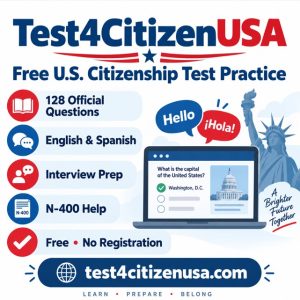
https://test4citizenusa.com/Test4CitizenUSA is a free online resource for adults preparing for U.S. naturalization. It includes practice with all 128 official civics questions in English and Spanish, citizenship interview preparation, and N-400 guidance. The resource is free to use, requires no registration, and is designed for independent study as well as use by adult education, ESL/ELL, literacy, and citizenship programs.
Access the resource: https://test4citizenusa.com/
Citizenship Test Practice: https://test4citizenusa.com/us-citizenship-test-2026
You must be logged in to download this resource. Register now if you don't have an account.
Abstract:
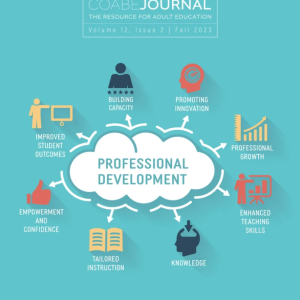
This reflection essay reports on a book reading inquiry circle (BRIC) on Paulo Freire’s Pedagogy of the Oppressed by English as a second language (ESL) faculty from a college located in the Greater Seattle area. Since professional development is usually not provided for ESL faculty in basic skills programs due to lack of funding at the institutional level, the instructors involved in this BRIC engaged in critical language pedagogy as professional development on a divisional level for an 11-week quarter. The ESL faculty engaged in robust conversations about issues regarding adult literacy. The goal of this group was to determine how a culturally responsive curriculum for adult basic skills students could be curated through deep critical reflections and active dialogues through Freirean philosophy of the oppressor and oppressed. The faculty involved in this BRIC shared their reflections on critical pedagogy, as well as culturally responsive teaching, and how it is reflected in their praxis. The BRIC created opportunities for colleagues to share what they are teaching in the classroom and would allow instructors in our division to include different perspectives and research practices to create culturally relevant curriculum for immigrant, refugee, and nontraditional students in basic skills programs.
You must be logged in to download this resource. Register now if you don't have an account.
Abstract:
Research shows that engaged and continuously developing teachers are more effective in the classroom. However, with a significant proportion of adult English as a second language (ESL) instructional staff consisting of adjunct faculty, it is crucial to address issues such as high turnover rates, feelings of isolation and marginalization, limited availability for PD due to transient schedules and multiple jobs, and insufficient funding for robust offerings. This article explores several best practices for overcoming those challenges—mini-conferences, professional development (PD) swaps, study groups, individualized faculty development plans, and leveraging technology for flexible and asynchronous options—and encourages other programs to adopt such PD initiatives to support and empower adjunct faculty.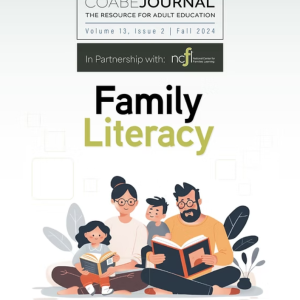
You must be logged in to download this resource. Register now if you don't have an account.
Abstract:
Maryland’s family literacy programs are built on a foundation of partnerships. Both Prince George’s Community College and Community College of Baltimore County have built strong family literacy programming through their partnerships with the Family Support Center of Prince George’s County and Baltimore County Public Schools. In Prince George’s County, community integration has taken place through a focus on workforce development as a key component in the family literacy adult education classes. In Baltimore County, the focus for family literacy students has been school integration. Student stories illustrate the importance of strategic community partnerships to create unified communities and a stronger, more skilled workforce in Maryland.
You must be logged in to download this resource. Register now if you don't have an account.
Abstract:
This article discusses how educators can bridge the digital divide for adult English language learners (ELLs) through mini-projects that are tied to family learning. These family motivated projects aim to boost learners’ English language proficiency and digital skills necessary for job readiness, and, most significantly, create stronger connections with their families. This article provides an overview of the learner demographics and programs at one nonprofit organization, the English Empowerment Center, and explains the key factors considered in designing the mini-projects. The authors discuss how the digital skills were chosen, common barriers to digital access, the importance of student motivation and digital resilience, and the role of weaving together multiple literacies. Examples of mini-projects focused on community and school connections are shared, along with outcomes related to digital skill development, family engagement, and learner confidence in supporting their children’s education.
You must be logged in to download this resource. Register now if you don't have an account.
Abstract:
This article describes an interdistrict collaborative project between a K–6 elementary school district and a 7–12 high school district’s adult school to provide ESL classes to family members of elementary school students on two elementary campuses during the school day. Program development required consideration of multiple factors, including security concerns, adult campus access, and technology access for faculty and adult students. The districts also developed a new recruitment and enrollment process to ensure adult students met the criteria for inclusion in the classes. Results from the first year of the project demonstrate that the ESL classes on the elementary campuses had higher attendance rates, higher measurable skills gains, and an overwhelmingly positive response from the districts, school sites, adult students, and the elementary school children of the adult students. This program is presented as a model for other districts and agencies to duplicate.
You must be logged in to download this resource. Register now if you don't have an account.
Abstract:
One of the largest family literacy providers in the Midwest shares a new initiative to bring the family literacy model to health care facilities as a means for providing families with deeper health literacy and language. The article details the early stages of program development, from codesign and deep-listening principles to the findings from the full program implementation. From these findings, we explore ways family literacy can bring important community conversations to the clinical space and inform future medical health literacy development.
You must be logged in to download this resource. Register now if you don't have an account.
Abstract:
Adult education has evolved from informal, oral traditions to structured programs that address the changing needs of society. This article traces its historical roots from early evening schools and trade education to modern community colleges and workforce development initiatives. It explores the relevance of adult learning through andragogical principles, emphasizing its problem-centered approach and immediate application. Finally, it highlights the profound impact of adult education, showcasing its role in personal growth, economic mobility, and community engagement.