
Download Resource
You must be logged in to download this resource. Register now if you don't have an account.
Abstract:
This interactive tool helps instructors diagnose classroom problems, think about possible causes, and explore solutions.
Resource URL
Publication Year
2015
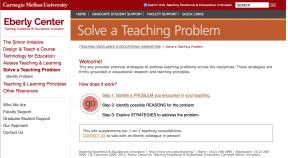
The Solve a Teaching Problem website walks users through a three-step process to identify strategies to address instructional problems in higher education. The strategies reflect sound learning principles and research.
Step 1: Identify a problem you encounter in your teaching. Users select a problem from a menu of problems under six categories:
- Attitudes & Motivation
- Prerequisite Knowledge & Preparedness
- Critical Thinking & Applying Knowledge
- Group Skills & Dynamics
- Classroom Behavior & Etiquette
- Grading & Assessment
- Students’ individual styles or personalities may inhibit their participation.
- Students’ cultural values and norms may inhibit their participation.
- Students may not have experience participating in discussions.
- The physical environment is not conducive to discussion.
- Help students to prepare in advance.
- Involve all students.
- Use groups.
- Reward participation.
What the experts say
This is such an interesting resource that targets discrete teaching/learning problems. While on the surface it appears to primarily for teaching/learning in postsecondary education, it addresses a wide range of problems that vex most adult educators: students who come late to class; students who don’t seek help when they need it; teaching in classrooms where there is wide variation in knowledge and skills; designing group work that really works; understanding why tests may be too hard for students, and on and on. Along with short statements and paragraphs that help frame problems and solution strategies are links to sample activities, examples of student work, original research papers, student success brochures throughout the website.
This resource is a practical, how-to guide for college instructors. It could be a stimulus to useful conversation about student needs and instructor strategies to meet those needs, in a professional development context such as a study circle. Although it focuses on college, much of it would be relevant to the needs of adult education students.
Resource Notice
This site includes links to information created by other public and private organizations. These links are provided for the user’s convenience. The U.S. Department of Education does not control or guarantee the accuracy, relevance, timeliness, or completeness of this non-ED information. The inclusion of these links is not intended to reflect their importance, nor is it intended to endorse views expressed, or products or services offered, on these non-ED sites.
Please note that privacy policies on non-ED sites may differ from ED’s privacy policy. When you visit lincs.ed.gov, no personal information is collected unless you choose to provide that information to us. We do not give, share, sell, or transfer any personal information to a third party. We recommend that you read the privacy policy of non-ED websites that you visit. We invite you to read our privacy policy.