
- Information and ideas on how to connect with new legislators
- Results from the COABE advocacy survey
- Information on the Student Ambassador Program and ways to engage your students
- Resources and examples of advocacy activities and events that can be replicated at the state and local level
- Opportunity to ask questions and share ideas
You must be logged in to download this resource. Register now if you don't have an account.
Abstract:
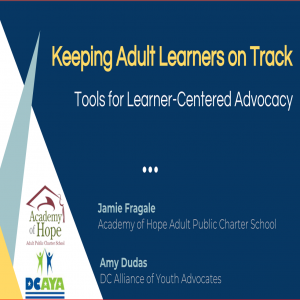
Adult learners face a number of barriers as they return to and attempt to remain in school. In Washington, DC, adult and alternative learners identified the high cost of transportation as one of those barriers and decided to do something about it. Over the course of three years, Academy of Hope Adult Public Charter School and the DC Alliance of Youth Advocates led a coalition of learners, volunteers and partners from across the city to build an evidence-based, inclusive, and learner-centered advocacy campaign that resulted in a $1.98 million per year investment in transportation subsidies for adult learners and alternative youth enrolled in school. Join us for a conversation about best practices for engaging adult and alternative learners in direct advocacy.
You must be logged in to download this resource. Register now if you don't have an account.
Abstract:
Every ten years, the US conducts a census which impacts the resources and representation your community receives in the years ahead. Come learn about current controversies around a census question and census delivery, planning underway, and how you can prepare yourself and your learners to be involved.
You must be logged in to download this resource. Register now if you don't have an account.
Abstract:
The Power of Partnerships: Adult Literacy and Libraries
You must be logged in to download this resource. Register now if you don't have an account.
Abstract:
The Open Door Collective (ODC) is dedicated to reshaping U.S. society to have dramatically less poverty and economic inequality and more civic engagement and participation in all our society has to offer. ODC is made up of professionals working in adult basic skills, social services and poverty reduction, who believe that adult basic skills and lifelong learning programs can open doors of opportunity to healthier, more prosperous and more satisfying lives. ODC members have expertise in connecting adult basic skills to healthcare, employment and training, corrections and family and social services. We advocate including adult basic skills, including English language, basic literacy, numeracy, high school equivalency, college readiness and technology skills as an integral part of a larger agenda of reducing poverty and income inequality, broadening social participation, and moving us closer to the kind of society in which we all want to live.
You must be logged in to download this resource. Register now if you don't have an account.
Abstract:
In this webinar session, the presenters provide an overview of the national Educate & Elevate campaign, including the current policy landscape. Presenters discuss recent election results and how changes in the House leadership may impact adult education. Additionally they share:
You must be logged in to download this resource. Register now if you don't have an account.
Abstract:
How to Fund a New Program Idea to Life! Participant Workbook. Document is in Word, so you can use or modify to suit your needs.
You must be logged in to download this resource. Register now if you don't have an account.
Abstract:
ROUND TABLE HANDOUT: Supporting ABE students’ academic success means advocating for institutional change beyond the borders of ABE programs. Our goal is to generate dialogue about the culture of ABE at our institutions to identify opportunities for student-centered initiatives that open college pathways for ABE students. Combined co-taught ABE and Dev. Ed. courses at TCC have broadened perspectives on student capacity, exposed assumptions and stereotypes, and created opportunities for acceleration.
You must be logged in to download this resource. Register now if you don't have an account.
Abstract:
The ability of adult learners to set and pursue lifelong learning goals is affected by a variety of policy decisions made at the federal, state, and local levels. This panel session provided information on the ways that such policy decisions can affect access to adult basic education and ESL; adult secondary education and high school equivalency; workforce skills training; postsecondary education; and family and community learning. Presenters were Judy Mortrude (Center for Law and Social Policy); Tracy Noles (National Center for Families Learning); Amanda Bergson-Shilcock (National Skills Coalition); and Michele Diecuch (ProLiteracy).