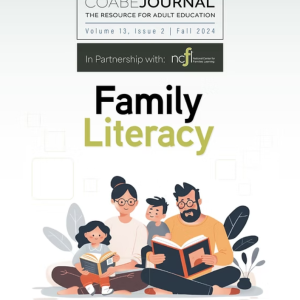
Volume 13, Issue 2 Fall 2024 What’s Missing From Adult Education?: Functional Literacy Skills and the Generational Cycle of Poverty
    Author: Christopher Richards
    Subject Area: Literacy, WIOA
    Program Level: COABE Journal
    Material Type: Journal
    Language: English
    License: (CC BY-NC-ND 4.0) For license summary click here

    Abstract:

    Adult education has changed tremendously over the past 20 years, with a deemphasis on core literacy skills. These changes have had a negative effect on family literacy and have changed the educational aims of adult programs, which are compelled to focus on workforce training and development. This reflection from an educator in the field who has witnessed the hardships faced by families struggling with basic literacy skills concludes with a call to action. Readers are encouraged to reach out to representatives and stakeholders to raise awareness about the importance of family literacy and basic literacy education.
    Volume 14, Issue 2 Fall 2025 Get the Facts on Adult Education
    Author: 2024–2025 Board of the National Association of State Directors of Adult Education
    Subject Area: Policy in Action, WIOA
    Program Level: COABE Journal
    Material Type: Journal
    Language: English
    License: (CC BY-NC-ND 4.0) For license summary click here

    Abstract:

    Every year, the National Association of State Directors of Adult Education (NASDAE) publishes fact sheets that showcase the performance of adult education programs. Nationally and for each state, these fact sheets display the scope of the services provided by the adult education programs, funded through the Workforce Innovation and Opportunity Act (WIOA) Title II federal and nonfederal matching funds. Performance for Program Year 2023–2024 is shown in the accompanying fact sheet and highlights are shared.
    Volume 14, Issue 2 Fall 2025 Indiana’s Integrated Education and Training Evolution
    Author: Lara Pastore; Marilyn Pitzulo
    Program Level: COABE Journal
    Material Type: Journal
    Language: English
    License: (CC BY-NC-ND 4.0) For license summary click here

    Abstract:

    For the past 15 years, Indiana has been undergoing an integrated education and training (IET) evolution. The inclusion of career training and certifications into the adult education framework has yielded economic benefits for Hoosier adults, employers, and communities. Indiana policy and legislation guided program implementation and expansion by codifying the dedication of 25% of all state and federal funding to this priority. Secondary feedback loops were established with education programs, training providers, employers, and workforce boards to inform continuous improvement and adjustments over the years. Using this information to increase completion and certification rates and refine training opportunities has improved student outcomes and certification availability. During the past 15 years, Indiana residents have earned more than 19,000 career certifications through the adult education system.
    SNAP E&T – Opportunities for Alignment with WIOA
    Author: David Kaz
    Subject Area: LINCS Resources, WIOA, Workforce
    Program Level: Professional Development
    Material Type: Collection
    Language: English
    License: (CC BY-NC-ND 4.0) For license summary click here

    Abstract:

    The brief presents an examination of the initial impact of the Workforce Innovation and Opportunity Act (WIOA) on state SNAP Employment and Training (E&T) programs.
    Author(s)
    David Kaz
    Author(s) Organizational Affiliation
    Seattle Jobs Initiative
    Publication Year
    2016
    Resource Type
    Product
    Number of Pages
    31
    Abstract
    Administered by the U.S. Department of Agriculture (USDA) Food and Nutrition Services (FNS), Supplemental Nutrition Assistance Program Employment and Training (SNAP E&T) is a federal program that supports employment and training activities and related supportive services to help SNAP participants advance to self-sufficiency. The brief presents an examination of the initial impact, if any, on States’ SNAP E&T programs of the passage of the Workforce Innovation and Opportunity Act (WIOA) and the opportunity it afforded States to develop new plans for their public workforce systems that align programs such as SNAP E&T with WIOA-supported core programs. It reviews State workforce plans that include SNAP E&T as a partner program. It also presents as a case study the approach of Tennessee, a state that has taken important steps to better align its growing SNAP E&T program with WIOA, both at a strategic and an operational level. Finally, the brief discusses the policies relevant to the alignment of WIOA and SNAP E&T as well as suggestions for integrating these programs in a way that is beneficial to the expansion of job-driven SNAP E&T programs.
    What the experts say
    For state or local adult education administrators, this resource adds to the growing body of work on SNAP E&T implementation strategies. The case study of Tennessee’s SNAP E&T program provides the most useful example to date of state adult serving systems developing an ongoing strategy for braiding SNAP E&T funds with education funds.  While the other states profiled in this report offer few details, the Tennessee example names specific roles for state agencies and local providers. Adult education has long served public benefits recipients but often without thought to aligning services or leveraging funding. Recent efforts by multiple states to align SNAP E&T services with education and workforce development services are enhancing services participants receive and building stronger relationships between organizations seeking to support individuals to economic self-sufficiency. The case studies are valuable in their descriptions of the complementary use of SNAP E&T and workforce development. Additionally, the section on moving forward proffers ideas that may better align WIOA and SNAP E&T program services including: planning and coordinating processes involving state human/social services and labor/workforce agencies; deepening partnerships between SNAP E&T and America’s Job Centers cross-referrals, common assessment, and alignment through sharing of data and data systems; expanding third-party partnerships; using career pathways as a framework for alignment; and seeking opportunities to better align through the coordination of non-core programs with WIOA programs (e.g., TANF, SNAP, etc.).
    Resource Notice
    This site includes links to information created by other public and private organizations. These links are provided for the user’s convenience. The U.S. Department of Education does not control or guarantee the accuracy, relevance, timeliness, or completeness of this non-ED information. The inclusion of these links is not intended to reflect their importance, nor is it intended to endorse views expressed, or products or services offered, on these non-ED sites. Please note that privacy policies on non-ED sites may differ from ED’s privacy policy. When you visit lincs.ed.gov, no personal information is collected unless you choose to provide that information to us. We do not give, share, sell, or transfer any personal information to a third party. We recommend that you read the privacy policy of non-ED websites that you visit. We invite you to read our privacy policy.
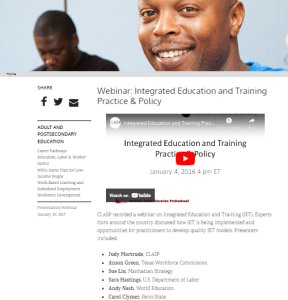
    CLASP Webinar: Integrated Education and Training Practice and Policy
    Author: Judy Mortrude, Anson Green, Sue Liu, Sara Hastings, Andy Nash, Carol Clymer, Blaire Toso, Amanda Bergson-Shilcock
    Program Level: Professional Development
    Material Type: Collection
    Language: English
    License: (CC BY-NC-ND 4.0) For license summary click here

    Abstract:

    This webinar recording features a panel of leading experts from around the country who discuss how IET models are being implemented and provide real examples of the opportunities (and lessons learned) for administrators and practitioners to develop quality IET models.
    Publication Year
    2016
    CLASP recorded a webinar on Integrated Education and Training (IET). Experts from around the country discussed how IET is being implemented and opportunities for practitioners to develop quality IET models.
    Benefits and Uses
    IETs are a core educational strategy for career pathways jointly developed between WIOA partners. This webinar highlights the many ways that states and individual programs have interpreted the definition and core elements of IETs and in turn used them to develop IETs as a strategy across all levels of service delivery in Title II of the Adult Education and Family Literacy Act (AEFLA). The panel, comprised of nationally recognized leaders in their field, provides easy-to-understand information starting with what an IET is to the ways data is collected and reported, and how partnerships can be formed.
    Resource Notice
    This site includes links to information created by other public and private organizations. These links are provided for the user’s convenience. The U.S. Department of Education does not control or guarantee the accuracy, relevance, timeliness, or completeness of this non-ED information. The inclusion of these links is not intended to reflect their importance, nor is it intended to endorse views expressed, or products or services offered, on these non-ED sites. Please note that privacy policies on non-ED sites may differ from ED’s privacy policy. When you visit lincs.ed.gov, no personal information is collected unless you choose to provide that information to us. We do not give, share, sell, or transfer any personal information to a third party. We recommend that you read the privacy policy of non-ED websites that you visit. We invite you to read our privacy policy.
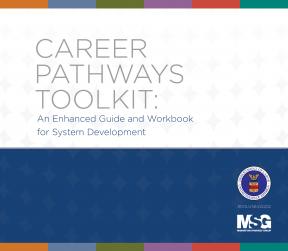
    Career Pathways Toolkit: An Enhanced Guide and Workbook for System Development
    Author: Bonnie Elsey, Laura Lanier, and Jessie Stadd
    Program Level: Professional Development
    Material Type: Collection
    Language: English
    License: (CC BY-NC-ND 4.0) For license summary click here

    Abstract:

    The newest revision to the Career Pathways Toolkits includes writeable worksheets that can help State and program teams develop, maintain, and enhance career pathways systems and programs.
    Publication Year
    2016
    The Department of Labor’s Employment and Training Administration (DOLETA) is excited to release the Career Pathways Toolkit: An Enhanced Guide and Workbook for System Development. The new Toolkit will be especially helpful for State offices and partners required to develop a Unified Plan as well as staff members supporting State Workforce Development Boards. DOLETA revised the Career Pathways Toolkit to align with the new vision, definition, and requirements of the Workforce Innovation and Opportunity Act (WIOA). It also reflects major advancements and emerging promising practices in the field over the past five years. The enhanced Toolkit features the Six Key Elements of Career Pathways. Each element now includes embedded – and writeable – worksheets to help State and local teams with implementation. Users can type directly into the worksheet fields and save and print as they go along.
    Benefits and Uses
    Under WIOA, which was signed into law in July 2014, States and localities collaborate with adult education, postsecondary education and other partners to establish career pathways systems to make it easier for all Americans to attain necessary skills and credentials to secure meaningful jobs in their regional economies. The Career Pathways Toolkit will help stakeholders develop more comprehensive and combined systems for workforce development.
    Resource Notice
    This site includes links to information created by other public and private organizations. These links are provided for the user’s convenience. The U.S. Department of Education does not control or guarantee the accuracy, relevance, timeliness, or completeness of this non-ED information. The inclusion of these links is not intended to reflect their importance, nor is it intended to endorse views expressed, or products or services offered, on these non-ED sites. Please note that privacy policies on non-ED sites may differ from ED’s privacy policy. When you visit lincs.ed.gov, no personal information is collected unless you choose to provide that information to us. We do not give, share, sell, or transfer any personal information to a third party. We recommend that you read the privacy policy of non-ED websites that you visit. We invite you to read our privacy policy.
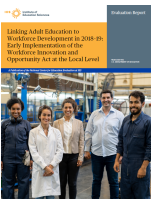
    Linking adult education to workforce development in 2018–19: Early implementation of the Workforce Innovation and Opportunity Act at the local level (NCEE 2023-001r)
    Author: Stephanie Cronen, Anne Diffenderffer, and Rebecca Medway
    Subject Area: LINCS Resources, WIOA, Workforce
    Program Level: Professional Development
    Material Type: Collection
    Language: English
    License: (CC BY-NC-ND 4.0) For license summary click here

    Abstract:

    This report from a national evaluation of Title II examines the extent to which local adult education providers' instructional approaches and coordination with other agencies in 2018–19 reflected the link between adult education and the overall workforce development system
    Publication Year
    2023
    Using WIOA Title II and Other Funding to Support Family Literacy Programming
    Author: Dr. Carol Clymer and Elizabeth Severson-Irby
    Subject Area: Literacy, WIOA
    Program Level: Adult Basic Education
    Language: English
    License: (CC BY-NC-ND 4.0) For license summary click here

    Abstract:

    Family literacy is a critical inter-generational strategy to help adult learners and their children build literacy and language skills. Its importance has been accentuated throughout the pandemic as students who are parents or caregivers dealt with the challenges of remote instruction. This webinar will examine how states are using their WIOA Title-II funding and other resources for family literacy programming. Original webinar date: September 14, 2022 Webinar recording link: https://youtu.be/JDKXIndIvoI