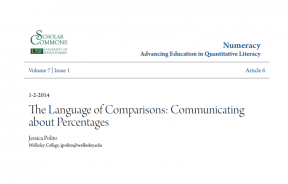
The Language of Comparisons: Communicating about Percentages
    Author: Jessica Polito
    Program Level: Professional Development
    Material Type: Collection
    Language: English
    License: (CC BY-NC-ND 4.0) For license summary click here

    Abstract:

    This paper describes an approach used to explicitly teach students how to analyze arguments based on comparisons of numbers and percentages, and how to write such comparisons with the necessary precision.
    Author(s)
    Jessica Polito
    Author(s) Organizational Affiliation
    Wellesley College
    Publication Year
    2014
    Resource Type
    Product
    Number of Pages
    15
    Abstract
    While comparisons between percentages or rates appear frequently in journalism and advertising, and are an essential component of quantitative writing, many students fail to understand precisely what percentages mean, and lack fluency with the language used for comparisons. After reviewing evidence demonstrating this weakness, this experience-based perspective lays out a framework for teaching the language of comparisons in a structured way, and illustrates it with several authentic examples that exemplify mistaken or misleading uses of such numbers. The framework includes three common types of erroneous or misleading quantitative writing: the missing comparison, where a key number is omitted; the apples-to-pineapples comparison, where two subtly incomparable rates are presented; and the implied fallacy, where an invalid quantitative conclusion is left of the reader to infer.
    What the experts say
    This article gives teachers much to think about in terms of truly understanding percentages as they relate to comparisons. The author does an exemplary job of showing where student and teachers weaknesses are in analyzing and interpreting data sets. Some discovery methods of teaching mathematics rely almost completely on what the student brings to class in terms of problem-solving abilities and mathematical knowledge. This method helps students develop the ability to analyze and apply mathematics in a way that will help them both in future math classes and in the world outside the classroom. The implications for instruction in this resource stretch beyond the lessons in data and communicating about percentages. The way these lessons are taught will strengthen student awareness of data, mathematics, and real world analysis.
    Resource Notice
    This site includes links to information created by other public and private organizations. These links are provided for the user’s convenience. The U.S. Department of Education does not control or guarantee the accuracy, relevance, timeliness, or completeness of this non-ED information. The inclusion of these links is not intended to reflect their importance, nor is it intended to endorse views expressed, or products or services offered, on these non-ED sites. Please note that privacy policies on non-ED sites may differ from ED’s privacy policy. When you visit lincs.ed.gov, no personal information is collected unless you choose to provide that information to us. We do not give, share, sell, or transfer any personal information to a third party. We recommend that you read the privacy policy of non-ED websites that you visit. We invite you to read our privacy policy.
    Readworks.org
    Author: ReadWorks
    Program Level: Professional Development
    Material Type: Collection
    Language: English
    License: (CC BY-NC-ND 4.0) For license summary click here

    Abstract:

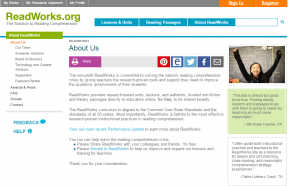
    ReadWorks is a non-profit organization which gives teachers the research-proven tools and support they need to improve the academic achievement of their students. The website provides lessons which are organized by skill and strategy units, comprehension units, and novel study units. Leveled non-fiction and literary reading passages are also provided. The ReadWorks materials are aligned to the Common Core State Standards (CCSS).  
    Benefits and Uses
    ReadWorks provides teachers with a large set of grade-level aligned complex literary and informational texts on a variety of topics. Many reading passages are accompanied by text-dependent questions, vocabulary student worksheets, and teacher notes. Each reading passage that comes with a question set identifies the specific CCSS encompassed in the activities. Reading passages are tagged by K-12 grade, Lexile level, subject domain, text types, and skill/strategy employed. Many of the reading passages are appropriate for adult education programs, and adult educators can use the Lexile information to select reading passages at an appropriate level for their learners. Teachers can use the resource to address College and Career Readiness (CCR) standards’ key advance one: regular practice with complex text and its academic language and key advance two: reading, writing, and speaking are grounded in evidence from text. Paired reading passages sets enable educators to select several reading passages on a topic or theme to address key advance three: building knowledge through content-rich nonfiction. Note: The site also provides lesson plans for grades K-6 which are aligned to the CCSS. The content of some of these lesson plans may not be appropriate for adult education students. ReadWorks might be used in the field of adult education to identify learning level appropriate texts and text-dependent tasks for classroom instructional use. The texts do not require any modification. Teachers can use text dependent questions and vocabulary resources as is or modify the text-dependent questions and develop writing prompts. The paired passages features may be used to build content knowedge in the classroom. Teachers would need to translate K-12 grade levels to their appropriate course level and review the grade-level CCSS to identify the CCR standards addressed by the materials. Professional developers could use the resource to prepare sample lessons using the text passages and questions. The reading passages are the most useful resources on the site. Users can use the filter functions to find appropriate texts for adult education students. The Text Type, Grade, and Lexile Level are all useful filters to find complex texts suitable for the learning level and content needs of adult education students. After opening a free account, users can download texts or save to “My Binder” for future access.  
    Resource Notice
    This site includes links to information created by other public and private organizations. These links are provided for the user’s convenience. The U.S. Department of Education does not control or guarantee the accuracy, relevance, timeliness, or completeness of this non-ED information. The inclusion of these links is not intended to reflect their importance, nor is it intended to endorse views expressed, or products or services offered, on these non-ED sites. Please note that privacy policies on non-ED sites may differ from ED’s privacy policy. When you visit lincs.ed.gov, no personal information is collected unless you choose to provide that information to us. We do not give, share, sell, or transfer any personal information to a third party. We recommend that you read the privacy policy of non-ED websites that you visit. We invite you to read our privacy policy.
    Guide to ELA Classroom Activities that Promote Life Skills, College and Career Readiness
    Author: World Education, Inc.
    Program Level: Professional Development
    Material Type: Collection
    Language: English
    License: (CC BY-NC-ND 4.0) For license summary click here

    Abstract:

    This guide provides suggested classroom tasks that combine the academic knowledge and skills described by the College and Career Readiness Standards for Adult Education with behaviors and composite skills needed to succeed in college, workplace, and civic life (essential competencies).
    Publication Year
    2014
    The Guide to ELA Classroom Activities that Promote Life Skills, College and Career Readiness was produced by World Education. It builds on a previous publication (The Life skills, College and Career Readiness Guide for ESOL Learners, October 2011).  The guide “provides suggested classroom tasks that combine the academic knowledge and skills described by the College and Career Readiness Standards for Adult Education…with behaviors and composite skills needed to succeed in college, workplace, and civic life, expressed here as Essential Competencies.” Seven Essential Competencies required to succeed in the college, workplace, and civic life are identified.  Based on the seven Essential Competencies, the Guide further defines a series of Tier One instructional tasks appropriate for 0-8 GLE, NRS low-high ABE, and college and career readiness standards (CCR) A-D and Tier Two instructional tasks appropriate for 9-12 GLE, NRS ASE, and CCR D-E. These instructional tasks are focused on three goals: (1) meeting life skills; (2) promoting college readiness; and (3) promoting career readiness. The Essential Competencies drive the instructional tasks. A cross-reference is provided between the Tier One instructional tasks and the applicable CCR English language arts/literacy (ELA/Literacy) Anchor Standards. The Guide also includes a set of lesson plans illustrating how a Tier One task is facilitated across several class sessions as well as a sample Tier Two project that culminates in short essays and class presentations.
    What the experts say
    The resource is intended for an adult educator audience. The resource contains instructional tasks that can be implemented in the adult education classroom. These instructional tasks are focused on three goals directly related to adult education students: (1) meeting life skills; (2) promoting college readiness; and (3) promoting career readiness. Educators might use this resource to support CCR standards-aligned teaching that integrates life and workplace skills development. It is a good ‘beginner’ resource that shows educators how to think about the CCR standards for ELA/Literacy in relation to classroom activities with which they may be familiar. While the resource lacks details about the three key advances inherent in the CCR ELA/Literacy standards, it shows adult educators how to re-conceptualize their teaching and classrooms in light of the CCR standards. It provides ideas for integrating Essential Competencies and the CCR standards at various bands of learning. It could be useful for showing educators how to start the process of bringing the key advances in instructional practice into their classrooms and lesson planning and employ transitional activities in their classrooms. To supplement and further enhance the resource, it would be beneficial for users to pair examples of level-appropriate complex texts with text-dependent tasks that support building coherent bodies of knowledge The tables of Tier One Tasks (pp. 13-17) and Tier Two Tasks (pp. 18-20). Tier One Tasks “require that students apply several CCR standards to achieve a focused, short-term outcome, such as writing a set of notes or a one-paragraph summary of an at-level text. Some of these tasks might also require real-world applications, such as actually entering work places or college campuses to observe classes, conduct interviews, or shadow jobs.” (Tier One Tasks relate to 0-8 GLE; NRS low-high ABE; and CCR A-D.) Tier Two Tasks are “project-based and designed to culminate in sophisticated products such as argumentative essays, reports, and/or slide presentations.”  A cross-reference is not explicitly made to CCR standards in the Tier Two Tasks. (The document states that nearly all standards will come into play.) (Tier Two Tasks relate to 9-12 GLE; NRS ASE; and CCR D-E.) These tables and examples provide teachers with a set of guides and ideas that serve as an excellent starting point for standards and life skills integration. The text resources required to complete the indicated tasks are not suggested. Thus, teachers would also need to find and apply learning-level appropriate texts to each of the tasks. This extra step, however, would help move the resource from a focus on skills development to a focus on literacy development. The sample units provided on pages 23 and 29 are also useful tools for educators. The two sample tasks, both centering on the US Constitution and Bill of Rights, show how complex text can be used with students at different levels.
    Resource Notice
    This site includes links to information created by other public and private organizations. These links are provided for the user’s convenience. The U.S. Department of Education does not control or guarantee the accuracy, relevance, timeliness, or completeness of this non-ED information. The inclusion of these links is not intended to reflect their importance, nor is it intended to endorse views expressed, or products or services offered, on these non-ED sites. Please note that privacy policies on non-ED sites may differ from ED’s privacy policy. When you visit lincs.ed.gov, no personal information is collected unless you choose to provide that information to us. We do not give, share, sell, or transfer any personal information to a third party. We recommend that you read the privacy policy of non-ED websites that you visit. We invite you to read our privacy policy.
    BC Reads: Adult Literacy Fundamental English – Course Pack 6
    Author: Shantel Ivits
    Program Level: Professional Development
    Material Type: Collection
    Language: English
    License: (CC BY-NC-ND 4.0) For license summary click here

    Abstract:

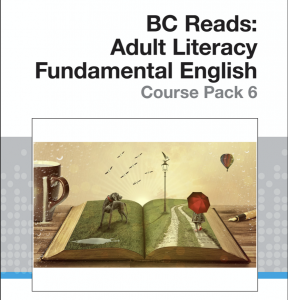
    This course pack embeds fundamental English and computer literacy learning in a project-based curriculum that is designed to meet adult education learning outcomes that are roughly equivalent to grades 7.5 to 9 in the K-12 system.
    Publication Year
    2015
    This course pack is part of the BC Open Textbook project.  BC Reads: Adult Literacy Fundamental English – Course Pack 6 embeds fundamental English and computer literacy learning in a project-based curriculum. Course Pack 6 provides activities to promote adult literacy skill acquisition as learners create their own digital story. The pack includes links to 11 level-appropriate texts and learning videos that support the learner's literacy development and engages them in relevant readings and examples of storytelling.  BC Reads: Adult Literacy Fundamental English – Course Pack 6 highlights the use of graphic organizers to help learners organize their thinking and writing.  It also includes activities that introduce and help learners use digital skills as a part of the process of creating their digital story (e.g., using the computer to find information, adding audio or images, storing folders on a computer). The course pack is designed to meet the learning outcomes for Adult Literacy Fundamental English Level 6, as outlined in the ABE in BC 2014/2015 Articulation Handbook, which is roughly equivalent to grades 7.5 to 9 in the K-12 system. The course pack contains:
    • Pre-reading questions that can be used for individual reflection, journaling, or class discussion.
    • Vocabulary-building exercises
    • Word attack strategies
    • Comprehension questions
    • Grammar lessons and practice exercises
    • Writing tasks
    The appendices feature the following tools:
    • Graphic organizers
    • Digital story progress sheet
    • Paragraph writing checklist
    • Level 6 scope and sequence
    What the experts say
    This multilayered, multilevel resource offers adults at many levels of literacy and language ability an opportunity to learn how to develop their own stories in digital format. It also provides an opportunity to gain or strengthen their existing skills to use language in face-to-face and electronic settings to communicate deep truths, and/or simply to strengthen their abilities to use language in ways they determine to be important and useful. Due to time constraints, adult education teachers in the U.S. probably should not implement it in their classrooms in its present form. Rather, BC Reads should be included as a resource as a well-crafted example for curriculum designers of how to organize and deliver project-based learning. Given the presence of trauma in the lives of many adult learners, some learners may attempt to tell personal stories that are very painful and psychologically damaging to recount. The authors of the resource are aware of this risk, and there is mention that learners should avoid such stories. Yet, at least two of the exemplar personal videos in the resource deal with traumatic events.
    Resource Notice
    This site includes links to information created by other public and private organizations. These links are provided for the user’s convenience. The U.S. Department of Education does not control or guarantee the accuracy, relevance, timeliness, or completeness of this non-ED information. The inclusion of these links is not intended to reflect their importance, nor is it intended to endorse views expressed, or products or services offered, on these non-ED sites. Please note that privacy policies on non-ED sites may differ from ED’s privacy policy. When you visit lincs.ed.gov, no personal information is collected unless you choose to provide that information to us. We do not give, share, sell, or transfer any personal information to a third party. We recommend that you read the privacy policy of non-ED websites that you visit. We invite you to read our privacy policy.
    Author: Student Achievement Partners
    Program Level: Professional Development
    Material Type: Collection
    Language: English
    License: (CC BY-NC-ND 4.0) For license summary click here

    Abstract:

    Achievethecore.org is a Student Achievement Partners website full of content designed to help educators understand and implement the Common Core State Standards (CCSS) and other college and career ready (CCR) standards
    Publication Year
    2015
    Achievethecore.org is a Student Achievement Partners website full of content designed to help educators understand and implement the Common Core State Standards (CCSS) and other college and career ready (CCR) standards. Many of the resources are applicable to adult educators and seven resources in particular have been selected. All seven resources help adult educators address CCR standards’ Key Advance One (regular practice with complex text and its academic language), Key Advance 2 (reading, writing, and speaking are grounded in evidence from text), and Key Advance 3 (building knowledge).
    1. Text Complexity Collection: http://achievethecore.org/page/642/text-complexity-collection
    2. Academic Word Finder (AWF): http://achievethecore.org/academic-word-finder
    3. Annotated-Mini Assessments: http://achievethecore.org/dashboard/300/search/1/1/0/1/2/3/4/5/6/7/8/9/10/11/12/page/1035/annotated-mini-assessments-list-pg
    4. Text Set Project: http://achievethecore.org/page/1112/text-set-project-building-knowledge-and-vocabulary
    5. Fluency Packet for the 9-10 Grade Band: http://achievethecore.org/page/1022/fluency-packet-for-the-9-10-grade-band
    Benefits and Uses
    Achieve the Core has a wealth of resources which support College and Career Ready (CCR) standards-based instruction. These specific resources represent a selection of tools and information that are particularly relevant for adult education.
    • Key Advance One: Text complexity collection and Academic Word Finder
    • Key Advances One and Two: Mini-assessments
    • Key Advance Three: Text set project
    • Reading and foundational skills: 9-10th grade fluency packet
    The text complexity collection focuses on measuring and describing the complexity of instructional texts, and meeting the demands of Key Advance One.  It provides all of the tools and resources available to understand and successfully address text complexity. Some of the resources directly refer to K-12 grades, but still hold some value for adult educators. The Academic Word Finder is designed to build the capacity of teachers and students alike to identify, understand, and effectively use academic vocabulary (tier two vocabulary) in complex text. This tool supports teachers and students to use level-appropriate complex texts in their lessons. The mini-assessments showcase sample assessments that illustrate the instructional shifts required by CCR standards for English language arts/literacy. “These mini-assessments are designed for teachers to use either in the classroom, for self-study, or in professional development settings.”  They demonstrate text-dependent questions which require close reading of texts. The text set project is designed to build students’ knowledge through reading a variety of literary and information texts at varying Lexile levels. The supplemental materials provided in each text set, such as the rolling vocabulary journal, glossary, and “learning worth remembering” graphic organizer allow students to compare texts, understand the main idea of text, and find the deeper meaning in words, sentence structure, and phrases. In the 9-10th grade fluency packet, students are tasked with repetitiously reading passages of a similar genre. Students exercise their ability to understand spoken word, decode and employ phonics, and read with accuracy. The vocabulary and checking for understanding at the end of the passage reinforces the idea that students should still be able to comprehend what they have read. The text complexity collection presents resources that provide the background information on why text complexity is important, how to measure and assess complex texts, and how to use them in the classroom. The tools can be used to verify that texts used for instruction are appropriately complex. The primary audience for this resource is teachers who are responsible for providing instruction aligned to CCR standards. The resource would also find an audience with professional developers responsible for teaching instructors how to implement CCR standards. Some adult educators will be familiar with the qualitative and quantitative text complexity tools, for example, those who have used The Instructional Advances in English Language Arts/Literacy online resources. However, these supplemental resources encourage adult educators to dive more deeply into text complexity and all its facets. The Academic Word Finder supports the tools available in the text complexity collection. It is not intended to “replace teacher judgment; rather it helps to support the teacher and identify the most useful academic words” in texts they are teaching. The primary target audience is practicing classroom teachers and those who support classroom instruction in adult education programs. Curriculum developers and publishers may also find this a useful tool for planning purposes. The mini-assessments are designed for teachers to use in the classroom, for self-learning, or in professional development settings. The assessments can be used immediately by adult educators and serve as models for the selection and analysis of complex texts and the development of related assessments.  The assessments offer an opportunity for students to do a close reading in a way that simulates a standardized testing experience. They are also useful for instructors to be able to see how well their students do with CCR standards aligned texts and tasks that are designed as a test simulation. No adaptation of these materials is needed. Some texts, however, may not be appropriate for adult education students. The mini-assessments for grades 6-12 are probably the most relevant for adults. Text sets are designed for teachers who are responsible for providing instruction aligned to CCR standards. Each text set centers on a single topic and includes a variety of sources including books, articles, videos, websites, infographics. The sets include suggested activities which build content knowledge and vocabulary and assess students’ comprehension. The fluency packets work to increase student fluency. The fluency packets can be used as supplemental materials, intervention work, homework assignments, or direct instruction. Each fluency packet includes high-quality texts, a focus on vocabulary, and comprehension questions. The text complexity collection provides a thorough and complete explanation of all aspects of text complexity. The quantitative and qualitative tools for text complexity as well as the research on text complexity are all helpful features of the resource.  The quick reference chart and guide to online complexity tools along with the qualitative scales are all extremely useful. This is a valuable selection of resources because text complexity is such a key component of implementing the CCR standards. The Academic Word Finder (AWF) itself is a very useful instructional tool. After opening a free account, users can upload texts to the AWF which then highlights the most useful academic vocabulary words from a given text. The tool identifies below, at, and above learning level tier two words and includes definitions for various contextual meanings and parts of speech. Learning levels are associated with k-12 grade levels, and adult educators will need to choose the corresponding CCR level. The quantitative assessment tool and AWF, used together, establish the quantitative complexity and corresponding CCR level of a text, and the academic vocabulary below, at, and above the CCR level. The text sets and fluency packets for higher grade levels will be most applicable for adult students.

    Resource Notice
    This site includes links to information created by other public and private organizations. These links are provided for the user’s convenience. The U.S. Department of Education does not control or guarantee the accuracy, relevance, timeliness, or completeness of this non-ED information. The inclusion of these links is not intended to reflect their importance, nor is it intended to endorse views expressed, or products or services offered, on these non-ED sites. Please note that privacy policies on non-ED sites may differ from ED’s privacy policy. When you visit lincs.ed.gov, no personal information is collected unless you choose to provide that information to us. We do not give, share, sell, or transfer any personal information to a third party. We recommend that you read the privacy policy of non-ED websites that you visit. We invite you to read our privacy policy.
    Teaching the Core
    Author: Teachingthecore.org
    Program Level: Professional Development
    Material Type: Collection
    Language: English
    License: (CC BY-NC-ND 4.0) For license summary click here

    Abstract:

    A collection of classroom videos and associated lesson materials to implement the instructional shifts required by the Common Core State Standards.
    Publication Year
    2016
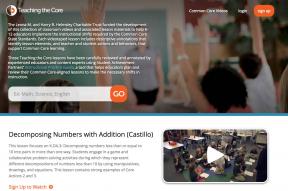
    The Leona M. and Harry B. Helmsley Charitable Trust funded the development of this collection of classroom videos and associated lesson materials to help K-12 educators implement the instructional shifts required by the Common Core State Standards. Each videotaped lesson includes descriptive annotations that identify lesson elements, and teacher and student actions and behaviors, that support Common Core learning. These Teaching the Core lessons have been carefully reviewed and annotated by experienced educators and content experts using Student Achievement Partners’ Instructional Practice Guide, a tool that helps educators plan and review their Common Core-aligned lessons to make the necessary shifts in instruction.
    Benefits and Uses
    The Teaching the Core video lessons demonstrate standards-based instruction at different grade levels. After opening a free account, use the search feature to find videos by subject and/or grade level. Each video is accompanied by a teacher interview, lesson plan, instructional materials, and student work. The lessons are K-12, so some adjustments and contextualization would need to be made for adult learners. The higher grade levels will be most appropriate for adult educators. Use the Teaching the Core videos for independent study or as part of a professional learning community or professional development program. The most useful feature of the actual videos is the timestamp feature, which allows viewers to go to certain sections of each video and watch for specific teacher and student moves. You may find the following ELA Teaching the Core videos very helpful: “Author’s Message with Multiple Texts” (10th grade) http://www.teachingthecore.org/view/51 and “Connotation & Exile” (9th grade) http://www.teachingthecore.org/view/20.
    Resource Notice
    This site includes links to information created by other public and private organizations. These links are provided for the user’s convenience. The U.S. Department of Education does not control or guarantee the accuracy, relevance, timeliness, or completeness of this non-ED information. The inclusion of these links is not intended to reflect their importance, nor is it intended to endorse views expressed, or products or services offered, on these non-ED sites. Please note that privacy policies on non-ED sites may differ from ED’s privacy policy. When you visit lincs.ed.gov, no personal information is collected unless you choose to provide that information to us. We do not give, share, sell, or transfer any personal information to a third party. We recommend that you read the privacy policy of non-ED websites that you visit. We invite you to read our privacy policy.
    Standards-in-Action: English Language Arts/Literacy Foundational Units to Fulfill the Instructional Shifts
    Author: StandardsWork, Inc.
    Program Level: Professional Development
    Material Type: Collection
    Language: English
    License: (CC BY-NC-ND 4.0) For license summary click here

    Abstract:

    These foundational-level Standards-in-Action (SIA) resources and professional development provide educators with practical knowledge about the key shifts in instruction required to align with college and career readiness standards in English language arts (ELA)/literacy.
    Author(s)
    StandardsWork, Inc.
    Author(s) Organizational Affiliation
    StandardsWork, Inc.
    Publication Year
    2016
    Resource Type
    Informational Material
    Abstract
    The College and Career Readiness (CCR) Standards ELA/Literacy Foundational Units 1-4 were produced by StandardsWork Inc. as part of the Implementing CCR Standards in Adult Education project, under contract to the U.S. Department of Education (Contract # ED-VAE-13-C-0066). The activities that make up Units 1 – 4 will help participants explore what it means to implement CCR standards for ELA/literacy in adult education. Participants will receive a practical and transferable understanding of the fundamental shifts in instruction embedded in CCR standards—including in your state standards—crucial to preparing adult students to meet the real-world demands of college and careers. At the heart of the instructional shifts is carefully examining the texts that students read and the questions students should address as they write and speak about them.
    • Foundational Unit 1 Connecting CCR Standards to Key Advances explores the fundamental elements, structure, and meaning of the CCR standards.
    • Foundational Unit 2 Selecting Texts Worth Reading introduces text complexity, its central role in the CCR standards, and the complex texts students need to read.
    • Foundational Unit 3, Identifying Questions Worth Answering focuses on the value of building students’ ability to draw evidence from texts and teachers’ ability to use text-based questions.
    • Foundational Unit 4 Creating High-Quality Prompts teaches instructors how to build a culminating writing assignment that assesses student knowledge.
    Each ready-to-use unit includes a facilitator’s guide, an annotated PowerPoint presentation, and participant materials. While training is not required before using this resource, fundamental awareness of the CCR standards for ELA/literacy is recommended. Experienced SIA trainers are available to provide this training to states and programs. For more information, please email the LINCS Technical Assistance Center at training@lincs.ed.gov.
    Benefits and Uses
    This resource supports state and program efforts to implement adult education content standards aligned with college and career readiness to support rigorous and high-quality instruction. Usage of the ELA/Literacy Foundational Units 1-4 will strengthen the capacity of adult educators to implement CCR standards to better prepare adult students for success in college and careers. These activities provide the field with opportunities to dig into the CCR standards and explore what it means to adopt CCR-aligned standards in classrooms and how to do so sustainably. Understanding how CCR standards differ from previous sets of standards—and the necessary shifts or advances they call for—is essential to implementing CCR standards well. Engagement in these four units of activities will enable adult educators to identify the most significant elements of CCR standards for ELA/literacy and to determine how best to integrate them into instruction and curriculum. The goal of Units 1 - 4 is for participants to leave with specific ideas, resources, and actions they can implement immediately. Designed primarily for group use, these units also support independent study. The four units should be worked through sequentially. The units can be facilitated during a single daylong training or multiple trainings over several weeks or months. Each ready-to-use unit contains all the materials required to facilitate these training activities, including a facilitator’s guide, an annotated PowerPoint Presentation, and a packet of participant materials. The participant materials include directions, charts, worksheets, answer keys, and other resource materials that guide the use of each unit. The PowerPoint presentations are a digital aid for presenters/facilitators who lead CCR ELA/literacy training activities. Notes are provided within the PowerPoint presentations to help you prepare for each session. This information accompanies the information offered in the facilitator guides—including the research base, rationale, advice, and other guidelines—to provide the support and guidance you may require.
    Resource Notice
    This site includes links to information created by other public and private organizations. These links are provided for the user’s convenience. The U.S. Department of Education does not control or guarantee the accuracy, relevance, timeliness, or completeness of this non-ED information. The inclusion of these links is not intended to reflect their importance, nor is it intended to endorse views expressed, or products or services offered, on these non-ED sites. Please note that privacy policies on non-ED sites may differ from ED’s privacy policy. When you visit lincs.ed.gov, no personal information is collected unless you choose to provide that information to us. We do not give, share, sell, or transfer any personal information to a third party. We recommend that you read the privacy policy of non-ED websites that you visit. We invite you to read our privacy policy.
    Purdue Online Writing Lab (OWL)
    Author: Purdue University
    Subject Area: ESL/ELL, LINCS Resources, Writing
    Program Level: Professional Development
    Material Type: Collection
    Language: English
    License: (CC BY-NC-ND 4.0) For license summary click here

    Abstract:

    The Online Writing Lab (OWL) at Purdue University houses writing resources and instructional material, which teachers and trainers may use for in-class and out-of-class instruction.
    Publication Year
    2016
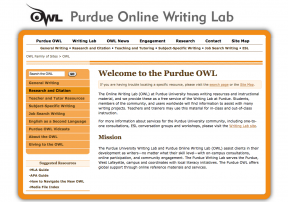
    The Online Writing Lab (OWL) website was developed at Purdue University as a free service of the Writing Lab at Purdue.  OWL houses writing resources and instructional material. Students—no matter their skill level— and members of the education community will find information to assist with many writing projects. Teachers and trainers may use this material for in-class and out-of-class instruction. The site is organized into the following sections:
    • General Writing
    • Research and Citation
    • Teacher and Tutor Resources
    • Subject-Specific Writing
    • Job Search Writing
    • English as a Second Language
    • Purdue OWL Video-casts
    Benefits and Uses
    OWL is a collection of resources that support writing instruction created for college-aged students—no matter their skill level—and their instructors and tutors. These materials are relevant to ABE and ESL students and relatively simple to adapt for the purposes of adult educators. OWL resources support instruction aligned to College and Career Readiness (CCR) Standards for writing and language, though CCR standards are not specifically named. For example, the sections on academic writing address expository, argumentative, and narrative writing—CCR Writing Standards 1-3.  The resources also support development of the writing process—CCR Writing Standard 5; the need for evidence to support claims—CCR Writing Standard 9 and Key Advance 2; and correct methods for citing resources—CCR Writing Standard 8. Conducting research is also addressed—CCR Writing Standard 7 as are mechanics, punctuation, and grammar—CCR Language Standards 1-2. OWL provides writing resources and instructional materials to support students as well as educators.  Resources present clear guidelines and expectations for academic writing. Teachers can use the site’s resources to develop lessons, assignments, and classroom resources. Students will find hands-on exercises and printable resources that support their continuing development as writers. OWL provides a wealth of materials that address a variety of topics about writing, topics that are also addressed by CCR writing and language standards. The site is well-organized by topics and subtopics. The Site Map provides a good overview of the site’s scope and sequence.  
    Resource Notice
    This site includes links to information created by other public and private organizations. These links are provided for the user’s convenience. The U.S. Department of Education does not control or guarantee the accuracy, relevance, timeliness, or completeness of this non-ED information. The inclusion of these links is not intended to reflect their importance, nor is it intended to endorse views expressed, or products or services offered, on these non-ED sites. Please note that privacy policies on non-ED sites may differ from ED’s privacy policy. When you visit lincs.ed.gov, no personal information is collected unless you choose to provide that information to us. We do not give, share, sell, or transfer any personal information to a third party. We recommend that you read the privacy policy of non-ED websites that you visit. We invite you to read our privacy policy.