

You must be logged in to download this resource. Register now if you don't have an account.
You must be logged in to download this resource. Register now if you don't have an account.
Abstract:
ROUND TABLE HANDOUT: Supporting ABE students’ academic success means advocating for institutional change beyond the borders of ABE programs. Our goal is to generate dialogue about the culture of ABE at our institutions to identify opportunities for student-centered initiatives that open college pathways for ABE students. Combined co-taught ABE and Dev. Ed. courses at TCC have broadened perspectives on student capacity, exposed assumptions and stereotypes, and created opportunities for acceleration.
You must be logged in to download this resource. Register now if you don't have an account.
Abstract:
"Hard skills" are important to getting a job. "Soft skills" are important for keeping a job. We can help our students qualify for and retain jobs with family sustaining incomes if we help them improve their soft, work readiness skills. The primary focus of this session is to explore a wealth of resources, strategies, and activities for infusing soft skills into your ABE, ESL, GED®, and AHS classrooms. Many of these resources have been developed by your colleagues in other states.
You must be logged in to download this resource. Register now if you don't have an account.
Abstract:
Students are open to making sense in a reading/writing classroom. Most people expect that reading/writing classrooms involve student interpretation and explanation of texts. In math classrooms, though, students often just want us to show us how to do it. They want teachers to do the interpreting and explaining, and we need to give that power back to them. With these materials, we explore how to translate a literacy frame for sense-making into our math classes. We’ll consider: How can we harness students’ background knowledge and observations to build a collective understanding before our first calculation? How do we promote close reading of a mathematical text? How do we engage students who move quickly, while supporting students who need more time? Our workshop is for anyone who believes math should make sense both to ourselves and to our students. All workshop materials can be found at bit.ly/COABE2018CUNY
You must be logged in to download this resource. Register now if you don't have an account.
Abstract:
This session showcases the resources CASAS offers - many at no cost - which help agencies implement quality ABE/ESL programs with standardized accountability measures. The CASAS framework assists programs to assess, instruct and track youth and adult student's progress from beginning literacy through transition to post-secondary and the workforce.
You must be logged in to download this resource. Register now if you don't have an account.
Abstract:
This extensive lesson plan is accompanied by a course outline for an additional 11 units. The unit explores introductory-level jobs that can lead to future advancement. The starting position presented in the first lesson plan is Customer Service Clerk at a Supermarket. The job description is presented and reviewed by Learners, accompanying vocabulary assists in their understanding of the job and the expectations for the worker. Practice dialogues, role plays, application and interview exercises are also suggested as additional activities. Twenty-six (26) "cue" statements are provided to assist the Learner in understanding the new vocabulary along with a Customer Service Job Description from Hannaford Supermarkets who assisted the author in researching this lesson plan. Twelve (12) potential interview questions are also listed that can be used with the Learners in preparation for a supermarket interview. ATTACHMENTS: STOTT LV ESoL LessonPln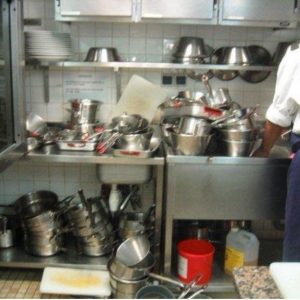
You must be logged in to download this resource. Register now if you don't have an account.
Abstract:
This entry is a four-lesson plan unit designed to assist a Learner understand the tasks and responsibilities of an entry-level restaurant position such as dishwasher. The scenario for these lessons takes place at a restaurant with the Learner gaining knowledge about the physical layout and organization of a restaurant (#1), equipment in a basic restaurant kitchen (#2), specific tasks of a restaurant dishwasher (#3), and the special vocabulary of a restaurant worker (#4). The lessons contain activity suggestions, large vocabulary lists, and discussion questions. ATTACHMENTS: WING Dishwasher Lesson Plans
You must be logged in to download this resource. Register now if you don't have an account.
Abstract:
This lesson plan is for a segment of a session spent with a workplace literacy student. See full curriculum at: http://adultresource.coabe.org/resources/workplace-literacy-curriculum This is a sample lesson plan of activities to help ESOL students prepare for entry-level jobs in our community. Pick and choose activities suitable to your student's goals and skills. These activities are designed to be adaptable to varying levels and easily modifiable to fit your unique student's skills. Start off each meeting by talking with your student, informally determining how much of the previous meeting they recall and what they want out of that day's meeting. This is also a chance to practice and assess your student's greetings and small talk skills, critical components of getting along with coworkers. This informal chit-chat- could take anywhere from 5-10 minutes of a one hour meeting. Each meeting might include two to four topics and should incorporate a variety of activities to develop the student's reading, speaking, and listening skills in English. Be aware that some activities may be tiring because of the amount of language included. It is okay to cover a topic repeatedly for shorter periods of time, ensuring long-term comprehension. Unfortunately some activities are straight memorization and cannot be made as engaging as other topics. Be aware of your student's engagement level and fatigue. If you are having success with an activity, do not feel like you need to stop after a given amount of time. An engaged and happy student will be a better learner! Basic Materials that may be useful in addition to materials for activities: whiteboard with markers, notebook to take notes during your lesson and to store lesson plans for planning future sessions, index cards (covered in contact paper to preserve them for regular use), baggies, sharpies