New Models for Distance Classes in Adult Education
    Author: Jerome Johnston, Sheryl Hart, Destiny Long, and Jen Vanek
    Program Level: Professional Development
    Material Type: Collection
    Language: English
    License: (CC BY-NC-ND 4.0) For license summary click here

    Abstract:

    This guide describes the classes of a number of distance education teachers who have adjusted their courses to incorporate college and career ready skills, enriching the online experience for students.
    Publication Year
    2015
    This guide describes the classes of a number of career readiness-focused teachers with the hope that they can inspire others to examine their distance teaching practices and offer a richer experience for their students. This resource is divided into two parts. The first consists of a collection of short vignettes describing the "classes" of a number of these teachers. In most of the vignettes, teachers have used one or more electronic tools to enable them to offer a richer classroom experience. The second part of the guide describes the tools in a bit more detail, providing an easy way for teachers to learn about the tools that they might use in their own classes. The guide organizes and explores tools in four categories: academic skill-building tools, communication tools, productivity tools, and LMS & website builders.
    What the experts say
    This is a valuable resource for educators looking to implement promising practices and to deploy innovative tools of technology in their adult classrooms. This resource also adds to the stack of tools growing the research base for technology as a way of expanding access to educational programming, and to legitimizing distance education as a meaningful platform for adult learning. It may help adult education instructors teaching distance classes to rethink and revise their methods in the classroom. Adult basic skills (including English language) teachers and program managers who offer, or are interested in offering, their students distance education or blended learning will find this practical guide of great help. In it they can read about what other adult basic skills teachers and programs are doing with distance education and blended learning, and they can find useful tools for doing it.
    Resource Notice
    This site includes links to information created by other public and private organizations. These links are provided for the user’s convenience. The U.S. Department of Education does not control or guarantee the accuracy, relevance, timeliness, or completeness of this non-ED information. The inclusion of these links is not intended to reflect their importance, nor is it intended to endorse views expressed, or products or services offered, on these non-ED sites. Please note that privacy policies on non-ED sites may differ from ED’s privacy policy. When you visit lincs.ed.gov, no personal information is collected unless you choose to provide that information to us. We do not give, share, sell, or transfer any personal information to a third party. We recommend that you read the privacy policy of non-ED websites that you visit. We invite you to read our privacy policy.
    Meeting the Language Needs of Today’s Adult English Language Learner: Issue Brief
    Author: Betsy Parrish
    Subject Area: ESL/ELL, LINCS Resources
    Program Level: Professional Development
    Material Type: Collection
    Language: English
    License: (CC BY-NC-ND 4.0) For license summary click here

    Abstract:

    This issue brief, one of the resources in the suite of materials “Meeting the Language Needs of Today’s Adult English Language Learner,” presents an overview of the need for increased rigor in all English language acquisition programs.
    Publication Year
    2015
    This Issue Brief seeks to address the gaps that exist between what is offered in adult English language acquisition (ELA) programming with regard to academic and work readiness (academic language, analytical and reasoning skills, organizational skills, strong oral and written communication skills) and the expectations in employment and postsecondary training. Increased demands are reflected in the College and Career Readiness Standards (CCRS), which represent the real-world demands of postsecondary training and employment, as well as in the Workforce Innovation and Opportunity Act (WIOA). This Brief provides an overview of current research and practice.  It draws from current scholarship, highlights issues in the topic and provides an update to adult educators as well as to other relevant audiences, such as government representatives, policymakers and researchers. Although the Brief can be used as a stand-alone document, it also provides the foundation to the other resources  in the suite of materials “Meeting the Language Needs of Today’s Adult English Language Learner”.
    Benefits and Uses
    The benefits and uses section will include the:
    • Reasons the resource has implications for the adult education field;
    • Resource’s potential use; and,
    • Most significant or useful features to the target audience(s).
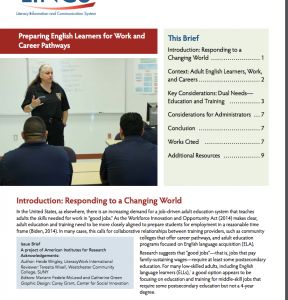
    This Issue Brief provides a synthesis of the research supporting the need for increased rigor in Adult ELA programming. It delineates the elements that should be integrated systematically into instruction, including academic language (e.g., complex texts, expressing cause and effect), language strategies (e.g., listening or reading for different purposes, inferring meaning from context, recognizing attitude), and critical thinking, all of which have been shown to be critical for full access to academic and work opportunities. Suggestions for how administrators can support these efforts are provided as well. The Issue Brief can serve as an introduction to its Companion Learning Resource or as a stand-alone overview of the topic.
    Resource Notice
    This site includes links to information created by other public and private organizations. These links are provided for the user’s convenience. The U.S. Department of Education does not control or guarantee the accuracy, relevance, timeliness, or completeness of this non-ED information. The inclusion of these links is not intended to reflect their importance, nor is it intended to endorse views expressed, or products or services offered, on these non-ED sites. Please note that privacy policies on non-ED sites may differ from ED’s privacy policy. When you visit lincs.ed.gov, no personal information is collected unless you choose to provide that information to us. We do not give, share, sell, or transfer any personal information to a third party. We recommend that you read the privacy policy of non-ED websites that you visit. We invite you to read our privacy policy.
    Mathematics Assessment Project (MAP)
    Author: University of California, Berkeley Shell Center Team at the University of Nottingham, U.K.
    Program Level: Professional Development
    Material Type: Collection
    Language: English
    License: (CC BY-NC-ND 4.0) For license summary click here

    Abstract:

    The Mathematics Assessment Project (MAP) provides tools for formative and summative assessment to assess students’ mathematical knowledge and reasoning, helping teachers guide them towards improvement and monitor student progress.
    Publication Year
    2015
    The Mathematics Assessment Project (MAP) set out to design and develop well-engineered tools for formative and summative assessment that shine a light on students’ mathematical knowledge and reasoning, helping teachers guide them towards improvement and monitor student progress.  It aims to bring the Common Core State Standards (CCSS) in mathematics to life in a way that will help teachers and their students turn their aspirations for achieving them into classroom realities. They exemplify CCSS in explicit down-to-earth performance terms. The project materials were produced as part of a collaborative effort between the University of California, Berkeley and the Shell Center team at the University of Nottingham, with support from the Bill & Melinda Gates Foundation. The MAP materials are of two complementary kinds:
    1. Summative tests or tasks, whichexemplify the performance targets that the standards imply. The tasks, with the associated guidance, equip teachers to effectively monitor overall progress and the mathematical understanding of their students.
    2. Classroom Challenges are complete lessons that support teachers in formative assessment. They both reveal and develop students’ understanding of key mathematical ideas and applications. These lessons enable teachers and students to monitor in more detail their progress towards the targets of the standards.
    Benefits and Uses
    MAP provides instructors and administrators with excellent resources in implementing and evaluating the College and Career Readiness (CCR) standards in mathematics.  The resource is valuable and well organized and provides very good examples of real-life applications of mathematics. MAP provides teachers and professional developers with honest examples of how mathematics is used in real life.  Built around rich problems or tasks, the Classroom Challenges aim to provide a critical supplement to any curriculum. The lessons are structured as formative assessments and are ideally delivered in small classes or group work classroom settings. Opportunities for interaction with and feedback from the instructor are recommended. The lessons are extensive tasks that provide opportunity for students to demonstrate their thinking, to be involved in some degree of productive struggle, and to be able to show modifications in their solutions based on teacher feedback. The support materials provided to instructors are critical in using the task appropriately with students and in providing feedback and evaluation of students’ work. Student work samples are provided to assist instructors in formulating language or instructional strategies that might assist struggling students. It is possible for instructors to either modify the task or select a subset of questions within a task.  With some careful preplanning, the lessons could be condensed and used in a class that has less time for working with larger problems of this type.  The Professional Development Modules, which help teachers with the pedagogical and mathematical challenges of the lessons, are particularly helpful. The whole site is recommended; the Classroom Challenges are particularly helpful. The lessons have a strong alignment to CCSS and individual lessons are linked to specific content standards and the Standards for Mathematical Practice. The lessons incorporate well-designed formative assessments and provide a wealth of material for instructors. This includes the lesson plan with detailed teacher guidance and a presentation PowerPoint, which includes the task information for students. Though designed for specific grade levels, for the most part, the lessons can be presented to students of all ages. As the lessons are aligned to the CCSS, users can search for lessons aligned to CCR mathematical content standards and specific Standards for Mathematical Practice from the “Common Core State Standards” page http://map.mathshell.org/stds.php Optimizing Security Cameras http://map.mathshell.org/materials/lessons.php?taskid=482&subpage=problemis an example of an exemplary lesson suitable for an adult education classroom.  The lesson involves the placement of security cameras to provide maximum security for a given floor plan of a store. This real-life application problem integrates several content domains and requires strategic thinking and an ability to explain and interpret explanations. The lesson plan includes several student work samples that help teachers understand the goals of the lesson and how it develops the targeted standards. The extensive package of resources connected to this lesson is extremely helpful to teachers.
    Resource Notice
    This site includes links to information created by other public and private organizations. These links are provided for the user’s convenience. The U.S. Department of Education does not control or guarantee the accuracy, relevance, timeliness, or completeness of this non-ED information. The inclusion of these links is not intended to reflect their importance, nor is it intended to endorse views expressed, or products or services offered, on these non-ED sites. Please note that privacy policies on non-ED sites may differ from ED’s privacy policy. When you visit lincs.ed.gov, no personal information is collected unless you choose to provide that information to us. We do not give, share, sell, or transfer any personal information to a third party. We recommend that you read the privacy policy of non-ED websites that you visit. We invite you to read our privacy policy.
    Learning for Life: The Opportunity for Technology to Transform Adult Education
    Author: Adam Newman
    Program Level: Professional Development
    Material Type: Collection
    Language: English
    License: (CC BY-NC-ND 4.0) For license summary click here

    Abstract:

    This publication series, Learning for Life: The Opportunity for Technology to Transform Adult Education, explores technology readiness, access, and use within various adult education delivery channels.
    Publication Year
    2015
    This publication series, Learning for Life: The Opportunity for Technology to Transform Adult Education, explores technology readiness, access, and use within various adult education delivery channels, as well as market opportunities, program decision-making processes, and the supplier ecosystem for instructional resources. The research and analysis featured in these publications will assist suppliers, investors, policy professionals, and institutions as they explore opportunities in the adult education market. This report is based on comprehensive research conducted on the role of and potential for instructional technologies in the U.S. adult education field through a national survey of more than 1,000 adult educators and program administrators to determine their interest in, aptitude for, and current use of technology-based instructional resources. There are two parts to this series:
    • Part 1: Interest and Aptitude for Technology
    • Part 2: The Supplier Ecosystem
    What the experts say
    The data and information gathered in this study provides credible and current input to help the field of adult education increase the effective use of technology to reach more adult learners. The recommendations that resulted from this study promise to create more collaborative efforts to fill the technology gaps that currently challenge programs and to promote the development of content that specifically addresses adults, especially through mobile devices. This national survey of adult basic skills practitioners' access to and use of technology is unique. For adult educators, the greatest value may be as a platform to engage their students and colleagues in discussions about access to and use of technology for education purposes. The survey can stimulate valuable discussion, as is evidence by the LINCS community of practice discussion featuring the resource's lead author. Teachers could administer a modified version of this survey in their classrooms to open up a discussion of technology with learners. Several of the graphs may be useful for teachers to share with their students (e.g. Benefits of Technology in Education, Estimated Smartphone Ownership Among Adult Education Students).
    Resource Notice
    This site includes links to information created by other public and private organizations. These links are provided for the user’s convenience. The U.S. Department of Education does not control or guarantee the accuracy, relevance, timeliness, or completeness of this non-ED information. The inclusion of these links is not intended to reflect their importance, nor is it intended to endorse views expressed, or products or services offered, on these non-ED sites. Please note that privacy policies on non-ED sites may differ from ED’s privacy policy. When you visit lincs.ed.gov, no personal information is collected unless you choose to provide that information to us. We do not give, share, sell, or transfer any personal information to a third party. We recommend that you read the privacy policy of non-ED websites that you visit. We invite you to read our privacy policy.
    KET: Active Learning in Adult Numeracy
    Author: Kentucky Educational Television — KET Kentucky Adult Education
    Program Level: Professional Development
    Material Type: Collection
    Language: English
    License: (CC BY-NC-ND 4.0) For license summary click here

    Abstract:

    These video segments from a KET professional development session are focused on broad math teaching practices that are appropriate for math teachers at all levels.
    Publication Year
    2015
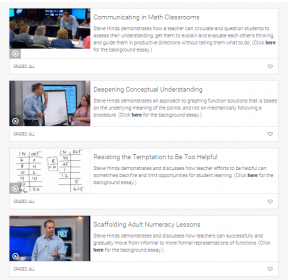
    Steve Hinds led a professional development training for Kentucky Adult Education math teachers where he demonstrated and discussed a series of lessons on functions. These video segments taken from the training are focused on broad math teaching practices that are appropriate for math teachers at all levels. To better understand the problems and issues discussed in the videos, it is strongly recommended that practitioners read the background essays that accompany the videos. Steve lives in Chicago and directs the Active Learning in Adult Numeracy project, which is focused on curriculum development, teacher training, and other reforms that promote active, student-centered math teaching and learning for adults.
    Benefits and Uses
    Steve Hinds demonstrates various approaches: Each short video also contains background essays and discussion questions.  
    Resource Notice
    This site includes links to information created by other public and private organizations. These links are provided for the user’s convenience. The U.S. Department of Education does not control or guarantee the accuracy, relevance, timeliness, or completeness of this non-ED information. The inclusion of these links is not intended to reflect their importance, nor is it intended to endorse views expressed, or products or services offered, on these non-ED sites. Please note that privacy policies on non-ED sites may differ from ED’s privacy policy. When you visit lincs.ed.gov, no personal information is collected unless you choose to provide that information to us. We do not give, share, sell, or transfer any personal information to a third party. We recommend that you read the privacy policy of non-ED websites that you visit. We invite you to read our privacy policy.
    KET – The Interview – Workplace Essential Skills
    Author: Kentucky Educational Television — KET
    Program Level: Professional Development
    Material Type: Collection
    Language: English
    License: (CC BY-NC-ND 4.0) For license summary click here

    Abstract:

    These videos from a professional career counselor help with interview skills.
    Publication Year
    2015
    Help students make a great impression at their next job interview with this lesson from KET's Workplace Essential Skills series. This self-paced lesson includes videos from a professional career counselor, interactive practice opportunities to get them thinking about their strategy, and more activities they can try at home on their own.
    Benefits and Uses
    Designed for adults who are looking for a job or want to improve their skills in order to get or keep a better job, Workplace Essential Skills shows students what to expect from the job interview process, what skills and attributes employers look for, and how those skills are put to work in real on-the-job situations.   Users will need to be logged in to the PBS Learning Media site to access the video.
    Resource Notice
    This site includes links to information created by other public and private organizations. These links are provided for the user’s convenience. The U.S. Department of Education does not control or guarantee the accuracy, relevance, timeliness, or completeness of this non-ED information. The inclusion of these links is not intended to reflect their importance, nor is it intended to endorse views expressed, or products or services offered, on these non-ED sites. Please note that privacy policies on non-ED sites may differ from ED’s privacy policy. When you visit lincs.ed.gov, no personal information is collected unless you choose to provide that information to us. We do not give, share, sell, or transfer any personal information to a third party. We recommend that you read the privacy policy of non-ED websites that you visit. We invite you to read our privacy policy.
    Integrating Digital Literacy Into English Language Instruction: Issue Brief
    Author: Kathy Harris
    Program Level: Professional Development
    Material Type: Collection
    Language: English
    License: (CC BY-NC-ND 4.0) For license summary click here

    Abstract:

    This issue brief, one of the resources in the suite of materials “Integrating Digital Literacy into English Language Instruction,” presents a broad overview of digital literacy as it relates to adult learners in English language acquisition programs.
    Publication Year
    2015
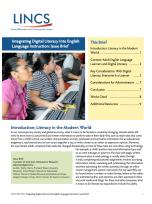
    This Issue Brief synthesizes current research and presents perspectives on digital literacy in English language acquisition. It includes an introduction to the definitions of literacy that are expanded to include digital literacies. The concept of “digital divide” is reframed as a continuum of digital skills, including the language, technology and problem-solving skills required for participation in everyday digital contexts.  Because technologies and their uses continually change, requiring different skills, everyone is a learner with respect to digital literacy. This shifts the role of the teacher to that of a co-learner, in addition to orchestrating learning. Although the Brief can be used as a stand-alone resource, it also provides the foundation to the other resources in the suite of materials “Integrating Digital Literacy into English Language Instruction.”
    Benefits and Uses
    The benefits and uses section will include the:
    • Reasons the resource has implications for the adult education field;
    • Resource’s potential use; and,
    • Most significant or useful features to the target audience(s).
    This Issue Brief draws from scholarship and highlights the current issues in the topic for adult educators and other relevant audiences including professional development specialists, policymakers and researchers. The Issue Brief describes four components of digital literacy and ways to integrate digital activities from each into the classroom.  It also describes how activities can be integrated into a wide range of topic-, project- or problem-based approaches to develop: 1. Basic digital literacy skills, 2. Skills to create and communicate information to extend English language acquisition, 3. Skills needed to find and evaluate information online, and 4. Skills in solving problems in technology-rich environments. The Brief includes multiple examples and links to relevant resources. The Brief can serve as an introduction to its Companion Learning Resource or as a stand-alone overview of the topic.
    Resource Notice
    This site includes links to information created by other public and private organizations. These links are provided for the user’s convenience. The U.S. Department of Education does not control or guarantee the accuracy, relevance, timeliness, or completeness of this non-ED information. The inclusion of these links is not intended to reflect their importance, nor is it intended to endorse views expressed, or products or services offered, on these non-ED sites. Please note that privacy policies on non-ED sites may differ from ED’s privacy policy. When you visit lincs.ed.gov, no personal information is collected unless you choose to provide that information to us. We do not give, share, sell, or transfer any personal information to a third party. We recommend that you read the privacy policy of non-ED websites that you visit. We invite you to read our privacy policy.
    Innovative State Approaches to Implementing CCR Standards Webinar
    Author: StandardsWork, Inc.
    Program Level: Professional Development
    Material Type: Collection
    Language: English
    License: (CC BY-NC-ND 4.0) For license summary click here

    Abstract:

    Innovative State Approaches to Implementing CCR Standards Webinar

    This webinar showcases some of the innovations in implementing CCR standards.
    .
    Publication Year
    2015
    The webinar, Innovative State Approaches to Implementing CCR Standards, was produced by StandardsWork, Inc. as part of the CCR Standards-in-Action (CCR SIA) project, under contract to the U.S. Department of Education (Contract # ED-VAE-13-C-0066).  The CCR SIA project was funded to develop and disseminate professional development and advanced-level supports for implementing CCR standards sustainably and at-scale. Since March 2015, implementation teams from 12 states have been piloting the CCR SIA materials and methods. This webinar, conducted on September 2, 2015, showcases some of the innovations that state teams have embraced in implementing CCR standards in their programs. Six state representatives highlight one noteworthy approach to share with their CCR SIA colleagues. In short presentations, they describe how an innovation has contributed to their state’s implementation efforts and any lessons they have learned. The presentations were followed by Q&A sessions. Susan Pimentel, lead consultant and content developer for the CCR SIA project, facilitated the event. It began with her sharing some findings from a recently published study entitled Learning to Improve: How America’s Schools Can Get Better at Getting Better Ms. Pimentel discusses how educational organizations have been able to successfully institute educational reforms and the potential implications for CCR SIA participants’ strategic planning. At the conclusion of the webinar, she provides an overview of activities planned for the project’s upcoming national workshop. The webinar features the following state presentations:
    • Using E-Learning to Supplement In-Person CCR SIA Trainings Chelsea Stewart, Director, ABE Training and Learning Center, CO
    • Finding Ways to Engage Key Practitioners in the CCR SIA Work Marilyn S. Schmidt, Director for Adult Education and Family Literacy, Curriculum and Instruction, Illinois Community College Board, IL
    • Decentralizing Professional Development to Support CCR Standards Implementation Christine Houck, Professional Development System Advisor, PA
    • Placing a CCR Teacher Trainer in Each Region Megan Dichter, WorkReady Statewide Coordinator and PD Portal Support, ME
    • Integrating CCR Standards Implementation into Existing State Structures Jane Schwerdtfeger, Curriculum Specialist, Adult and Community LearningServicesUnit, MA
    • Integrating CCR Standards Implementation with Other State Initiatives Brad Hasskamp, Adult Education Policy and Operations Specialist, Minnesota Department of Education, MN
    Benefits and Uses
    The state presenters are all adult educators sharing information about how their states are implementing CCR standards. Given these states’ efforts, members of the LINCS community may find value in learning about these implementation strategies with a view to trying some of them in their own programs. The cross-state discussion of different ways of structuring CCR professional development opportunities and the lessons learned may be useful. Another theme which emerged in the discussion was strategies for meeting the needs of part-time teachers and isolated teachers in CCR implementation. The resource could be used by program administrators and state staff as they plan for the implementation of CCR standards in their own programs. The webinar could fuel a discussion of different strategies and approaches to piloting and full scale up of the CCR standards. All of the Webinar discussion is useful to states that are implementing the CCR standards. Adult educators may also wish to access the work of Anthony Birk et al. Learning to Improve: How America’s Schools Can Get Better at Getting Better February 2015, which is discussed by Sue Pimentel in the beginning of the Webinar (PowerPoint slides 4-7).  
    Required Training
    A fundamental awareness of the CCR Standards for English Language Arts/Literacy and Mathematics is recommended.
    Resource Notice
    This site includes links to information created by other public and private organizations. These links are provided for the user’s convenience. The U.S. Department of Education does not control or guarantee the accuracy, relevance, timeliness, or completeness of this non-ED information. The inclusion of these links is not intended to reflect their importance, nor is it intended to endorse views expressed, or products or services offered, on these non-ED sites. Please note that privacy policies on non-ED sites may differ from ED’s privacy policy. When you visit lincs.ed.gov, no personal information is collected unless you choose to provide that information to us. We do not give, share, sell, or transfer any personal information to a third party. We recommend that you read the privacy policy of non-ED websites that you visit. We invite you to read our privacy policy.