Career Pathways Checklist
    Author: Daniel S. Eckstein and Dana M. Young
    Program Level: Professional Development
    Material Type: Collection
    Language: English
    License: (CC BY-NC-ND 4.0) For license summary click here

    Abstract:

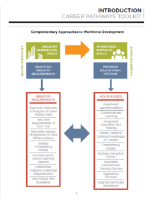
    This checklist is designed as a work aid to help determine the extent to which a newly developed or existing program meets the requirements for career pathways in section (3)(7) of WIOA.
    Publication Year
    2017
    Resource Type
    The Workforce Innovation and Opportunity Act (WIOA) was enacted on July 22, 2014. WIOA calls for cross-system alignment; education and training that is focused on the needs of high-demand industry sectors and occupations; regional collaboration focused on the skill needs of regional economies; and the establishment of career pathways systems that make it easier for all Americans to attain the skills and credentials needed for family-supporting jobs and careers. Within these systems, career pathways programs offer a clear sequence, or pathway, of education coursework and/or training credentials aligned with employer-validated work readiness standards and competencies. This checklist is designed as a work aid to help determine the extent to which a newly developed or existing program meets the requirements for career pathways in section (3)(7) of WIOA.
    Benefits and Uses
    This checklist is for planners and managers of career pathways programs Financial aid counselors and administrators responsible for administering the Ability to Benefit (AtB) provisions of the Higher Education Act (HEA), that allow a student who does not have a high school diploma (or its recognized equivalent) to be eligible for Title IV, HEA student assistance through one of the AtB alternatives if the student is enrolled in an “eligible career pathway program” that aligns to the statutory requirements in WIOA.
    Resource Notice
    This site includes links to information created by other public and private organizations. These links are provided for the user’s convenience. The U.S. Department of Education does not control or guarantee the accuracy, relevance, timeliness, or completeness of this non-ED information. The inclusion of these links is not intended to reflect their importance, nor is it intended to endorse views expressed, or products or services offered, on these non-ED sites. Please note that privacy policies on non-ED sites may differ from ED’s privacy policy. When you visit lincs.ed.gov, no personal information is collected unless you choose to provide that information to us. We do not give, share, sell, or transfer any personal information to a third party. We recommend that you read the privacy policy of non-ED websites that you visit. We invite you to read our privacy policy.
    Work-Based Learning: Model Policy Components
    Author: Jennifer Zinth
    Program Level: Professional Development
    Material Type: Collection
    Language: English
    License: (CC BY-NC-ND 4.0) For license summary click here

    Abstract:

    This policy brief presents a comprehensive policy approach to providing high-quality work-based learning experiences that prepare participants for postsecondary and workforce success in high-demand occupations.
    Publication Year
    2018
    High-quality, work-based learning opportunities can confer a number of benefits — not only for students, but also for schools, employers, and communities. Because high-quality work-based learning opportunities integrate applicable academic concepts and state standards and evaluate a student’s mastery of key employability skills, students can reap greater benefits from quality work-based learning programs than they can from traditional teen employment opportunities.
    In the absence of state policies providing structures and funding for work-based learning programs, there can be disparities in program access from one district to another. Fewer than one-third of states have adopted policies regarding secondary student work-based learning, according to the National Skills Coalition. As of April 2017, 14 states had policies governing pre-apprenticeships and youth apprenticeship programs for high school students, and 11 states had policies governing other secondary student work-based learning. To ensure wide and equitable access to high-quality work-based learning experiences designed to prepare participants for postsecondary and workforce success in high-demand occupations in their region or state, a comprehensive policy approach should include the following components:
    • Single, clear and statewide definition of various work-based learning experiences.
    • High-quality career awareness and exploration beginning in the elementary and middle grades.
    • Funds to support deployment of all activities at the state, regional, and local levels.
    • Development and dissemination of a state framework for work-based learning.
    • Non-elective graduation credit for approved work-based learning experiences.
    Because all five policy areas are interrelated, these components should be viewed as a comprehensive package of policies for state adoption rather than a menu from which states may choose without compromising program availability or quality.
    What the experts say
    Work-Based Learning Model: Policy Components is an excellent resource for state, regional and local entities looking to outline policy considerations for a work-based learning system that includes adult learners. It is well written, concise, and superiorly organized, making it easy to read and understand. Current and well-sourced information is provided from the work-based learning field covering multiple scenarios that educators might encounter in building a work-based learning program. The combination of content and concrete examples of collaboration across state, local, employer and charitable organizations make it a must have resource for work-based learning planning and implementation.
    Resource Notice
    This site includes links to information created by other public and private organizations. These links are provided for the user’s convenience. The U.S. Department of Education does not control or guarantee the accuracy, relevance, timeliness, or completeness of this non-ED information. The inclusion of these links is not intended to reflect their importance, nor is it intended to endorse views expressed, or products or services offered, on these non-ED sites. Please note that privacy policies on non-ED sites may differ from ED’s privacy policy. When you visit lincs.ed.gov, no personal information is collected unless you choose to provide that information to us. We do not give, share, sell, or transfer any personal information to a third party. We recommend that you read the privacy policy of non-ED websites that you visit. We invite you to read our privacy policy.
    Northstar Digital Literacy Assessments
    Author: Northstar Digital Literacy Project
    Program Level: Professional Development
    Material Type: Collection
    Language: English
    License: (CC BY-NC-ND 4.0) For license summary click here

    Abstract:

    This open-access version of the Northstar Digital Literacy Project assessments can be used for assessing digital literacy skills to inform instruction.
    Publication Year
    2018
    The Northstar Digital Literacy Project offers online learning modules and assessments in ten categories:
    • Basic computer skills
    • Internet
    • Windows OS
    • Mac OS
    • Email
    • Social media
    • Microsoft Word
    • Microsoft Excel
    • Microsoft PowerPoint
    • Information literacy
    What the experts say
    Learners must be digitally literate in order to find and succeed in a career with family-sustaining wages. The Northstar Digital Literacy Assessment is a group of standards-based interactive assessment modules that measure adult digital literacy skills at a basic level. Each assessment moves the learner up a level in their digital literacy skills. The lessons are simple and easy to understand and navigate. Many adult education teachers are seeking introductory courses in computer/digital literacy for themselves and their students. The Northstar Assessments are widely used in the fields of adult basic skills education and digital literacy skills. Designed specifically for adult basic skills (including ESL/ESOL) learners, the project began with designing a set of digital literacy standards that are acceptable to public libraries, adult basic skills educators and employers in Minnesota. The standards are based on the needs of low-literate adults as perceived by adult educators, librarians, and employment and training services specialists.  
    Resource Notice
    This site includes links to information created by other public and private organizations. These links are provided for the user’s convenience. The U.S. Department of Education does not control or guarantee the accuracy, relevance, timeliness, or completeness of this non-ED information. The inclusion of these links is not intended to reflect their importance, nor is it intended to endorse views expressed, or products or services offered, on these non-ED sites. Please note that privacy policies on non-ED sites may differ from ED’s privacy policy. When you visit lincs.ed.gov, no personal information is collected unless you choose to provide that information to us. We do not give, share, sell, or transfer any personal information to a third party. We recommend that you read the privacy policy of non-ED websites that you visit. We invite you to read our privacy policy.
    Innovative Partnerships: Adult Basic Education and Workforce Development Boards
    Author: Robert Moore
    Subject Area: Workforce
    Program Level: Adult Basic Education
    Language: English
    License: (CC BY-NC-ND 4.0) For license summary click here

    Abstract:

    This interactive workshop explores how adult basic education providers can strengthen outcomes by building innovative, results-driven partnerships with their workforce development boards. Through real-world examples and guided discussion, the session highlights how co-enrollment, integrated education and training (IET), pre-apprenticeships, shared data, and braided funding can help workforce development and ABE partners respond to talent shortages while expanding access and equity for job seekers. Attendees will identify common challenges to effective partnerships and learn concrete strategies for overcoming them through trust-building, joint planning, and continuous communication. The workshop emphasizes by positioning ABE programs and workforce development boards not only as referral agencies, but as strategic partners in talent development. Participants will leave with actionable ideas, partnership tools, and next steps they can adapt to their local systems to better serve job seekers, employers, and communities in a rapidly changing economy. Participants will (1) identify effective partnership models between workforce development and adult basic education, including co-enrollment, pre-apprenticeships, and Integrated Education and Training; (2) apply strategies to align goals, data, and resources across systems to address common partnership challenges; and (3) develop actionable next steps to strengthen local collaborations that improve outcomes for jobseekers and employers. Original webinar date: May 14, 2026 Webinar recording link: https://youtu.be/Cht1pbZg75w
    What Works for Adult Learners: Lessons from Career Pathway Evaluations
    Author: Debra Bragg, Erica Acevedo, Nate Anderson, Barbara Endel, and Lisa Soricone
    Subject Area: LINCS Resources, Workforce
    Program Level: Professional Development
    Material Type: Collection
    Language: English
    License: (CC BY-NC-ND 4.0) For license summary click here

    Abstract:

    This report presents the results of a systematic examination of rigorous evaluation studies to determine what is known about the impact of career pathways on adults seeking to attain a living-wage career.
    CK-12 Adult Education FlexBooks
    Author: CK-12 Foundation and Outreach and Technical Assistance Network
    Subject Area: Health, IET, LINCS Resources, Workforce
    Program Level: Professional Development
    Material Type: Collection
    Language: English
    License: (CC BY-NC-ND 4.0) For license summary click here

    Abstract:

    This library of CK-12’s interactive FlexBooks was developed by the Outreach and Technical Assistance Network specifically to support adult educators and learners. The library includes FlexBooks for Adult Basic Education, Adult Secondary Education, English as a Second Language, High School Equivalency, and Career and Technical Education courses. All textbooks are interactive and include instruction, interactive media (including videos), and knowledge checks.
    This library of open-source textbooks can be beneficial to support on-ramp, bridge, or integrated education and training programming, and it can be used for Adult Basic Education, Adult Secondary Education, English as a Second Language, High School Equivalency, and Career and Technical Education courses. All textbooks are interactive and include instruction, interactive media (including videos), and knowledge checks. Three of the textbooks are relevant to health science careers, including a detailed course for home health aides. Given that these resources were developed on the CK-12 platform, they are designed to be easily reused with licensing that allows instructors to adapt and remix the content to be used in different contexts.
    Resource Notice
    This site includes links to information created by other public and private organizations. These links are provided for the user’s convenience. The U.S. Department of Education does not control or guarantee the accuracy, relevance, timeliness, or completeness of this non-ED information. The inclusion of these links is not intended to reflect their importance, nor is it intended to endorse views expressed, or products or services offered, on these non-ED sites. Please note that privacy policies on non-ED sites may differ from ED’s privacy policy. When you visit lincs.ed.gov, no personal information is collected unless you choose to provide that information to us. We do not give, share, sell, or transfer any personal information to a third party. We recommend that you read the privacy policy of non-ED websites that you visit. We invite you to read our privacy policy.
    Publication Year
    2019
    Career Exploration Unit
    Author: Danielle Brown
    Program Level: Professional Development
    Material Type: Collection
    Language: English
    License: (CC BY-NC-ND 4.0) For license summary click here

    Abstract:

    Designed for advanced English as a Second Language and General Education Development learners, this two-week unit helps students learn about currently available entry-level work that is in high demand, pays over minimum wage, and does not require a high school credential. This easy-to-use PDF unit contains eight lessons that include detailed objectives, teacher guidance for all activities, and activity handouts. Lessons are designed to help learners practice the English and employment-preparedness skills necessary to obtain entry-level jobs.
    Brewing Brilliance: Adult Education Virtual Coffee Talk
    Author: Steve Schmidt, Shaketta Thomas, and Sharon Bonney
    Subject Area: ESL/ELL, Workforce
    Program Level: Adult Basic Education
    Language: English
    License: (CC BY-NC-ND 4.0) For license summary click here

    Abstract:

    This meeting focused on sharing best practices and challenges in adult education, particularly around ESL programs and workforce development. Participants discussed various initiatives including college and career readiness labs, apprenticeship programs, digital literacy efforts, and strategies for supporting ESL students during challenging times. Key topics included the implementation of Career Gateway classes that simulate workplace experiences, partnerships with employers for workplace learning, and the challenges of providing services to ESL students in correctional settings. Several participants shared resources including AI literacy lesson plans, digital literacy frameworks, and community partnerships, while others discussed the importance of trauma-informed instruction and multi-generational impact of adult education programs. The meeting highlighted successful collaborations between state directors, local programs, and employers, with participants emphasizing the value of working together to create pathways for adult learners.

    Summary

    College Career Readiness Program Development

    Tammy described their college and career readiness lab, which offers various training programs like health sciences and HR, supported by Michigan Works and grants. The lab has created a class called Career Gateway that simulates a job environment, focusing on resume writing, cover letters, and LinkedIn creation for their high ESL population. Adrienne mentioned Louisiana's progress in developing pathways and hiring staff to coordinate between K-12, adult education, and CTE programs. Both Tammy and Adrienne noted challenges in apprenticeships, with limited opportunities and a mismatch between ESL students' needs and available programs.

    ESL Workforce Preparation Programs Update

    The meeting focused on ESL and workforce preparation programs, with Tammy discussing Career Gateway classes for intermediate to advanced students and Raynell presenting a new 8-week civics and citizenship pathway pilot using the USCIS civics test and Burlington English modules. Hannah shared World Relief's approach to teaching Know Your Rights information to refugee students, including memorizing A numbers and emergency contacts, and discussed their transition to online classes using Signal as a communication tool, which has maintained attendance despite the pandemic.

    Education Collaboration and Workforce Challenges

    Lynnette shared that recent administrative changes have led to more collaborative partnerships and outreach efforts in education, particularly in working with city hall offices to ensure student safety. Dinash discussed a challenge with their 25-year-old initiative in New York State, highlighting a disconnect between their computer technology services and the local workforce needs in the Rust Belt region, where traditional industries have disappeared, leaving a gap between available certifications and actual job opportunities.

    AI in Education and Literacy

    The group discussed using AI to analyze educational data, with Lynnette sharing that 65,000 people in their city lack a high school diploma or GED, and Ashley announced the release of a new digital literacy toolkit. Glenda and Ashley highlighted their work on AI literacy and digital skills training, while Alethea presented Upwardly Global as a resource for helping immigrants and refugees restart their careers in the U.S. through professional training and job placement services.

    IET Programs in Correctional Settings

    Tammy explained that county correctional facilities have been unable to implement IET (Individualized Education Training) programs effectively due to high turnover and restrictions on working with violent inmates. Shaketta inquired about successful IET programs in correctional settings, particularly in state prisons, and Kristine shared that Minnesota has developed a digital literacy curriculum that's been adapted for use in correctional settings, noting that their Lindale program in Minneapolis created a modified version of the North Star digital literacy curriculum that's more accessible for learners.

    Adult Education Best Practices Sharing

    The meeting focused on sharing best practices and resources in adult education. Glenda highlighted Texas's successful coordination between education and workforce agencies to streamline services for learners. Nakita discussed South Dakota's new volunteer training program using Monday.com, aimed at increasing classroom support. Adrienne praised Tracy for redesigning their website to better serve students, providers, and partners. Heather shared Memphis's success in workplace learning, particularly through a partnership with a distribution center and an apprenticeship program with IUPAT.

    Adult Education Best Practices Sharing

    The meeting focused on sharing resources and best practices in adult education. Xavier presented AI literacy lesson plans developed by his organization, while Patsy highlighted Minnesota's work on trauma-informed instruction and immigration-related resources. Echo discussed the need to update digital literacy frameworks, emphasizing the importance of literacy skills for accessing vocational programs. Tim shared a powerful success story of a student who went on to achieve academic and professional success, highlighting the impact of trauma-informed education. Sharon, representing COABE, encouraged participants to share their challenges and ideas, offering support and resources. She emphasized the importance of collaboration between state directors, state associations, and local programs, and encouraged participants to register for the upcoming COABE conference.

    Meeting date: March 10, 2026 Meeting recording link: https://youtu.be/qoX5PbooNSw