
You must be logged in to download this resource. Register now if you don't have an account.
Abstract:
Students from other countries learn different procedures for math operations and can become confused when trying to understand the standard algorithms taught in the U.S. But through the use of "number talk" instruction, ELLs explain their procedure for solving a problem. The instructor prompts the student and records and illustrates the student's thinking to develop all students' abilities in procedural fluency, conceptual understanding, and adaptive reasoning. This workshop presents ideas for using number talks and gives opportunities to try them out. ATTACHMENTS: Integrating Diverse Learners Math
You must be logged in to download this resource. Register now if you don't have an account.
Abstract:
We all know about the Workforce Innovation and Opportunity Act (WIOA), but what other federal programs might you be able to access? In this session, learn about opportunities to serve people with basic skills needs using support from the U.S. Departments of Transportation, Agriculture, Housing and Urban Development, and more. Go home with ideas for how new partnerships can help you tap into new sources of funding. ATTACHMENTS: Beyond WIOA drawing on other federal resources to help your learners Apr 2016 conference presentation FINAL
You must be logged in to download this resource. Register now if you don't have an account.
Abstract:
During this session participants will join Jessica and Sandra to explore the 8 Math Practices of the CCRS, what they mean for teaching math with greater depth, and simple activities to get your students thinking deeper about mathematics. Participants with all levels of math knowledge are invited to attend as no level of expertise is required by the participants. Participants will travel to 8 stations to learn a math practice and try out an activity that shows the practice in action. Each station will demonstrate an activity that can easily be translated into skills needed for any of the High School Equivalency Exams and College and Career Readiness. All activities will be differentiated as well so attendees of all levels will be able to participate. Activities to be covered include differentiated war, algebra tiles, Cuisenaire rods, pattern blocks, exploring triangles, fractions strips, problem solving, and attribute cards. ATTACHMENTS: Math Practices Handout FINAL
You must be logged in to download this resource. Register now if you don't have an account.
Abstract:
Adult educators have a lot to add to policy conversations, but it can be hard to figure out the best use for your scarce time. In this presentation, National Skills Coalition provides a practical overview of the policy landscape, and numerous examples of how adult educators can weigh in on these important discussions.
You must be logged in to download this resource. Register now if you don't have an account.
Abstract:
Interested in using your mobile device in your classroom? Explore features of your device that will help adult students. Discussion focuses on management, etiquette, and recent research along with ideas that work with any phone. Leave this invigorating workshop with lots of ideas Download the COABE Powerpoint here. ATTACHMENTS: mobilelearning1
You must be logged in to download this resource. Register now if you don't have an account.
Abstract:
Presenters will provide information about a program designed to provide intensive support to low level developmental students. Participates will gain an understanding of specific strategies to plan, develop, and implement similar programs on their own campuses. The program's student success rates will also be shared. ATTACHMENTS: COABE Presentation PPT Final Version
You must be logged in to download this resource. Register now if you don't have an account.
Abstract:
HSE Foundations is a bridge course developed in response to data showing that many students were exiting the program shortly after completing our Student Success Seminar (SSS). Anecdotal evidence for their leaving included students reporting feeling as though there were no clear program plan and feeling lost upon entering classes that were already in progress. Additionally, CBP instructors faced the difficulty of working to shore up the knowledge and skills of incoming students while simultaneously providing stimulating lessons for existing students in order for them to continue progressing. In developing HSE Foundations, the team used location data in conjunction with principles of adult learning theory. The four-week course incorporates primarily in-class instruction along with a hybrid element created by working in Pearson's MyFoundationsLab and is intended to start students off on solid footing. Following completion of SSS, students progress as a cohort through the four-week course which consists of 24 hours of language arts instruction followed by 24 hours of mathematics instruction, creating a closed system- in which the 40-hour state requirement for post-testing is met. Because students remain in a cohort for a total of five weeks, this model also builds a sense of community, providing an academic support system to students beyond that offered by staff. After piloting HSE Foundations at one location in 2014-2015, a refined version was implemented at all program locations in August 2015. Early data since launch has shown outcomes that are on track to far surpass the goals of increasing post-testing by 5% and educational gains by 3%. With several sites having completed eight cohorts of Foundations, there has been a post-test rate of between 90 and 95%, and an educational gain rate of approximately 65%. The initial outcomes are a great improvement from past years' data, and student retention has increased since the implementation of the course. Due to this success, CBP lead HSE instructors are working collaboratively to create a standardized, standards-aligned curriculum for all HSE I courses. The first of its kind in Rio Salado College's College Bridge Pathways program, as well as in Arizona adult education on the whole, HSE Foundations incorporates a standardized syllabus of competencies aligned with Arizona College and Career Ready Standards. HSE Foundation's in-class instruction, along with the addition of MyFoundationsLab, creates a hybrid learning experience that is a major step in standardizing HSE curriculum in the program. ATTACHMENTS: Closing the Loop 1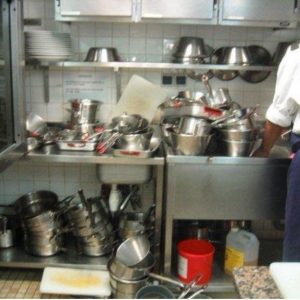
You must be logged in to download this resource. Register now if you don't have an account.
Abstract:
This entry is a four-lesson plan unit designed to assist a Learner understand the tasks and responsibilities of an entry-level restaurant position such as dishwasher. The scenario for these lessons takes place at a restaurant with the Learner gaining knowledge about the physical layout and organization of a restaurant (#1), equipment in a basic restaurant kitchen (#2), specific tasks of a restaurant dishwasher (#3), and the special vocabulary of a restaurant worker (#4). The lessons contain activity suggestions, large vocabulary lists, and discussion questions. ATTACHMENTS: WING Dishwasher Lesson Plans