
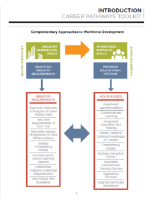
- Build cross-agency partnerships and clarify roles
- Identify industry sectors and engage employers
- Design education and training programs
- Identify funding needs and sources
- Align policies and programs
- Measure system change and performance
- RF.1. Demonstrate understanding of the organization and basic features of print. (Print Concepts)
- RF.2. Demonstrate understanding of spoken words, syllables, and sounds (phonemes). (Phonological Awareness)
- RF.3. Know and apply grade-level phonics and word analysis skills in decoding words. (Phonics and Word Recognition)
- RF.4. Read with sufficient accuracy and fluency to support comprehension. (Fluency)
- Pre-reading questions that can be used for individual reflection, journaling, or class discussion.
- Vocabulary-building exercises
- Word attack strategies
- Comprehension questions
- Grammar lessons and practice exercises
- Writing tasks
- Graphic organizers
- Digital story progress sheet
- Paragraph writing checklist
- Level 6 scope and sequence
- Pre-reading questions that can be used for individual reflection, journaling, or class discussion
- Vocabulary-building exercises
- Comprehension questions
- Spelling lists and exercises
- Grammar lessons and exercises
- Writing tasks
- The Most Amazing Structure on Earth
- The Many Faces of Genius
- The Many Pathways to Knowledge
- Boost Your Brainpower
- Memory Magic
- Put to the Test
- The Sixth Sense: Intuition
- The Big Five: Personality
- Secrets of a Happy Brain
You must be logged in to download this resource. Register now if you don't have an account.
Abstract:
You must be logged in to download this resource. Register now if you don't have an account.
Abstract:
You must be logged in to download this resource. Register now if you don't have an account.
Abstract:
You must be logged in to download this resource. Register now if you don't have an account.
Abstract:
You must be logged in to download this resource. Register now if you don't have an account.
Abstract:
You must be logged in to download this resource. Register now if you don't have an account.
Abstract:
You must be logged in to download this resource. Register now if you don't have an account.
Abstract:
You must be logged in to download this resource. Register now if you don't have an account.
Abstract:
This course pack features a set of nine high-interest reading materials that are designed to meet the learning outcomes for Adult Literacy Fundamental English Level 5 (roughly equivalent to grades 6 to 7.5 in the K-12 system). Resource URL https://opentextbc.ca/abealf5/ Publication Year 2015 The BC Reads: Adult Literacy Fundamental English – Course Pack 5 is designed to meet the learning outcomes for Adult Literacy Fundamental English Level 5 (roughly equivalent to grades 6 to 7.5 in the K-12 system). Every chapter includes a level-appropriate, high-interest reading of between 500 and 800 words. The readings are freely available in a separate reader with convenient links to the readings in each chapter of the course pack. Font size and line spacing can be adjusted in the online view, and have been enhanced for the print and PDF versions for easier reading. This course pack has been reviewed by subject experts from colleges and universities. Links to the nine readings are embedded in this course pack. While this resource does not provide instructional strategies nor lesson plan, the readings are accompanied by: