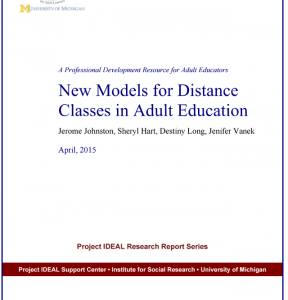
New Models for Distance Classes in Adult Education
    Author: Jerome Johnston, Sheryl Hart, Destiny Long, and Jen Vanek
    Program Level: Professional Development
    Material Type: Collection
    Language: English
    License: (CC BY-NC-ND 4.0) For license summary click here

    Abstract:

    This guide describes the classes of a number of distance education teachers who have adjusted their courses to incorporate college and career ready skills, enriching the online experience for students.
    Publication Year
    2015
    This guide describes the classes of a number of career readiness-focused teachers with the hope that they can inspire others to examine their distance teaching practices and offer a richer experience for their students. This resource is divided into two parts. The first consists of a collection of short vignettes describing the "classes" of a number of these teachers. In most of the vignettes, teachers have used one or more electronic tools to enable them to offer a richer classroom experience. The second part of the guide describes the tools in a bit more detail, providing an easy way for teachers to learn about the tools that they might use in their own classes. The guide organizes and explores tools in four categories: academic skill-building tools, communication tools, productivity tools, and LMS & website builders.
    What the experts say
    This is a valuable resource for educators looking to implement promising practices and to deploy innovative tools of technology in their adult classrooms. This resource also adds to the stack of tools growing the research base for technology as a way of expanding access to educational programming, and to legitimizing distance education as a meaningful platform for adult learning. It may help adult education instructors teaching distance classes to rethink and revise their methods in the classroom. Adult basic skills (including English language) teachers and program managers who offer, or are interested in offering, their students distance education or blended learning will find this practical guide of great help. In it they can read about what other adult basic skills teachers and programs are doing with distance education and blended learning, and they can find useful tools for doing it.
    Resource Notice
    This site includes links to information created by other public and private organizations. These links are provided for the user’s convenience. The U.S. Department of Education does not control or guarantee the accuracy, relevance, timeliness, or completeness of this non-ED information. The inclusion of these links is not intended to reflect their importance, nor is it intended to endorse views expressed, or products or services offered, on these non-ED sites. Please note that privacy policies on non-ED sites may differ from ED’s privacy policy. When you visit lincs.ed.gov, no personal information is collected unless you choose to provide that information to us. We do not give, share, sell, or transfer any personal information to a third party. We recommend that you read the privacy policy of non-ED websites that you visit. We invite you to read our privacy policy.
    Blended Learning for the Adult Education Classroom
    Author: David J. Rosen and Carmine Stewart
    Program Level: Professional Development
    Material Type: Collection
    Language: English
    License: (CC BY-NC-ND 4.0) For license summary click here

    Abstract:

    For those professionals with the desire to implement, or further develop their implementation of blended learning, this guide will serve as a step-by-step road map for choosing and efficiently implementing a blended learning model design that meets their needs and budget.
    Publication Year
    2015
    This guide to blended learning is intended for teachers and administrators of adult basic education (including ESL/ESOL/ELL, adult basic education, adult secondary education, and transition to higher education). It is designed to help teachers and administrators understand how blended learning can enhance learning in their classes, programs, or schools. For those professionals with the desire to implement, or further develop their implementation of blended learning, this guide will serve as a step-by-step road map for choosing and efficiently implementing a blended learning model design that meets their needs and budget. The guide has information and resources for readers who are new to blended learning, have experimented with blended learning and want to further develop or improve their practice, or are blended learning experts. The Appendix includes links to resources for adult basic education teachers, tutors and program administrators who want to try out or expand their use of blended learning.
    What the experts say
    Blended Learning for the Adult Education Classroom is an excellent resource for teachers and administrators looking to incorporate blended learning into a new or established adult education program. This is an excellent resource because it is realistic and has proven to be a way to instruct and learn, Blended Learning allows the student and instructor to modify the curriculum, class time and modalities. Many programs believe that they have to have advanced technology and lots of money to implement blended instruction. This guide, which is unique to the field, makes it easy for anyone to explore the benefits of blended learning. It also provides easily-digested information and guidance on how to immediately implement research-supported practices in blended-learning instruction.
    Resource Notice
    This site includes links to information created by other public and private organizations. These links are provided for the user’s convenience. The U.S. Department of Education does not control or guarantee the accuracy, relevance, timeliness, or completeness of this non-ED information. The inclusion of these links is not intended to reflect their importance, nor is it intended to endorse views expressed, or products or services offered, on these non-ED sites. Please note that privacy policies on non-ED sites may differ from ED’s privacy policy. When you visit lincs.ed.gov, no personal information is collected unless you choose to provide that information to us. We do not give, share, sell, or transfer any personal information to a third party. We recommend that you read the privacy policy of non-ED websites that you visit. We invite you to read our privacy policy.
    Transforming Distance Education Online Course
    Author: EdTech Center
    Program Level: Professional Development
    Material Type: Collection
    Language: English
    License: (CC BY-NC-ND 4.0) For license summary click here

    Abstract:

    This course was designed for education providers and practitioners teaching adult basic academic skills, ESOL, and literacy at a distance and/or through blended learning; it provides strategies and resources that are essential for both setting up and implementing distance education or teaching with a blended approach.
    Teaching Online: Communicating and Tracking Learner Progress
    Author: EdTech Center @ World Education
    Program Level: Professional Development
    Material Type: Collection
    Language: English
    License: (CC BY-NC-ND 4.0) For license summary click here

    Abstract:

    Teaching Online: Communicating and Tracking Learner Progress presents a clear and comprehensive approach for instructors to transition from an in-person to online learning environment.
    Ready, Set, Go: Steps to Rapidly Start Distance Learning
    Author: EdTech Center @ World Education
    Program Level: Professional Development
    Material Type: Collection
    Language: English
    License: (CC BY-NC-ND 4.0) For license summary click here

    Abstract:

    Ready, Set, Go: Steps to Rapidly Start Distance Learning provides guidance to adult educators on how to quickly set-up distance learning programs for their students.
    Increasing Engagement and Student Persistence Through Distance- and Blended-Learning Models: What the Research Says and Which Practices Work
    Author: Mariann Fedele-McLeod, Kristi Reyes, Penny Pearson, Thoibi Rublaitus, Shannon Swain, Dr. Carolyn Zachry, Stephanie Kriebel, and Yecsenia Lorenzo
    Program Level: Adult Basic Education
    Language: English
    License: (CC BY-NC-ND 4.0) For license summary click here

    Abstract:

    For decades, California adult education has been developing tools to address how changes in technology in turn change society and therefore learning processes. The focus has been in three areas: (1) infrastructure— resources and access; (2) uses for technology— instructional, assessment, and student information systems; and (3) approaches to creating learning environments— distance learning, professional development, and communication. In the spring of 2021, a team of California adult educators examined the research and shared their practice for offering and greatly expanding high quality distance learning in the context of the COVID-19 pandemic. The end result of their work was a brief published by CALPRO that can be found here http://calpro-online.org/documents/CALPRO-Research-Brief-15-508.pdf.
    Original webinar date: September 10, 2021
    Webinar recording link: https://youtu.be/E60K7hdmUqs
    Making Measurable Skill Gains That Point To Student Success
    Author: Robert Breitbard and Jane Egüez
    Program Level: Adult Basic Education
    Language: English
    License: (CC BY-NC-ND 4.0) For license summary click here

    Abstract:

    Helping students reach their goals is the mission of adult education. One critical component is to reassure students that they are making progress learning and to document their achievement of Measurable Skill Gains (MSGs), such as making assessment gains. It is now far easier than ever before to improve the chances for students to make MSGs by leveraging technology. In this webinar, learn how programs can use CASAS’ impressive features to easily access assessment results that can be quickly used to determine the BurlingtonEnglish instruction to emphasize. Teachers’ lives have never been easier! This streamlined approach also provides the benefit of enhancing data accuracy and completeness for reporting purposes, as well as improving the chances that students eligible to be tested won’t be missed. Administrators’ lives have never been easier! Join us to see this great synergy in action. Original Webinar Date: November 16, 2020 Webinar Recording Link: https://youtu.be/BRT1qAW3sbQ
    MINDS THAT MOVE US TOOL KIT: A Collection of Place-Based Solutions for Future Adult Career Pathways Models
    Author: Celina Shands, Alicia Bolton, Sharon Bonney, Patricia Tyler, Jeffery Abramowitz, Stephenie Rittberger, Rose Reza, Robin Matusow, Karen Oswald, Timothy Campbell
    Program Level: Adult Basic Education
    Language: English
    License: (CC BY-NC-ND 4.0) For license summary click here

    Abstract:

    In this current climate of health, economic and social unrest, new approaches for creating a greater abundance of effective and affordable career pathways for low-income learners are more important than ever. Two years ago, ten community-based teams embarked on a journey to do just that! They participated in the Minds that Move Us (MTMU) Adult Career Pathways Design Challenge, which focused on the creation of bold, sustainable career pathways approaches for low-income adults (aged 26+) for a chance to win $100,000 in prize money. Fast forward to present day, the ten teams have rich and timely lessons that are shared in The MTMU Toolkit: A Collection of Place-Based Solutions for Future Adult Career Pathways Models. During this engaging panel discussion, you’ll hear from teams that participated in the challenge and the project’s key partners—IEL, COABE, and NASDAE—as they discuss the toolkit’s key principles for being adaptable, removing barriers and maximizing potential to innovate within adult career pathways. Original Webinar Date: October 2, 2020 Webinar Recording Link: https://youtu.be/xPjjLVnMnqM