Fact Sheets: Eligibility for ORR Benefits & Services
    Author: U.S. Department of Health and Human Services, Administration for Children and Families, Office of Refugee Resettlement
    Subject Area: LINCS Resources
    Program Level: Professional Development
    Material Type: Collection
    Language: English
    License: (CC BY-NC-ND 4.0) For license summary click here

    Abstract:

    This resource contains fact sheets for refugees from selected populations to learn about their s Office of Refugee Resettlement (ORR) eligibility and benefits.
    Publication Year
    2023
    Enhancing Access: Using Bridge Strategies to Connect IELCE Activities to IET Programs
    Author: Jessie Stadd and Judy Mortrude
    Program Level: Professional Development
    Material Type: Collection
    Language: English
    License: (CC BY-NC-ND 4.0) For license summary click here

    Abstract:

    IELCE activities funded by WIOA Section 243 funds must be delivered in combination with IET programs. Using bridge strategies to connect IELCE to IET is one approach to delivering IELCE activities in combination with IET programs. This spotlight how states, regions, and programs are using bridge strategies to prepare learners enrolled in IELCE activities for IET programs.
    Benefits and Uses
    Recognizing that states and programs must deliver Section 243-funded IELCE activities in combination with IET, this spotlight aims to provide substantive examples of one approach: the use of bridge strategies. This spotlight describes the benefits of using bridge strategies to connect IELCE to IET. It also provides an example framework for how IELCE can serve a bridge by preparing learners for an IET and other steps along a career pathway. The spotlight showcases examples of this approach in action at the state, regional, and program level. State staff and program administrators will benefit from the experience shared by Washington State, Women Employed, and Prince George’s Community College. States and programs can also explore considerations for using bridge strategies to connect IELCE to IET.
    Resource Notice
    This site includes links to information created by other public and private organizations. These links are provided for the user’s convenience. The U.S. Department of Education does not control or guarantee the accuracy, relevance, timeliness, or completeness of this non-ED information. The inclusion of these links is not intended to reflect their importance, nor is it intended to endorse views expressed, or products or services offered, on these non-ED sites. Please note that privacy policies on non-ED sites may differ from ED’s privacy policy. When you visit lincs.ed.gov, no personal information is collected unless you choose to provide that information to us. We do not give, share, sell, or transfer any personal information to a third party. We recommend that you read the privacy policy of non-ED websites that you visit. We invite you to read our privacy policy.
    Dr. Martin Luther King Jr.
    Author: Smithsonian
    Subject Area: LINCS Resources
    Program Level: Professional Development
    Material Type: Collection
    Language: English
    License: (CC BY-NC-ND 4.0) For license summary click here

    Abstract:

    This resource links to various collections from the Smithsonian through which to learn about about Dr. Martin Luther King Jr.
    Publication Year
    2023
    Civics in the Adult Education Classroom
    Author: Jessie Stadd
    Subject Area: ESL/ELL, LINCS Resources
    Program Level: Professional Development
    Material Type: Collection
    Language: English
    License: (CC BY-NC-ND 4.0) For license summary click here

    Abstract:

    Civics can be broadly defined as the “lifelong process that makes people into active, responsible, and knowledgeable members of their communities.” This spotlight describes and provides examples of how civics content can be integrated and contextualized into adult education instruction in four discrete ways.
    A Collection of Two Standards-in-Action Classroom Videos for English Language Arts/Literacy
    Author: StandardsWork, Inc.
    Program Level: Professional Development
    Material Type: Collection
    Language: English
    License: (CC BY-NC-ND 4.0) For license summary click here

    Abstract:

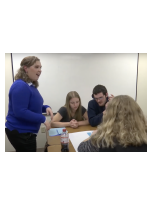
    These two classroom videos and accompanying materials are designed to provide adult educators with models of effective standards implementation. Through these Standards-in-Action (SIA) videos, adult educators can identify instructors employing effective language acquisition teaching and learning practices required by challenging academic standards. Both videos showcase online teaching, so there are also many good examples of using a combination of technology tools and resources to engage learners and enhance learning.
    Publication Year
    2023
    A Collection of Two Standards-in-Action Classroom Videos and a Video Resource Package for English Language Arts/Literacy
    Author: StandardsWork, Inc.
    Program Level: Professional Development
    Material Type: Collection
    Language: English
    License: (CC BY-NC-ND 4.0) For license summary click here

    Abstract:

    These two classroom videos and accompanying materials are designed to provide adult educators with models of effective standards implementation. Through these Standards-in-Action (SIA) videos, adult educators can identify instructors employing effective teaching and learning practices in English language arts (ELA)/literacy required by challenging academic standards.

    These two SIA ELA/literacy videos and associated lesson materials are designed to support adult educators in implementing the instructional shifts required by college and career readiness (CCR) standards. The videos can be used for independent study or as part of a professional learning community or professional development program. They can also accompany the SIA classroom observation system. The SIA Video Resource Package for ELA/Literacy accompanying the videos provides additional guidance and concrete, visible evidence of CCR standards-aligned lessons.  It includes:
    • Completed evidence-based observation rubrics that include descriptive annotations identifying observed lesson elements as well as instructor and student actions that support high levels of learning; 
    • Detailed ELA/literacy lesson plans that identify targeted standards, learning goals, and sequence of planned activities;
    The classroom videos have been carefully reviewed and annotated by experienced educators and content experts using the SIA Classroom Observation Tool for ELA/Literacy. The videos show students' productive and active engagement in effective, standards-based lessons. This includes, for example, peer-to-peer and small group discussions and deliberations. Educators can use the videos and the accompanying materials as models to support their teaching and lesson design to ensure they reflect the necessary shifts in instruction.
    Benefits and Uses
    Through these videos and accompanying materials, adult educators can:
    • See examples of strong, standards-aligned lessons in a variety of settings;
    • Hear from the videotaped instructors about their teaching;
    • Use the annotated instructional examples to better understand the video lessons and the evidence of desired instructor and student actions;
    • Guide targeted professional learning for instructors working with students in various standards-based contexts;
    • Support the use of the SIA classroom observation system in all programs statewide.
    Resource Notice
    This site includes links to information created by other public and private organizations. These links are provided for the user’s convenience. The U.S. Department of Education does not control or guarantee the accuracy, relevance, timeliness, or completeness of this non-ED information. The inclusion of these links is not intended to reflect their importance, nor is it intended to endorse views expressed, or products or services offered, on these non-ED sites. Please note that privacy policies on non-ED sites may differ from ED’s privacy policy. When you visit lincs.ed.gov, no personal information is collected unless you choose to provide that information to us. We do not give, share, sell, or transfer any personal information to a third party. We recommend that you read the privacy policy of non-ED websites that you visit. We invite you to read our privacy policy.
    Resource URL
    Publication Year
    2023
    A Collection of Four Standards-in-Action Classroom Videos and Two Video Resource Packages for Mathematics
    Author: StandardsWork, Inc.
    Program Level: Professional Development
    Material Type: Collection
    Language: English
    License: (CC BY-NC-ND 4.0) For license summary click here

    Abstract:

    These four classroom videos and accompanying materials are designed to provide adult educators with models of effective standards implementation. Through these Standards-in-Action (SIA) videos, adult educators can identify instructors employing effective teaching and learning practices in mathematics required by challenging academic standards.
    These four SIA classroom videos and associated lesson materials are designed to support adult educators in implementing the instructional shifts required by college and career readiness (CCR) standards in mathematics. The videos can be used for independent study or as part of a professional learning community or professional development program. They can also accompany the SIA classroom observation system. SIA Video Resources Packages One and Two for Mathematics provide additional guidance and visible evidence of CCR standards-aligned lessons.  They include:
    • Completed evidence-based observation rubrics that include descriptive annotations identifying observed lesson elements as well as instructor and student actions that support high levels of learning; 
    • Detailed mathematics lesson plans that identify targeted standards, learning goals, and a sequence of planned activities;
    The classroom videos have been carefully reviewed and annotated by experienced educators and content experts using the SIA Classroom Observation Tool for Mathematics. The videos show students' productive and active engagement in effective, standards-based lessons. This includes, for example, peer-to-peer and small group discussions and deliberations. English learners are represented in two of the mathematics classroom videos. Educators can also use all four videos and the accompanying materials as models to support their teaching and lesson design to ensure they reflect the necessary shifts in instruction.
    Benefits and Uses
    Through these videos and accompanying materials, adult educators can:
    • See examples of strong, standards-aligned lessons in a variety of settings;
    • Hear from the videotaped instructors and participating students about the teaching and learning;
    • Use the annotated instructional examples to better understand the video lessons and the evidence of desired instructor and student actions;
    • Guide targeted professional learning for instructors working with students in various standards-based contexts;
    • Support the use of the SIA classroom observation system in all programs statewide.
    Resource Notice
    This site includes links to information created by other public and private organizations. These links are provided for the user’s convenience. The U.S. Department of Education does not control or guarantee the accuracy, relevance, timeliness, or completeness of this non-ED information. The inclusion of these links is not intended to reflect their importance, nor is it intended to endorse views expressed, or products or services offered, on these non-ED sites. Please note that privacy policies on non-ED sites may differ from ED’s privacy policy. When you visit lincs.ed.gov, no personal information is collected unless you choose to provide that information to us. We do not give, share, sell, or transfer any personal information to a third party. We recommend that you read the privacy policy of non-ED websites that you visit. We invite you to read our privacy policy.
    Resource URL
    Publication Year
    2023
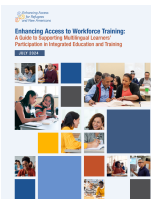
    Enhancing Access to Workforce Training: A Guide to Supporting Multilingual Learners’ Participation in Integrated Education and Training
    Author: Jessie Stadd and Laura Rasmussen Foster
    Program Level: Professional Development
    Material Type: Collection
    Language: English
    License: (CC BY-NC-ND 4.0) For license summary click here

    Abstract:

    This guide supports the development of workforce training programs, including Integrated Education and Training (IET), that maximizes accessibility for multilingual learners. To prepare multilingual learners for success in the workforce, adult education programs can develop workforce training programs, including IET, that maximizes accessibility for multilingual learners, helping them to access and succeed in these programs. The guide describes the required components of IET, potential barriers for multilingual learners, and, strategies for supporting their participation and success in education and workforce training. The strategies focus on four key topics:
    • program design,
    • partnerships,
    • navigation and advising, and
    • instructional approaches.
    For each strategy, the guide summarizes actions to take and additional resources to explore. The guide also provides tips for using a learner-centered approach within each of these strategies.
    Benefits and Uses
    This guide is designed for adult education providers who are already offering IET programming or connections to IET programs. Program designers and staff can help use the strategies described in the guide to help learners build the language skills and workforce knowledge they need to participate and be successful in IET and other education and training opportunities. By using a learner-centered approach and intentionally connecting multilingual learners with IET programs, adult educators can leverage learners’ assets to address their linguistic, academic, workforce, and basic needs barriers and bring learner voice into program design. These practices can help multilingual learners access and succeed in workforce training programs, preparing them for good jobs that enable their economic integration into their communities.
    Resource Notice
    This site includes links to information created by other public and private organizations. These links are provided for the user’s convenience. The U.S. Department of Education does not control or guarantee the accuracy, relevance, timeliness, or completeness of this non-ED information. The inclusion of these links is not intended to reflect their importance, nor is it intended to endorse views expressed, or products or services offered, on these non-ED sites. Please note that privacy policies on non-ED sites may differ from ED’s privacy policy. When you visit lincs.ed.gov, no personal information is collected unless you choose to provide that information to us. We do not give, share, sell, or transfer any personal information to a third party. We recommend that you read the privacy policy of non-ED websites that you visit. We invite you to read our privacy policy.
    Publication Year
    2024