Foundational Skills in the Service Sector
    Author: Amanda Bergson-Shilcock
    Subject Area: LINCS Resources
    Program Level: Professional Development
    Material Type: Collection
    Language: English
    License: (CC BY-NC-ND 4.0) For license summary click here

    Abstract:

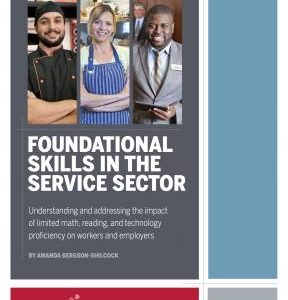
    This paper describes the characteristics of American workers employed in key service-sector industries who lack foundational skills, highlights promising practices and interventions to help them upskill, and details key federal and state policy levers that foster economic mobility.
    Publication Year
    2017
    Approximately forty-eight million Americans are employed in the service sector industries of retail, health and social assistance, and leisure and hospitality. Data from the Organization for Economic Cooperation and Development (OECD) Survey of Adult Skills indicates that:
    • Low skills are prevalent among service sector workers.
    • Most low-skilled workers have at least a high school diploma or equivalent.
    • Nearly two out of three low-skilled workers have children.
    • Most low-skilled workers have been with their employer for at least 3 years.
    • Most low-skilled workers have low earnings.
    • Despite their skill gaps, many workers regularly use reading, writing, and math on the job.
    • Workers with low digital skills are more likely to use computers on the job than those with low literacy skills.
    • A majority of workers are continuing to learn new things on the job.
    • More than 1 in 3 workers regularly teach people on the job.
    • Nearly 1 in 4 low-skilled workers are supervisors.
    Many workers actively pursue education and training opportunities:
    • One in ten have participated in a basic skills class in the previous year.
    • 27% have pursued a formal degree or certificate in the previous year.
    • 69% of those in a degree or certificate program are doing so for job-related reasons.
    The analysis also identified obstacles that prevent workers from accessing upskilling opportunities:
    • Employers are more likely to financially support workers’ participation in non-formal training than in formal degree or certificate programs.
    • Logistical barriers such as lack of time and money, make it hard for workers to participate in learning opportunities.
    • The costs of the digital technology needed to participate in distance education are prohibitive for many workers.
    Small- and medium-sized employers interested in helping employees build skills and advance in their companies have a range of interventions available to them including:
    • Partnering with other firms and education providers to provide training.
    • Providing in-house, on-site training.
    • Providing ancillary services such as peer mentoring, helping employees acquire English language skills or helping them prepare for U.S. citizenship.
    • Matching employee contributions to cover educational costs.
    While many of the employer practices can be implemented on a small scale by individual companies, facilitating widespread economic mobility for service-sector workers requires advancing proven policies at the federal and state levels. At the federal level, policies that foster employee upskilling include:
    • Making sector partnerships America’s way of doing business.
    • Making it easier for workers to navigate career pathways.
    • Fully funding federal investment in adult education.
    • Expanding financial aid to be more responsive to working learners and businesses.
    • Supporting the expansion of work-based learning opportunities.
    • Incentivizing private investment in frontline workers with basic skill needs.
    States can support upskilling by:
    • Funding and supporting industry sector partnerships.
    • Advancing effective Integrated Education and Training models.
    • Supporting job-driven financial aid policies.
    • Establishing stackable credential policies that include industry certifications.
    • Supporting businesses in providing work-based learning opportunities.
    What the experts say
    Foundational Skills in the Service Sector provides good examples of programs and important policy recommendations. The resource does not differentiate between sub-sectors, disseminating assumptions about service works, and narrowing the focus of interested parties to primarily government and employers. Citations are scarce particularly in the programmatic section. Some policy suggestions have value but, other than the need for greater investment in adult education and workforce development, seem unrelated to the arguments in the paper. The research described in this resource has value for classroom instructors (e.g. better understanding specific proficiencies service sector workers need on the job and what motivates workers to seek further education) and program managers reaching out to workforce development entities, employers, and support programs. Adult educators will find a bonus in Foundational Skills’ extensive section describing model programs and recommended policies—with many helpful citations. Well-documented partnerships are described as well as programs that employers can undertake on their own.  A “Taking Upskilling to Scale” section describes policies that advocates can promote at the federal and state level such as “Make it easier for workers to navigate career pathways.” Adult education administrators and lead teachers will find this specific analysis of PIAAC data on the service sector workforce - arguably the largest employer sector of low skilled adults - very useful for both strategic and operational planning. The paper's argument that low skills among America's workforce lowers productivity and is a barrier to personal economic mobility supports adult education advocacy on state and local workforce boards, regional economic development corporations, chambers of commerce, and with specific employers. This paper is a call to action within America's largest and fastest growing industry sector.
    Resource Notice
    This site includes links to information created by other public and private organizations. These links are provided for the user’s convenience. The U.S. Department of Education does not control or guarantee the accuracy, relevance, timeliness, or completeness of this non-ED information. The inclusion of these links is not intended to reflect their importance, nor is it intended to endorse views expressed, or products or services offered, on these non-ED sites. Please note that privacy policies on non-ED sites may differ from ED’s privacy policy. When you visit lincs.ed.gov, no personal information is collected unless you choose to provide that information to us. We do not give, share, sell, or transfer any personal information to a third party. We recommend that you read the privacy policy of non-ED websites that you visit. We invite you to read our privacy policy.
    Developing Basic Skills Curriculum for an IET
    Author: Institute for the Study of Adult Literacy (ISAL), The Pennsylvania State University
    Program Level: Professional Development
    Material Type: Collection
    Language: English
    License: (CC BY-NC-ND 4.0) For license summary click here

    Abstract:

    This resource provides templates, guidance, and tools that will help practitioners plan, design, and implement the basic skills component of an IET curriculum.
    Publication Year
    2017
    Integrated Education and Training (IET) has become a useful strategy to help adult education students and others improve their basic and occupational skills while meeting local workforce development requirements and needs. The resource provides templates, guidance, and tools that will help practitioners plan, design, and implement the basic skills component of an IET curriculum. The resource is designed to enable Title II providers and their training partners to adapt existing curriculum and/or develop new basic skills curriculum to help adult education students successfully complete occupational skills training and move forward on a career path. The focus of this guide is on basic skills rather than occupational skills training curriculum.
    Benefits and Uses
    The resource may provide support for those developing an IET as it provides guidance on the development of contextualized basic skills curriculum. The resource includes examples, instructional approaches, and templates that could be used for IET planning or for professional development.
    Resource Notice
    This site includes links to information created by other public and private organizations. These links are provided for the user’s convenience. The U.S. Department of Education does not control or guarantee the accuracy, relevance, timeliness, or completeness of this non-ED information. The inclusion of these links is not intended to reflect their importance, nor is it intended to endorse views expressed, or products or services offered, on these non-ED sites. Please note that privacy policies on non-ED sites may differ from ED’s privacy policy. When you visit lincs.ed.gov, no personal information is collected unless you choose to provide that information to us. We do not give, share, sell, or transfer any personal information to a third party. We recommend that you read the privacy policy of non-ED websites that you visit. We invite you to read our privacy policy.
    Material Type: Collection
    Language: English
    License: (CC BY-NC-ND 4.0) For license summary click here
    Exploring Coaching for Powerful Technology Use in Education
    Author: Tina Ehsanipour and Florence Gomez Zaccarelli
    Program Level: Professional Development
    Material Type: Collection
    Language: English
    License: (CC BY-NC-ND 4.0) For license summary click here

    Abstract:

    This paper examines how to best provide teachers with the time, support, and space to learn how to use new technological tools and resources effectively.
    Publication Year
    2017
    This report examines the role of technology in the 21st century classroom and how to best provide teachers with the time, support, and space to learn how to use technological tools and resources effectively to support deeper learning. Although coaching and mentoring are sometimes used interchangeable, they involve slightly different relationships between the two parties involved. Coaching suggests a partnership-type relationship in which the coach encourages growth by sharing their expertise through a sustained professional dialogue aimed at developing instructional skills. Mentorship implies a hierarchical relationship in which the mentor serves as a role model. Just as there isn’t one way to teach, there isn’t one way to coach. There is still much to be explored and studied when it comes to creating and implementing impactful coaching programs. Existing literature suggests that:
    • Coaching is most meaningful to teachers when it is content-specific and stimulates collaboration between coaches and teachers in a coaching relationship.
    • Long-term coaching is more impactful than one-shot professional development opportunities because it allows for more responsive coaching and relationship-building between the coach and teacher, in turn having the most impact on the teacher’s practice.
    • Coaching for technology integration should be based in the understanding that technology is in service of specific content and supports developing higher order skills as well as effective teaching practices.
    What the experts say
    There can be feeling of urgency in determining how to implement technology into classrooms. The authors contend that thoughtfully considering how teachers are trained to roll out, implement, and evolve the use of technology in their classrooms is a much-needed dose of slow and steady deliberateness. Program administrators and instructors will find the resource is helpful in understanding how adult learners learn and the different ways to assess student learning. It can also be used to foster higher-order thinking skills in teachers and help them model the skill sets and mindset that will positively impact students lives. Uses will note that the theoretical framework underlying the narrative is not specifically from the field of adult education, but education more broadly. However, all the techniques and recommendations within the resource can be meaningfully applied in adult education classrooms.  
    Resource Notice
    This site includes links to information created by other public and private organizations. These links are provided for the user’s convenience. The U.S. Department of Education does not control or guarantee the accuracy, relevance, timeliness, or completeness of this non-ED information. The inclusion of these links is not intended to reflect their importance, nor is it intended to endorse views expressed, or products or services offered, on these non-ED sites. Please note that privacy policies on non-ED sites may differ from ED’s privacy policy. When you visit lincs.ed.gov, no personal information is collected unless you choose to provide that information to us. We do not give, share, sell, or transfer any personal information to a third party. We recommend that you read the privacy policy of non-ED websites that you visit. We invite you to read our privacy policy.
    Career Pathways Checklist
    Author: Daniel S. Eckstein and Dana M. Young
    Program Level: Professional Development
    Material Type: Collection
    Language: English
    License: (CC BY-NC-ND 4.0) For license summary click here

    Abstract:

    This checklist is designed as a work aid to help determine the extent to which a newly developed or existing program meets the requirements for career pathways in section (3)(7) of WIOA.
    Publication Year
    2017
    Resource Type
    The Workforce Innovation and Opportunity Act (WIOA) was enacted on July 22, 2014. WIOA calls for cross-system alignment; education and training that is focused on the needs of high-demand industry sectors and occupations; regional collaboration focused on the skill needs of regional economies; and the establishment of career pathways systems that make it easier for all Americans to attain the skills and credentials needed for family-supporting jobs and careers. Within these systems, career pathways programs offer a clear sequence, or pathway, of education coursework and/or training credentials aligned with employer-validated work readiness standards and competencies. This checklist is designed as a work aid to help determine the extent to which a newly developed or existing program meets the requirements for career pathways in section (3)(7) of WIOA.
    Benefits and Uses
    This checklist is for planners and managers of career pathways programs Financial aid counselors and administrators responsible for administering the Ability to Benefit (AtB) provisions of the Higher Education Act (HEA), that allow a student who does not have a high school diploma (or its recognized equivalent) to be eligible for Title IV, HEA student assistance through one of the AtB alternatives if the student is enrolled in an “eligible career pathway program” that aligns to the statutory requirements in WIOA.
    Resource Notice
    This site includes links to information created by other public and private organizations. These links are provided for the user’s convenience. The U.S. Department of Education does not control or guarantee the accuracy, relevance, timeliness, or completeness of this non-ED information. The inclusion of these links is not intended to reflect their importance, nor is it intended to endorse views expressed, or products or services offered, on these non-ED sites. Please note that privacy policies on non-ED sites may differ from ED’s privacy policy. When you visit lincs.ed.gov, no personal information is collected unless you choose to provide that information to us. We do not give, share, sell, or transfer any personal information to a third party. We recommend that you read the privacy policy of non-ED websites that you visit. We invite you to read our privacy policy.
    Career Kits: A Comprehensive Career Preparation Teaching Resource for HSE & ESL Learners Reflecting NYS Regional Labor Market Statistics
    Author: The City University of New York (CUNY) Adult Literacy/HSE/ESOL Program
    Program Level: Professional Development
    Material Type: Collection
    Language: English
    License: (CC BY-NC-ND 4.0) For license summary click here

    Abstract:

    The New York State Education Department (NYSED) and The City University of New York (CUNY) co-developed the NYSED/CUNY CareerKit, which is a comprehensive career preparation resource for teachers and counselors to equip students with the skills necessary to make informed choices about their career paths in ten industry sectors.
    Publication Year
    2017
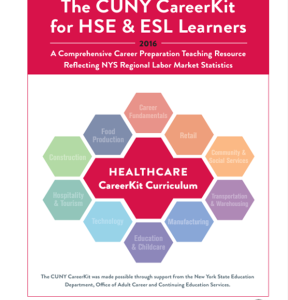
    The New York State Education Department (NYSED) and The City University of New York (CUNY) co-developed the NYSED/CUNY CareerKit. It is a comprehensive career preparation resource for teachers and counselors to equip students with the skills necessary to make informed choices about their career paths in ten industry sectors. CareerKit activities are written at the high school equivalency (HSE)/Upper English as a second language (ESL) level, with adaptations possible for Pre-HSE and intermediate ESL levels, and integrates reading, writing, research and math skills. The sectors are Healthcare, Technology, Community & Social Services, Education & Childcare, Manufacturing, Hospitality, Recreation, & the Arts, Food Production, Retail, Construction, and Transportation & Warehousing. There is also a foundational, multisector CareerKit, Career Fundamentals, which introduces students to key questions related to career decision-making.
    Benefits and Uses
    The resource provides teachers and counselors with resources to support students with the skills necessary to make informed decisions/choices about ten career sectors/paths. The resource contextualizes the career exploration activities by integrating reading, writing, research, and math skills. Because each kit has the same unit topics, the resource also allows for instructors to deliver workforce readiness instruction in areas such as career planning, educational pathways, and self-awareness to learners interested in careers in different industries.
    Resource Notice
    This site includes links to information created by other public and private organizations. These links are provided for the user’s convenience. The U.S. Department of Education does not control or guarantee the accuracy, relevance, timeliness, or completeness of this non-ED information. The inclusion of these links is not intended to reflect their importance, nor is it intended to endorse views expressed, or products or services offered, on these non-ED sites. Please note that privacy policies on non-ED sites may differ from ED’s privacy policy. When you visit lincs.ed.gov, no personal information is collected unless you choose to provide that information to us. We do not give, share, sell, or transfer any personal information to a third party. We recommend that you read the privacy policy of non-ED websites that you visit. We invite you to read our privacy policy.
    Blended Learning for Adult Educators
    Author: David Rosen
    Program Level: Professional Development
    Material Type: Collection
    Language: English
    License: (CC BY-NC-ND 4.0) For license summary click here

    Abstract:

    This webinar is an introduction to blended learning—a teaching and learning model that combines face-to-face instruction with online learning.
    Publication Year
    2017
    This online presentation, developed by the Commission on Adult Basic Education (COABE), describes blended learning, an instructional approach that integrates face-to-face and online learning. The percentage of instruction delivered online is what differentiates blended learning from distance learning and web-facilitated instruction. In blended learning, online learning constitutes between 30 and 79 percent of instruction compared to less than 30 percent in web-facilitated instruction and 80 percent or more in distance learning. Online learning can be offered in real time or asynchronously and can range in complexity and cost from online lessons stored in free online filing systems, to sophisticated online platforms that offer multiple features.
    There is evidence suggesting that blended learning has some advantages over traditional classroom instruction. This presentation includes information further explored in the report, Blended Learning for the Adult Education Classroom. For example, the presentation shares data from the report indicating that Texas adult learners who received up to 50% of their instruction online outperformed those who attended traditional classes and those who received more than half of their learning online. A 2010 meta-analysis published by the U.S. Department of Education’s Office of Planning, Evaluation and Policy Development found that K-12 and higher education students learning online performed modestly better than counterparts learning the same subject matter through traditional face-to-face instruction. Examples of how adult education teachers are using blended learning are provided as well as strategies for ensuring that students have access to technology and free blended learning tools.
    What the experts say
    This webinar provides a clear and useful introduction to blended learning and is suitable for new and veteran adult education teachers. The presenter reviews principles of blended learning and the reasons why instructors may wish to use it with their students. These reasons include acquiring digital literacy/online skills, providing a way for students to make up missed class work, and extending available learning time. Recognizing that the webinar is simply an introduction, the presenter frequently refers participants to Blended Learning for the Adult Education Classroom, a more in-depth report also included in the LINCS Resource Collection. The Blended Learning report identifies additional resources that will help adult education practitioners and adult education students make more effective use of online resources and formats.
    Resource Notice
    This site includes links to information created by other public and private organizations. These links are provided for the user’s convenience. The U.S. Department of Education does not control or guarantee the accuracy, relevance, timeliness, or completeness of this non-ED information. The inclusion of these links is not intended to reflect their importance, nor is it intended to endorse views expressed, or products or services offered, on these non-ED sites. Please note that privacy policies on non-ED sites may differ from ED’s privacy policy. When you visit lincs.ed.gov, no personal information is collected unless you choose to provide that information to us. We do not give, share, sell, or transfer any personal information to a third party. We recommend that you read the privacy policy of non-ED websites that you visit. We invite you to read our privacy policy.
    A Planning Guide for Aligning Career and Technical Education (CTE) and Apprenticeship Programs
    Author: Audrey Denney, Seth Derner, and Scott Stump
    Program Level: Professional Development
    Material Type: Collection
    Language: English
    License: (CC BY-NC-ND 4.0) For license summary click here

    Abstract:

    This planning guide is designed as an interactive tool for initiating or expanding the alignment between existing career and technical education (CTE) and apprenticeship programs.
    Publication Year
    2017
    This planning guide is designed as an interactive tool for initiating or expanding the alignment between existing CTE and apprenticeship programs. It provides a blueprint for state, regional, and local administrators leading efforts to transform CTE and apprenticeship linkages across a state or community. The blueprint begins with defining the potential impact that CTE and apprenticeship alignment will have for students, employers, and communities. The process then moves to developing a plan of action tailored to the needs and readiness of state or local programs. Once a plan is in place, partnerships are developed with institutions, employers, and agencies who then help in defining and designing the program. Customizable tools and templates are provided that allow users to adjust each resource to fit their unique needs. While the steps, tools, and resources in this guide are valuable to anyone interested in strengthening the potential intersection between CTE and apprenticeship programs, this resource is targeted at two distinct groups of users. The first includes state leaders of education and workforce training systems seeking to improve the alignment of secondary CTE and apprenticeship programs. The second includes education and training providers who are interested in working with regional or local employers or industry groups to expand the role of CTE in preparing high school students for apprenticeships.
    Benefits and Uses
    State, regional, and local administrators can use the customizable tools and templates to improve the alignment of secondary CTE and apprenticeship programs. Education and training providers can also use the tools with regional or local employers or industry groups to expand the role of CTE in preparing high school students for apprenticeships that fit well within the context of federal, state, and local efforts to build seamless career pathways that align and integrate education and workforce development programs.
    Resource Notice
    This site includes links to information created by other public and private organizations. These links are provided for the user’s convenience. The U.S. Department of Education does not control or guarantee the accuracy, relevance, timeliness, or completeness of this non-ED information. The inclusion of these links is not intended to reflect their importance, nor is it intended to endorse views expressed, or products or services offered, on these non-ED sites. Please note that privacy policies on non-ED sites may differ from ED’s privacy policy. When you visit lincs.ed.gov, no personal information is collected unless you choose to provide that information to us. We do not give, share, sell, or transfer any personal information to a third party. We recommend that you read the privacy policy of non-ED websites that you visit. We invite you to read our privacy policy.