A Collection of Four Standards-in-Action Classroom Videos and Two Video Resource Packages for Mathematics
    Author: StandardsWork, Inc.
    Program Level: Professional Development
    Material Type: Collection
    Language: English
    License: (CC BY-NC-ND 4.0) For license summary click here

    Abstract:

    These four classroom videos and accompanying materials are designed to provide adult educators with models of effective standards implementation. Through these Standards-in-Action (SIA) videos, adult educators can identify instructors employing effective teaching and learning practices in mathematics required by challenging academic standards.
    These four SIA classroom videos and associated lesson materials are designed to support adult educators in implementing the instructional shifts required by college and career readiness (CCR) standards in mathematics. The videos can be used for independent study or as part of a professional learning community or professional development program. They can also accompany the SIA classroom observation system. SIA Video Resources Packages One and Two for Mathematics provide additional guidance and visible evidence of CCR standards-aligned lessons.  They include:
    • Completed evidence-based observation rubrics that include descriptive annotations identifying observed lesson elements as well as instructor and student actions that support high levels of learning; 
    • Detailed mathematics lesson plans that identify targeted standards, learning goals, and a sequence of planned activities;
    The classroom videos have been carefully reviewed and annotated by experienced educators and content experts using the SIA Classroom Observation Tool for Mathematics. The videos show students' productive and active engagement in effective, standards-based lessons. This includes, for example, peer-to-peer and small group discussions and deliberations. English learners are represented in two of the mathematics classroom videos. Educators can also use all four videos and the accompanying materials as models to support their teaching and lesson design to ensure they reflect the necessary shifts in instruction.
    Benefits and Uses
    Through these videos and accompanying materials, adult educators can:
    • See examples of strong, standards-aligned lessons in a variety of settings;
    • Hear from the videotaped instructors and participating students about the teaching and learning;
    • Use the annotated instructional examples to better understand the video lessons and the evidence of desired instructor and student actions;
    • Guide targeted professional learning for instructors working with students in various standards-based contexts;
    • Support the use of the SIA classroom observation system in all programs statewide.
    Resource Notice
    This site includes links to information created by other public and private organizations. These links are provided for the user’s convenience. The U.S. Department of Education does not control or guarantee the accuracy, relevance, timeliness, or completeness of this non-ED information. The inclusion of these links is not intended to reflect their importance, nor is it intended to endorse views expressed, or products or services offered, on these non-ED sites. Please note that privacy policies on non-ED sites may differ from ED’s privacy policy. When you visit lincs.ed.gov, no personal information is collected unless you choose to provide that information to us. We do not give, share, sell, or transfer any personal information to a third party. We recommend that you read the privacy policy of non-ED websites that you visit. We invite you to read our privacy policy.
    Resource URL
    Publication Year
    2023
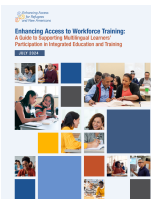
    Enhancing Access to Workforce Training: A Guide to Supporting Multilingual Learners’ Participation in Integrated Education and Training
    Author: Jessie Stadd and Laura Rasmussen Foster
    Program Level: Professional Development
    Material Type: Collection
    Language: English
    License: (CC BY-NC-ND 4.0) For license summary click here

    Abstract:

    This guide supports the development of workforce training programs, including Integrated Education and Training (IET), that maximizes accessibility for multilingual learners. To prepare multilingual learners for success in the workforce, adult education programs can develop workforce training programs, including IET, that maximizes accessibility for multilingual learners, helping them to access and succeed in these programs. The guide describes the required components of IET, potential barriers for multilingual learners, and, strategies for supporting their participation and success in education and workforce training. The strategies focus on four key topics:
    • program design,
    • partnerships,
    • navigation and advising, and
    • instructional approaches.
    For each strategy, the guide summarizes actions to take and additional resources to explore. The guide also provides tips for using a learner-centered approach within each of these strategies.
    Benefits and Uses
    This guide is designed for adult education providers who are already offering IET programming or connections to IET programs. Program designers and staff can help use the strategies described in the guide to help learners build the language skills and workforce knowledge they need to participate and be successful in IET and other education and training opportunities. By using a learner-centered approach and intentionally connecting multilingual learners with IET programs, adult educators can leverage learners’ assets to address their linguistic, academic, workforce, and basic needs barriers and bring learner voice into program design. These practices can help multilingual learners access and succeed in workforce training programs, preparing them for good jobs that enable their economic integration into their communities.
    Resource Notice
    This site includes links to information created by other public and private organizations. These links are provided for the user’s convenience. The U.S. Department of Education does not control or guarantee the accuracy, relevance, timeliness, or completeness of this non-ED information. The inclusion of these links is not intended to reflect their importance, nor is it intended to endorse views expressed, or products or services offered, on these non-ED sites. Please note that privacy policies on non-ED sites may differ from ED’s privacy policy. When you visit lincs.ed.gov, no personal information is collected unless you choose to provide that information to us. We do not give, share, sell, or transfer any personal information to a third party. We recommend that you read the privacy policy of non-ED websites that you visit. We invite you to read our privacy policy.
    Publication Year
    2024
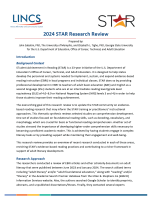
    2024 STAR Research Review
    Author: John Sabatini, PhD and Elizabeth L. Tighe, PhD
    Subject Area: LINCS Resources, Reading
    Program Level: Professional Development
    Material Type: Collection
    Language: English
    License: (CC BY-NC-ND 4.0) For license summary click here

    Abstract:

    The overarching goal of the research review is to update the STudent Achievement in Reading (STAR) community on evidence-based reading research that may inform the STAR training or practitioners’ instructional approaches. This thematic synthesis reviews selected studies on comprehension development. One set of studies focused on foundational reading skills, such as decoding, vocabulary, and morphology, which are crucial for basic or functional reading comprehension. Another set of studies stressed the importance of developing higher-order comprehension skills necessary to becoming a proficient academic reader. This is achieved by having students engage in complex literacy tasks or by providing support while monitoring their engagement and well-being.  This research review provides an overview of recent research conducted in each of these areas, enriching STAR’s evidence-based reading practices and contributing to a richer framework in support of adult literacy development.
    Benefits and Uses
    The STAR Research Synthesis provides the field with up-to-date information on promising practices, challenges, and new developments in the science of reading that adult education instructors and administrators can use in EBRI implementation.
    Resource Notice
    This site includes links to information created by other public and private organizations. These links are provided for the user’s convenience. The U.S. Department of Education does not control or guarantee the accuracy, relevance, timeliness, or completeness of this non-ED information. The inclusion of these links is not intended to reflect their importance, nor is it intended to endorse views expressed, or products or services offered, on these non-ED sites. Please note that privacy policies on non-ED sites may differ from ED’s privacy policy. When you visit lincs.ed.gov, no personal information is collected unless you choose to provide that information to us. We do not give, share, sell, or transfer any personal information to a third party. We recommend that you read the privacy policy of non-ED websites that you visit. We invite you to read our privacy policy.
    Publication Year
    2024
    Integrated Education and Training Design Toolkit and Train-the-Trainer Resources
    Author: Amanda Ahlstrand, Debby Andrews, Michelle Carson, KayLynn Hamilton, Jennifer Jirous-Rapp, Gina Wells, and Blaire Willson-Toso
    Subject Area: IET, LINCS Resources
    Program Level: Professional Development
    Material Type: Collection
    Language: English
    License: (CC BY-NC-ND 4.0) For license summary click here

    Abstract:

    The Office of Career, Technical, and Adult Education (OCTAE) supported development of the Integrated Education and Training (IET) Toolkit to assist state and local adult education staff to plan, design, implement, and evaluate effective IET programs that are responsive to state and local labor market demands and fulfill the requirements of WIOA.  Please find the online, interactive Toolkit at the link here: https://courses.lincs.ed.gov/course/view.php?id=268.  (Please note that you have to have a LINCS account to access the course.) The Toolkit has been updated since the initial release posted in October 2021.
    In early 2024, the PDF version of the Toolkit was updated to include links to desk aids that support the development of IET programs that are fully accessible to English Learners. These desk aids were created with support from OCTAE through the Enhancing Access for Refugees and New Americans project. In addition, OCTAE’s IET in Corrections project has created the IET in Corrections: A Companion Guide to the IET Design Toolkit to provide further consideration and tools for those designing IET programs for delivery in correctional facilities.
    Publication Year
    2025
    Benefits and Uses
    The Toolkit is designed to support IET program implementation in alignment with WIOA statute and regulations. It is a comprehensive set of steps and activities that can be used in whole or in part to design and develop an IET program from scratch or to enhance existing programs. The Train-the-Trainer materials can be used to provide professional development to staff involved in administering and designing IET programs and can be tailored to a specific state or local context.
    Required Training
    No prior training required.
    Resource Notice
    This site includes links to information created by other public and private organizations. These links are provided for the user’s convenience. The U.S. Department of Education does not control or guarantee the accuracy, relevance, timeliness, or completeness of this non-ED information. The inclusion of these links is not intended to reflect their importance, nor is it intended to endorse views expressed, or products or services offered, on these non-ED sites. Please note that privacy policies on non-ED sites may differ from ED’s privacy policy. When you visit lincs.ed.gov, no personal information is collected unless you choose to provide that information to us. We do not give, share, sell, or transfer any personal information to a third party. We recommend that you read the privacy policy of non-ED websites that you visit. We invite you to read our privacy policy.
    Resource URL: https://lincs.ed.gov/sites/default/files/2025-05/IET-Toolkit-2025.pdf
    Learners, Educators & Communities as Problem-Solvers Special Collection
    Author: Paul Jurmo
    Material Type: Collection
    Language: English
    License: (CC BY-NC-ND 4.0) For license summary click here

    Abstract:

    This “Learners, Educators & Communities as Problem Solvers” Special Collection is written for adult educators, adult learners, public policy makers, funders, and other stakeholders who are interested in building more effective U.S. adult foundational education (AFE) systems. It provides diverse examples of research and theory, program models, and curriculum and planning tools that might be adapted at the national, state, local, and program levels.
    Workplace Learning Special Collection
    Author: Paul Jurmo
    Material Type: Collection
    Language: English
    License: (CC BY-NC-ND 4.0) For license summary click here

    Abstract:

    This Workplace Learning Special Collection is written for adult educators, public policy makers, funders, employers, labor unions, and others who are interested in strengthening and expanding adult foundational education (AFE) supports for already-employed workers in the U.S. It provides diverse examples of policy and funding, program models, contextualized curricula relevant to diverse industries, tools for planning and evaluating programs and assessing learner needs, employer and union roles, and examples from other nations.
    Policy for Adult Foundational Education Special Collection
    Author: Paul Jurmo
    Material Type: Collection
    Language: English
    License: (CC BY-NC-ND 4.0) For license summary click here

    Abstract:

    This Policy for Adult Foundational Education Special Collection is written for adult educators, public policy makers, funders, and others who are interested in strengthening policy supports for U.S. adult foundational education (AFE) efforts. It provides diverse examples of general guidelines for AFE policy that might be adapted at the national, state, and local levels and more-detailed evidence on five policy-related issues: workforce AFE policy; welfare reform; state planning and policy; goals, outcomes, and accountability for AFE; and GED and transition to post-secondary education.
    Business Partnerships Special Collection
    Author: Paul Jurmo
    Material Type: Collection
    Language: English
    License: (CC BY-NC-ND 4.0) For license summary click here

    Abstract:

    This Business Partnerships Guide is written for adult educators, business leaders, labor organizations, public policy makers, funders, and others who are interested in strengthening business-sector support for U.S. adult foundational education (AFE) efforts. It provides diverse examples of ways that businesses have – over decades -- provided financial and in-kind supports to community AFE services, advocated for policies and funding for AFE, and provide AFE supports for employees in diverse industries. The Guide’s purpose is to help AFE advocates create new, robust versions of AFE-business partnerships that support healthy, productive communities. View Business Collections Abstract (PDF) »