Northstar Digital Literacy Assessments
    Author: Northstar Digital Literacy Project
    Program Level: Professional Development
    Material Type: Collection
    Language: English
    License: (CC BY-NC-ND 4.0) For license summary click here

    Abstract:

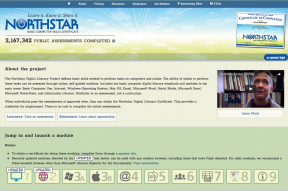
    This open-access version of the Northstar Digital Literacy Project assessments can be used for assessing digital literacy skills to inform instruction.
    Publication Year
    2018
    The Northstar Digital Literacy Project offers online learning modules and assessments in ten categories:
    • Basic computer skills
    • Internet
    • Windows OS
    • Mac OS
    • Email
    • Social media
    • Microsoft Word
    • Microsoft Excel
    • Microsoft PowerPoint
    • Information literacy
    What the experts say
    Learners must be digitally literate in order to find and succeed in a career with family-sustaining wages. The Northstar Digital Literacy Assessment is a group of standards-based interactive assessment modules that measure adult digital literacy skills at a basic level. Each assessment moves the learner up a level in their digital literacy skills. The lessons are simple and easy to understand and navigate. Many adult education teachers are seeking introductory courses in computer/digital literacy for themselves and their students. The Northstar Assessments are widely used in the fields of adult basic skills education and digital literacy skills. Designed specifically for adult basic skills (including ESL/ESOL) learners, the project began with designing a set of digital literacy standards that are acceptable to public libraries, adult basic skills educators and employers in Minnesota. The standards are based on the needs of low-literate adults as perceived by adult educators, librarians, and employment and training services specialists.  
    Resource Notice
    This site includes links to information created by other public and private organizations. These links are provided for the user’s convenience. The U.S. Department of Education does not control or guarantee the accuracy, relevance, timeliness, or completeness of this non-ED information. The inclusion of these links is not intended to reflect their importance, nor is it intended to endorse views expressed, or products or services offered, on these non-ED sites. Please note that privacy policies on non-ED sites may differ from ED’s privacy policy. When you visit lincs.ed.gov, no personal information is collected unless you choose to provide that information to us. We do not give, share, sell, or transfer any personal information to a third party. We recommend that you read the privacy policy of non-ED websites that you visit. We invite you to read our privacy policy.
    NEFE Financial Education Evaluation Online Toolkit
    Author: National Endowment for Financial Education
    Program Level: Professional Development
    Material Type: Collection
    Language: English
    License: (CC BY-NC-ND 4.0) For license summary click here

    Abstract:

    This online evaluation toolkit is designed to help financial educators understand evaluation concepts and efficiently apply them to document the impact their educational programs have on students.
    Publication Year
    2018
    The NEFE Financial Education Evaluation Online Toolkit helps financial educators document the impact of their financial education programs on learners. Evaluation allows educators, administrators and funding agencies to make decisions about their programs based on objective data. It not only provides information about areas for improvement, but also demonstrates the impact of a course or program on participants.
    After creating a free login account, teachers can create and save course evaluations. Users select what kind of evaluation to conduct and the type of impact indicators to include (e.g., Attitudinal, Knowledge). Instructors can create their own questions or select from over 800 questions from a question bank. The assessments can be printed out or instructors can send students a link to take it online. Completed assessments are automatically scored and teachers can view the results online or download them as an Excel spreadsheet. Teachers can create as many evaluations as they like and each can be saved and accessed later.
    What the experts say
    The NEFE Financial Education Evaluation Toolkit is an invaluable tool to financial literacy educators and financial literacy programs. The framework supports all financial literacy training resources, and allows for pre-, post- and multi-assessments. It provides step by step instructions to ensure instructors understand the need for conducting evaluations and how to create a valid assessment. Because it’s web-based, instructors can use the content as is or remix and modify it. Results are automatically compiled and graded under the instructor’s account. This feature allows the instructor to analyze individual learner results to ensure they’re understanding the concepts being presented.
    Resource Notice
    This site includes links to information created by other public and private organizations. These links are provided for the user’s convenience. The U.S. Department of Education does not control or guarantee the accuracy, relevance, timeliness, or completeness of this non-ED information. The inclusion of these links is not intended to reflect their importance, nor is it intended to endorse views expressed, or products or services offered, on these non-ED sites. Please note that privacy policies on non-ED sites may differ from ED’s privacy policy. When you visit lincs.ed.gov, no personal information is collected unless you choose to provide that information to us. We do not give, share, sell, or transfer any personal information to a third party. We recommend that you read the privacy policy of non-ED websites that you visit. We invite you to read our privacy policy.
    Multiplying Impact: Five Frameworks for Investment in EdTech for Adult Learners
    Author: Luminary Labs
    Program Level: Professional Development
    Material Type: Collection
    Language: English
    License: (CC BY-NC-ND 4.0) For license summary click here

    Abstract:

    This report explores the potential for technology to enhance the teaching and learning of advanced math skills for adults.
    Total Transcript, Real Outcomes: Redefining High School Equivalency for Career Pathway Success
    Author: Bronwyn Robertson and Beth Little
    Subject Area: High School Equivalency
    Program Level: Adult Basic Education
    Language: English
    License: (CC BY-NC-ND 4.0) For license summary click here

    Abstract:

    Mississippi’s innovative Total Transcript model is expanding access to high school equivalency by recognizing achievement through GED®, HiSET®, and ACT® WorkKeys®. This webinar will explore how Mississippi integrated workforce readiness and academic attainment to accelerate career pathways, increase credential opportunities, and support adult learner success. Participants will gain practical insight into policy development, implementation strategies, partnerships, and lessons learned that can be adapted within their own states and programs. Original webinar date: June 15, 2026 Webinar recording link: https://youtu.be/pl8oE0sTxvQ

    Innovative Partnerships: Adult Basic Education and Workforce Development Boards
    Author: Robert Moore
    Subject Area: Workforce
    Program Level: Adult Basic Education
    Language: English
    License: (CC BY-NC-ND 4.0) For license summary click here

    Abstract:

    This interactive workshop explores how adult basic education providers can strengthen outcomes by building innovative, results-driven partnerships with their workforce development boards. Through real-world examples and guided discussion, the session highlights how co-enrollment, integrated education and training (IET), pre-apprenticeships, shared data, and braided funding can help workforce development and ABE partners respond to talent shortages while expanding access and equity for job seekers. Attendees will identify common challenges to effective partnerships and learn concrete strategies for overcoming them through trust-building, joint planning, and continuous communication. The workshop emphasizes by positioning ABE programs and workforce development boards not only as referral agencies, but as strategic partners in talent development. Participants will leave with actionable ideas, partnership tools, and next steps they can adapt to their local systems to better serve job seekers, employers, and communities in a rapidly changing economy. Participants will (1) identify effective partnership models between workforce development and adult basic education, including co-enrollment, pre-apprenticeships, and Integrated Education and Training; (2) apply strategies to align goals, data, and resources across systems to address common partnership challenges; and (3) develop actionable next steps to strengthen local collaborations that improve outcomes for jobseekers and employers. Original webinar date: May 14, 2026 Webinar recording link: https://youtu.be/Cht1pbZg75w
    Student Voice Through Participatory Multimedia
    Author: Laura Porfirio
    Subject Area: Student Leadership
    Program Level: Adult Basic Education
    Language: English
    License: (CC BY-NC-ND 4.0) For license summary click here

    Abstract:

    How can we use multimedia storytelling to promote student voice in adult ed? Using digital stories in the classroom and professional development promotes inclusive and relevant instruction, leadership development, community building, and media literacy. In this session, attendees will explore the digital storytelling process and important elements of producing a personal narrative focusing on message and audience. They will also get practical resources, tools, and strategies for the classroom and community. Original webinar date: May 8, 2026 Webinar recording link: https://youtu.be/nQIW-bL72JM
    Building the Talent Pipeline: Adult Education’s Role in Apprenticeship Success
    Author: Patrick Brown, Karyn Goven, and Sharon Bonney
    Subject Area: Apprenticeship
    Program Level: Adult Basic Education
    Language: English
    License: (CC BY-NC-ND 4.0) For license summary click here

    Abstract:

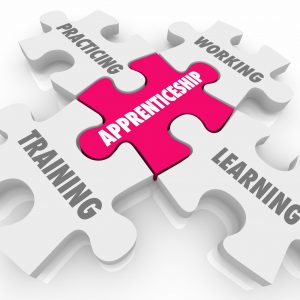
    Adult education is not a feeder system—it is a foundational workforce partner. In celebration of National Apprenticeship Week, this webinar will spotlight how adult education programs are advancing Registered Apprenticeship through IET models, contextualized instruction, and strong employer engagement. Hear real-world examples of programs that are aligning instruction with industry needs, removing barriers for adult learners, and creating seamless transitions into apprenticeship and family-sustaining careers. Discover actionable steps to elevate your program’s role in apprenticeship partnerships. Original webinar date: April 29, 2026 Webinar recording link: https://youtu.be/VmMdQ95JtG0   Important links:

    Public Access NRS Adult Education Data: Home | National Reporting System

    Michigan Center of Data Analytics: Michigan Hot 50 Job Outlook through 2032

    U.S. Employment Projections: Employment Projections Home Page : U.S. Bureau of Labor Statistics

    Finding Your State Apprenticeship Contact: State Offices | Apprenticeship.gov

    Michigan Apprenticeship Readiness Certificate: LEO - Michigan Apprenticeship Readiness Certificates (MARC)

    Michigan Adult Education: www.michigan.gov/adulteducation

    “One Person. One Plan. Many Partners.”
    Author: "Christopher Aro (christopher.aro@nucleos.com) Ian Dunnington (ian.dunnington@it1.com) Noah Freedman (noah@nucleos.com)"
    Language: English
    License: (CC BY-NC-ND 4.0) For license summary click here

    Abstract:

    Nucleos presents, "One Person. One Plan. Many Partners." Every individual on a second-chance journey has a different story, different challenges, and different goals. A one-size-fits-all approach simply doesn’t work. In this webinar, we’ll explore how personalized learning and support pathways can help individuals identify their strengths, address their needs, and build a meaningful path forward. Through the Nucleos platform, education, career development, mental health resources, reentry support, and essential soft skills can come together to form a coordinated strategy for success. When these services are connected through trusted partners, organizations can move beyond separate programs and create a support system tailored to each person. Because real progress happens when we focus on one person, create one plan, and bring together many partners. Original webinar date: April 21, 2026 Webinar recording link: https://youtu.be/xP7LMUcKJNk