Beginning Alphabetics Tests and Tools
    Author: Marn Frank and Kristin Perry
    Subject Area: ESL/ELL, LINCS Resources, Reading
    Program Level: Professional Development
    Material Type: Collection
    Language: English
    License: (CC BY-NC-ND 4.0) For license summary click here

    Abstract:

    Beginning Alphabetics Tests and Tools (BATT) strives to provide a ‘principled’ system for ABE/ESL teachers who want and/or need to develop their students’ knowledge of Roman alphabet letters, English letter-sound patterns, sight or high frequency words, and transfer of those lettersound-word skills to text fluency and comprehension.
    Publication Year
    2015
    Beginning Alphabetics Tests and Tools (BATT) strives to provide a 'principled' system for ABE/ESL teachers who want and/or need to develop their students' knowledge of Roman alphabet letters, English letter-sound patterns, sight or high frequency words, and transfer those letter-sound-word skills to text fluency and comprehension. This resource includes: 1) teacher-friendly tests for determining known and unknown skills, 2) evidence-based reading instructional practices, orders, approaches, and lesson plans for teaching unknown skills, 3) teacher-tested lists of other activities and materials, and 4) time-saving teacher resources. It was also piloted by a group of MN ABE/ESL reading teachers, who contributed their insightful feedback, teacher-tested tools, and testimonials. BATT is closely aligned with four Reading Standards: Foundational Skills (K–5) from the Minnesota Academic Standards (MDE, 2010) and Career and College Readiness Standards for Adult Education (OCTAE, 2013):
    • RF.1. Demonstrate understanding of the organization and basic features of print. (Print Concepts)
    • RF.2. Demonstrate understanding of spoken words, syllables, and sounds (phonemes). (Phonological Awareness)
    • RF.3. Know and apply grade-level phonics and word analysis skills in decoding words. (Phonics and Word Recognition)
    • RF.4. Read with sufficient accuracy and fluency to support comprehension. (Fluency)
     
    What the experts say
    Beginning Alphabetics Tests and Tools offers ABE/ESL instructors a simple but comprehensive toolkit for encouraging adults to develop a strong foundation for reading English well. The activities within support best practices from evidence-based recommendations in literacy instruction and provide instructors with the tools (handouts, plans, resources, tests) to engage beginning readers as they learn to read and, hopefully, enjoy reading! The resource provides a teacher-friendly collection of free, accessible assessment tools for practitioners to use that target alphabetics instruction for beginning readers. In addition, the resource takes a pragmatic approach to phonics instruction, thoughtfully describing and then applying synthetic, analogic, and analytic approaches in ways that make sense for various purposes. Furthermore, the five lesson plans progress developmentally, addressing increasingly higher stages of students’ alphabetics knowledge and providing a picture of the scope of instruction in this area. If used within a balanced approach to literacy instruction and introduced with training (or used by someone with a general knowledge of alphabetics instruction), this resource could be a valuable one for teachers of adults being introduced to literacy. Users are encouraged to read the front matter at the beginning of each section with care since good directions and advice are offered there—and it may be easy to overlook them. Of special note: the authors invite users to adapt the assessment directions as needed, and practitioners may want to do so. For instance, students are usually not told what the test is about until step 6 or 7—after the demonstration of what to do on the test. In general, it would be better to tell them the purpose of test first and then provide the demo, so students know what to attend to in the demo.
    Resource Notice
    This site includes links to information created by other public and private organizations. These links are provided for the user’s convenience. The U.S. Department of Education does not control or guarantee the accuracy, relevance, timeliness, or completeness of this non-ED information. The inclusion of these links is not intended to reflect their importance, nor is it intended to endorse views expressed, or products or services offered, on these non-ED sites. Please note that privacy policies on non-ED sites may differ from ED’s privacy policy. When you visit lincs.ed.gov, no personal information is collected unless you choose to provide that information to us. We do not give, share, sell, or transfer any personal information to a third party. We recommend that you read the privacy policy of non-ED websites that you visit. We invite you to read our privacy policy.
    Realizing Opportunities for English Language Learners (ELLs) Through State Academic Content Standards Webinar
    Author: StandardsWork, Inc.
    Program Level: Professional Development
    Material Type: Collection
    Language: English
    License: (CC BY-NC-ND 4.0) For license summary click here

    Abstract:

    Archive of September 14, 2016 webinar.
    Publication Year
    2016
    Realizing Opportunities for English Language Learners (ELLs) Through State Academic Content Standards was produced by StandardsWork, Inc. as part of the CCR Standards-in-Action (CCR SIA) project. Facilitated by Susan Pimentel, lead CCR SIA content expert, the webinar concentrates on meeting the needs of English-language learners (ELLs). It discusses the necessary shifting away from traditional teaching theories that encourage language instruction in isolation from other academic disciplines. Specifically, the webinar showcases research-tested strategies on how ELLs can realize opportunities through new state-level academic standards in reading, writing, speaking and listening, and language. The webinar highlights a series of research findings on how best to realize opportunities for ELLs in reading, writing, speaking and listening, and language. Ms. Pimentel discusses pedagogical shifts for language acquisition and ten steps adult educators can take to re-envision ELL education in their programs. In the final portion of the webinar, she responds to attendees’ questions.
    Benefits and Uses
    This Webinar was created for College and Career Readiness Standards In Action (CCR SIA) project for adult educators from 12 states, who requested information on how CCR standards can be implemented for ELLs. This Webinar responds to their questions. The Webinar content, demonstration video, and links to further resources all provide essential information for you to use as you re-envision ELL education in your states. Use this resource to help plan ways to implement CCR academic content in classrooms with ELLs. View it individually, as part of a professional learning community, or a professional development workshop. In addition to providing essential information about teaching ELLs, it could fuel a discussion of different strategies and approaches to implementing CCR standards. The webinar includes a classroom video demonstration that is particularly useful in conjunction with Ms. Pimentel’s summary of research on reading, writing, speaking and listening, and language (slides 17-28). The slides which articulate the pedagogical shifts in teaching ELLs (slides 29-30) provide a concise statement of the new direction for ELL instruction afforded by the CCR standards. The PowerPoint slides are available a stand-alone resource.
    Required Training
    A fundamental awareness of the CCR Standards for English Language Arts/Literacy is recommended.
    Resource Notice
    This site includes links to information created by other public and private organizations. These links are provided for the user’s convenience. The U.S. Department of Education does not control or guarantee the accuracy, relevance, timeliness, or completeness of this non-ED information. The inclusion of these links is not intended to reflect their importance, nor is it intended to endorse views expressed, or products or services offered, on these non-ED sites. Please note that privacy policies on non-ED sites may differ from ED’s privacy policy. When you visit lincs.ed.gov, no personal information is collected unless you choose to provide that information to us. We do not give, share, sell, or transfer any personal information to a third party. We recommend that you read the privacy policy of non-ED websites that you visit. We invite you to read our privacy policy.
    Purdue Online Writing Lab (OWL)
    Author: Purdue University
    Subject Area: ESL/ELL, LINCS Resources, Writing
    Program Level: Professional Development
    Material Type: Collection
    Language: English
    License: (CC BY-NC-ND 4.0) For license summary click here

    Abstract:

    The Online Writing Lab (OWL) at Purdue University houses writing resources and instructional material, which teachers and trainers may use for in-class and out-of-class instruction.
    Publication Year
    2016
    The Online Writing Lab (OWL) website was developed at Purdue University as a free service of the Writing Lab at Purdue.  OWL houses writing resources and instructional material. Students—no matter their skill level— and members of the education community will find information to assist with many writing projects. Teachers and trainers may use this material for in-class and out-of-class instruction. The site is organized into the following sections:
    • General Writing
    • Research and Citation
    • Teacher and Tutor Resources
    • Subject-Specific Writing
    • Job Search Writing
    • English as a Second Language
    • Purdue OWL Video-casts
    Benefits and Uses
    OWL is a collection of resources that support writing instruction created for college-aged students—no matter their skill level—and their instructors and tutors. These materials are relevant to ABE and ESL students and relatively simple to adapt for the purposes of adult educators. OWL resources support instruction aligned to College and Career Readiness (CCR) Standards for writing and language, though CCR standards are not specifically named. For example, the sections on academic writing address expository, argumentative, and narrative writing—CCR Writing Standards 1-3.  The resources also support development of the writing process—CCR Writing Standard 5; the need for evidence to support claims—CCR Writing Standard 9 and Key Advance 2; and correct methods for citing resources—CCR Writing Standard 8. Conducting research is also addressed—CCR Writing Standard 7 as are mechanics, punctuation, and grammar—CCR Language Standards 1-2. OWL provides writing resources and instructional materials to support students as well as educators.  Resources present clear guidelines and expectations for academic writing. Teachers can use the site’s resources to develop lessons, assignments, and classroom resources. Students will find hands-on exercises and printable resources that support their continuing development as writers. OWL provides a wealth of materials that address a variety of topics about writing, topics that are also addressed by CCR writing and language standards. The site is well-organized by topics and subtopics. The Site Map provides a good overview of the site’s scope and sequence.  
    Resource Notice
    This site includes links to information created by other public and private organizations. These links are provided for the user’s convenience. The U.S. Department of Education does not control or guarantee the accuracy, relevance, timeliness, or completeness of this non-ED information. The inclusion of these links is not intended to reflect their importance, nor is it intended to endorse views expressed, or products or services offered, on these non-ED sites. Please note that privacy policies on non-ED sites may differ from ED’s privacy policy. When you visit lincs.ed.gov, no personal information is collected unless you choose to provide that information to us. We do not give, share, sell, or transfer any personal information to a third party. We recommend that you read the privacy policy of non-ED websites that you visit. We invite you to read our privacy policy.
    Preparing English Learners for Work and Career Pathways: Companion Learning Resource
    Author: Jayme Adelson-Goldstein
    Subject Area: ESL/ELL, LINCS Resources
    Program Level: Professional Development
    Material Type: Collection
    Language: English
    License: (CC BY-NC-ND 4.0) For license summary click here

    Abstract:

    This Companion Learning resource, Preparing English Learners for Work and Career Pathways, provides teachers and administrators with instructional tools, strategies, and resources that support career-focused, contextualized English language acquisition instruction.
    Publication Year
    2016
    This Companion Learning Resource provides an update to several seminal resources from the adult English language learner (ELL) resource collection.  It also extends and expands upon these resources by offering many practical ideas and concrete classroom examples that practitioners can use and adapt in order to better integrate language development and career and postsecondary preparation in adult ELA classes. Highlights of key concepts and practical strategies include:
    • How to prepare adult learners effectively for career training and postsecondary education, including related language demands
    • Effective instructional models of integrating career training with academic instruction
    • Key concepts in integrating academic skill development across many ELL levels to assist with learners’ transitions to postsecondary education, in preparation for work
    Although this Companion Learning Resource can be used as a stand-alone document, it also complements the other resources in the suite of materials, “Preparing English Learners for Work and Career Pathways.”  Other resources in this suite are the Issue Brief, and the Professional Development Modules.
    Benefits and Uses
    This practice-oriented resource examines language demands of the workforce, postsecondary transitions for adult ELLs, and effective preparation of adult learners for career training and postsecondary education. It illustrates effective instructional models for integrating career training with academic instruction and demonstrates key concepts in integrating academic skill development across many ELL levels to assist with learners’ transitions to postsecondary education, in preparation for work. Concrete classroom examples come from across a range of levels and teaching contexts. Formatted as a digital magazine, this clickable PDF contains embedded resources and links to websites that encourage users to delve deeply into the areas of greatest relevance. Through the resource, practitioners are able to link to concrete examples taken from each of the seminal resources and, where relevant, additional examples drawn from other relevant contexts (e.g., K–12 education).
    Resource Notice
    This site includes links to information created by other public and private organizations. These links are provided for the user’s convenience. The U.S. Department of Education does not control or guarantee the accuracy, relevance, timeliness, or completeness of this non-ED information. The inclusion of these links is not intended to reflect their importance, nor is it intended to endorse views expressed, or products or services offered, on these non-ED sites. Please note that privacy policies on non-ED sites may differ from ED’s privacy policy. When you visit lincs.ed.gov, no personal information is collected unless you choose to provide that information to us. We do not give, share, sell, or transfer any personal information to a third party. We recommend that you read the privacy policy of non-ED websites that you visit. We invite you to read our privacy policy.
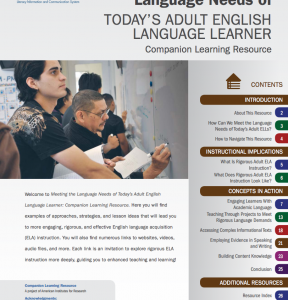
    Meeting the Language Needs of Today’s Adult English Language Learner: Companion Learning Resource
    Author: Patsy Egan Vinogradov
    Subject Area: ESL/ELL, LINCS Resources
    Program Level: Professional Development
    Material Type: Collection
    Language: English
    License: (CC BY-NC-ND 4.0) For license summary click here

    Abstract:

    This Companion Learning Resource, Meeting the Language Needs of Today’s Adult English Language Learner, presents numerous examples of instructional models, strategies, tools, and tasks for increasing the rigor of adult English language instruction.
    Publication Year
    2016
    This Companion Learning Resource provides a synthesis of the main ideas in several seminal resources from the adult English language learner (ELL) resource collection. It also extends and expands upon these resources by offering many practical ideas and techniques that practitioners can use and adapt in order to increase rigor in adult ELA classes. Highlights of key concepts and practical strategies include:
    • The need for instruction and accompanying professional development that support the language demands of rigorous college- and career-focused content
    • Engaging learners in increasingly complex texts, especially informational texts, while building students’ content knowledge
    • Expanding project-based learning into academic subjects
    • Enhancing the rigor of reading instruction for adult English language learners
    Although this Companion Learning Resource can be used as a stand-alone document, it also complements the other resources in the suite of materials, “Meeting the Language Needs of Today’s Adult English Language Learner.”  Other resources in this suite are the Issue Brief, and the Professional Development Modules.
    What the experts say
    This practice-oriented Companion Learning Resource helps adult ELL instructors to better understand and meet the language demands of rigorous college- and career-focused content. A variety of instructional strategies and supports are included, such as nurturing academic conversations in the classroom, engaging learners with increasingly complex texts while building content knowledge, expanding project-based learning into academic subjects, and building teachers’ knowledge and skills around reading instruction. Formatted as a digital magazine, this clickable PDF contains embedded resources and links to websites, encouraging users to delve deeply into the areas of greatest relevance. Through the resource, practitioners are able to link to concrete examples taken from each of the seminal resources and, where relevant, additional examples drawn from other relevant contexts (e.g., K–12 education).
    Resource Notice
    This site includes links to information created by other public and private organizations. These links are provided for the user’s convenience. The U.S. Department of Education does not control or guarantee the accuracy, relevance, timeliness, or completeness of this non-ED information. The inclusion of these links is not intended to reflect their importance, nor is it intended to endorse views expressed, or products or services offered, on these non-ED sites. Please note that privacy policies on non-ED sites may differ from ED’s privacy policy. When you visit lincs.ed.gov, no personal information is collected unless you choose to provide that information to us. We do not give, share, sell, or transfer any personal information to a third party. We recommend that you read the privacy policy of non-ED websites that you visit. We invite you to read our privacy policy.
    Integrating Digital Literacy Into English Language Instruction: Companion Learning Resource
    Author: Rob Jenkins
    Program Level: Professional Development
    Material Type: Collection
    Language: English
    License: (CC BY-NC-ND 4.0) For license summary click here

    Abstract:

    This companion learning resource, Integrating Digital Literacy into English Language Instruction, provides numerous examples of instructional models, strategies, tools, and tasks for integrating digital literacy into English language acquisition instruction.
    Publication Year
    2016
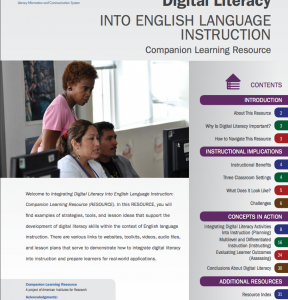
    This Companion Learning Resource provides a synthesis of the main ideas and practices in several existing seminal resources from the adult English language learner (ELL) resource collection. It also extends and expands upon these resources by offering many hands-on ideas and techniques to help practitioners integrate digital literacy instruction into adult ELA classes.  . Highlights of key concepts and practical strategies include:
    • The variety of technology integration options in ESL instruction
    • The role of digital literacy instruction in reducing the digital divide
    • The role technology can play in problem-based learning
    • The benefits of using technology to support learner-centered instruction at all levels of ESL and in various learning environments
    Although this Companion Learning Resource can be used as a stand-alone document, it also complements the other resources in the suite of materials, “Integrating Digital Literacy into Adult English Language Instruction.” Other resources in this suite are the Issue Brief, and the Professional Development Modules.
    Benefits and Uses
    Formatted as a digital magazine, this clickable PDF contains embedded resources and links to websites that encourage users to delve deeply into the areas of greatest relevance. It includes task-based lesson plans, problem scenarios, open educational resources, and digital literacy tasks that integrate language development, information literacy, and technology integration. Practitioners are able to link to concrete examples taken from multiple sources including, where relevant, from other contexts (e.g., K–12 education).
    Resource Notice
    This site includes links to information created by other public and private organizations. These links are provided for the user’s convenience. The U.S. Department of Education does not control or guarantee the accuracy, relevance, timeliness, or completeness of this non-ED information. The inclusion of these links is not intended to reflect their importance, nor is it intended to endorse views expressed, or products or services offered, on these non-ED sites. Please note that privacy policies on non-ED sites may differ from ED’s privacy policy. When you visit lincs.ed.gov, no personal information is collected unless you choose to provide that information to us. We do not give, share, sell, or transfer any personal information to a third party. We recommend that you read the privacy policy of non-ED websites that you visit. We invite you to read our privacy policy.
    Classroom Activities for Adult ESL Learners
    Author: Minnesota Literacy Council
    Subject Area: ESL/ELL, LINCS Resources
    Program Level: Professional Development
    Material Type: Collection
    Language: English
    License: (CC BY-NC-ND 4.0) For license summary click here

    Abstract:

    A video series featuring teachers leading adult ESL classes through common classroom activities.
    Publication Year
    2016
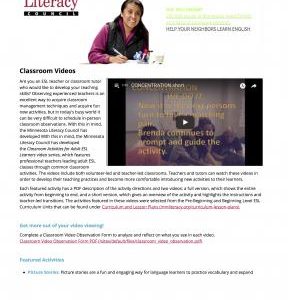
    Observing classroom instruction delivered by experienced teachers is a good way for teachers and tutors to acquire classroom management techniques and learn new activities. Because finding time to do in-person classroom observations can be difficult, the Minnesota Literacy Council developed the Classroom Activities for Adult ESL Learners video series. The 17 videos feature professional teachers leading adult ESL classes through common classroom activities. Teachers and tutors can use the videos to develop their teaching practices and become more comfortable introducing new activities to students. Each activity includes:
    • a PDF version of the lesson plan;
    • a full version of the video ranging in length from 8 to 35 minutes that shows the entire activity from beginning to end; and
    • a shorter 3- to 16-minute version that gives an overview of the activity and highlights the instructions and teacher-led transitions.
    The activities featured in these videos were selected from the Minnesota Literacy Council’s Pre-Beginning ESL Curriculum and Beginning ESL Curriculum. The site also features a Classroom Video Observation Form to analyze and reflect on what users see in the videos.
    What the experts say
    The activities modeled in the Classroom Activities for Adult ESL Learners videos bring variety and interest to the classroom. They will be helpful to beginning tutor and teachers as well as those who previously relied on workbooks and lecture. Many of the activities are directed toward beginning learners, who often present a challenge to teachers. There is, however, little information about learner preparation or follow-up activities. The videos in the Classroom Activities for Adult ESL Learners series show teachers working with adult ESL students without a formal workbook or worksheets. The videos feature teachers facilitating cooperative/collaborative learning activities with small group work and discussion. ESL students are quick to learn and engage when the instructor (like those in the video) demonstrates a true interest in them and their learning. Performance-based assessments activities are used in some of the videos that concentrate on oral communication and/or reading.
    Resource Notice
    This site includes links to information created by other public and private organizations. These links are provided for the user’s convenience. The U.S. Department of Education does not control or guarantee the accuracy, relevance, timeliness, or completeness of this non-ED information. The inclusion of these links is not intended to reflect their importance, nor is it intended to endorse views expressed, or products or services offered, on these non-ED sites. Please note that privacy policies on non-ED sites may differ from ED’s privacy policy. When you visit lincs.ed.gov, no personal information is collected unless you choose to provide that information to us. We do not give, share, sell, or transfer any personal information to a third party. We recommend that you read the privacy policy of non-ED websites that you visit. We invite you to read our privacy policy.
    Low-Literacy Adult ESL Study Circle II: Next Steps in Designing Balanced Instruction
    Author: Kristin Perry, Patsy Egan Vinogradov, and Kristin Klas
    Subject Area: ESL/ELL, LINCS Resources
    Program Level: Professional Development
    Material Type: Collection
    Language: English
    License: (CC BY-NC-ND 4.0) For license summary click here

    Abstract:

    This study circle is a professional learning activity for teachers of low-literacy adult ESL students.
    Publication Year
    2017
    This study circle is a professional learning activity for teachers of low-literacy adult ESL students, i.e., learners with little or no first-language literacy. With a special focus on balancing instruction to meet the complex needs of these learners, teachers explore relevant research and its implications for best practices in the classroom. Participants engage in at-home reading and reflective classroom tasks that inform and deepen discussions and allow for maximum professional growth. The study circle is designed to be delivered in a total of nine hours, delivered through three, 3-hour meetings spread over six to eight weeks. The study circle objectives are that participants will:
    1. Identify the varied roles teachers play in order to cover the wide range of content taught in low-literacy adult ESL classrooms.
    2. Become familiar with frameworks and strategies for building balanced instruction into big picture planning and daily lessons.
    3. Become familiar with frameworks and strategies for building balanced instruction into big picture planning and daily lessons.
    Clear objectives are also identified for each topic. Additionally, ways in which the study circle exemplifies the core featrures of effecrive professional develop are presented as well as the expectations of the facilitator and participants.
    What the experts say
    This resource is designed to be a professional development guide for teachers of low-literacy adult language learners, an often overlooked segment of the adult learner population. It provides practical guidance for facilitators with multiple activities for participants. These activities include a review of research and practice, practical application in classrooms, and reflection and discussion. Step-by-step guidance is provided for establishing and running a study circles as well as discussion questions and processes. The guide relies on, and is informed by, evidence-based practice and research in the areas of balanced literacy instruction for both children and adults. Explicit links to research and practice provide the foundation for the activities. It is a model that facilitators could use with other topics. While it is designed for facilitators, it also provides sufficient materials and readings suggestions for work and study to be undertaken independently.
    Resource Notice
    This site includes links to information created by other public and private organizations. These links are provided for the user’s convenience. The U.S. Department of Education does not control or guarantee the accuracy, relevance, timeliness, or completeness of this non-ED information. The inclusion of these links is not intended to reflect their importance, nor is it intended to endorse views expressed, or products or services offered, on these non-ED sites. Please note that privacy policies on non-ED sites may differ from ED’s privacy policy. When you visit lincs.ed.gov, no personal information is collected unless you choose to provide that information to us. We do not give, share, sell, or transfer any personal information to a third party. We recommend that you read the privacy policy of non-ED websites that you visit. We invite you to read our privacy policy.