Yes You Can! Savings Tips for People with Disabilities
    Author: Michael R. Rousch, Chris Rodriguez, and Lindsay Ferguson
    Program Level: Professional Development
    Material Type: Collection
    Language: English
    License: (CC BY-NC-ND 4.0) For license summary click here

    Abstract:

    This webinar describes savings options available to individuals with disabilities that do not jeapordize public benefits.
    Publication Year
    2017
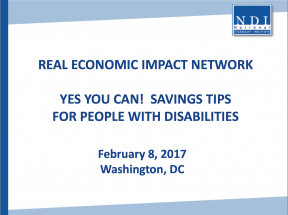
    A webinar hosted by the National Disability Institute on programs that encourage individuals with disabilities to develop money saving habits. Chris Rodriguez, Senior Public Policy Advisor with the National Disability Institute, provides overviews of:
    • The Stephen Beck, Jr. Achieving a Better Life Experience (ABLE) Act
    • Individual Development Accounts (IDAs)
    • Plan for Achieving Self-Support (PASS)
    The Stephen Beck, Jr. Achieving a Better Life Experience (ABLE) Act, is a saving option for some people with disabilities and their families that protects their eligibility for public benefits. Up to $14,000 a year from multiple sources can be contributed to an ABLE account for qualified disability related expenses. Estimates are that over 10 million people are participating in a program. The ABLE National Resource Center is a collaborative of organizations that share the goal of accelerating the design and availability of ABLE accounts for the benefit of individuals with disabilities and their families. Individual Development Accounts (IDAs) are special bank accounts that help low income individuals and families save for things like education, purchasing a first home or starting a business. Workers use earnings from their work to set up an approved bank account for an IDA. Contributions may be matched with funds from State TANF (Temporary Assistance for Needy Families) programs or from special funds called "demonstration project" money. Over the last decade, more than 85,000 IDAs have been opened in programs administered by more than 1,100 sites across the country. The impact of this initiative has resulted in more than 9,400 new homeowners, 7,200 educational purchases and 6,400 small business start-ups and expansion purchases. Plan for Achieving Self-Support (PASS) allows a person with a disability to set aside otherwise countable income and/or resources for a specific period of time in order to achieve a work goal. A PASS account can be used for supplies to start a business, school expenses, equipment and tools, transportation, uniforms and other items or services needed to reach an employment goal. Under PASS, persons with disabilities can set aside money for purchases, installment payments, or down payments for things like a vehicle, wheelchair, or a computer if needed to achieve their work goal. America Saves, a national campaign that uses the principles of social marketing and behavioral economics to motive and support low to moderate income households to save money, reduce debt, and build wealth, is reviewed. Motivational and information resources information are available.
    What the experts say
    As increasing numbers of adults with disabilities participate in K-12 career and technical and adult/postsecondary education, there has been an increase in the number of adults with disabilities in the workforce. Consequently, adults with disabilities are becoming increasingly responsible for managing benefits and general savings plans. The information and support offered in Yes You Can! provides important information about savings plans for individuals with disabilities and care takers. The presenters discuss the information from both a formal and a practical perspective providing adult education programs with valuable resources to support students. It is particularly valuable for adult education programs that combine traditional adult education with workforce training and community supports. This resource presents useful information for those with diagnosed disabilities. The webinar clears up many misconceptions about savings accounts for individuals with disablities and their families. For instance, many people think that if they build up a savings account that they may lose benefits. The charts and other visuals in Yes You Can! are very good. The visual titled "America Saves Research" could be used in a discussion with students about how they should set money aside for savings. Instructors could also incorporate the Motivational Resources" into lesson plans or they could simply share them with students. Yes You Can! is a useful financial literacy resource especially in the arena of savings. It can be used to complement curriculum emphasizing savings as a tool for financial independence. The presenters provide great resources about the savings plans and cite laws that are in place to assist in savings. It would be of value to instructors who are planning lessons on the topic of finances and have students with diagnosed disabilities. The resource could also be used in teacher professional development.
    Resource Notice
    This site includes links to information created by other public and private organizations. These links are provided for the user’s convenience. The U.S. Department of Education does not control or guarantee the accuracy, relevance, timeliness, or completeness of this non-ED information. The inclusion of these links is not intended to reflect their importance, nor is it intended to endorse views expressed, or products or services offered, on these non-ED sites. Please note that privacy policies on non-ED sites may differ from ED’s privacy policy. When you visit lincs.ed.gov, no personal information is collected unless you choose to provide that information to us. We do not give, share, sell, or transfer any personal information to a third party. We recommend that you read the privacy policy of non-ED websites that you visit. We invite you to read our privacy policy.
    The Math Gap: Implications for Investing in America’s Workforce
    Author: Luminary Labs
    Program Level: Professional Development
    Material Type: Collection
    Language: English
    License: (CC BY-NC-ND 4.0) For license summary click here

    Abstract:

    This report explores the potential for technology to enhance the teaching and learning of advanced math skills to adults.
    Publication Year
    2017
    Given the ongoing growth of technical careers and demand for high-skill labor, there is a particular need for more technology to increase and quicken access for adult learners studying advanced mathematics. The adult classroom presents numerous barriers for all stakeholders; market signals require meeting learners and educators where they are.
    Technology offers a promising fix to many of the challenges within adult education, but is not a silver bullet. It is not a cure-all for complex issues around funding, degree pathways, and teacher preparation, but presents promising solutions to many systemic challenges around access, resourcing, and contextualization. This report showcases the potential for technology to enhance the teaching and learning of advanced math skills to adults, providing nuanced guidance for funders and educational innovators. We will discuss key stakeholders, their needs, and opportunities for investment to capitalize on the potential of technology to better ready adult learners for the workforce. In particular, we will delve into areas of key need like contextualization of classroom resources and professional development for educators. Following a review of needs for relevant stakeholders (employers, adult learners, and educators) and a discussion of technology’s promise, we will introduce “three A’s” of adult edtech: Accessibility, Adaptability, and Applicability. These encapsulate and represent many ongoing cross-disciplinary calls to tailor new tools and approaches to the needs of learners and the educators who serve them, ultimately laddering up to the requirements of industry job creators. Several such efforts and technologies are particularly relevant to advanced math, and we will hone in on open educational resources (OER), a parallel movement in education to leverage digital technology and open source licensing to expand access. This document was funded by the U.S. Department of Education Office of Career, Technical and Adult Education under the project titled “Power in Numbers: Advancing Math for Adult Learners” (OER Math project), Contract Number: ED-VAE-14-D-0006/0004, and it includes input from adult education practitioners, researchers, and policy experts.
    Benefits and Uses
    This document is the first in a series of three reports on the state of the technology market for adult learners of advanced mathematics. This initial report focuses on demand, including demand for advanced math skills, demand for new tools and approaches that meet learner and educator needs, and demand for teacher training to support deployment of new tools. Subsequent reports will focus on the landscape of existing tools for learning advanced mathematics, as well as opportunities to improve the creation and deployment of new tools for adult learners. The purpose of these reports is to capitalize on the intersection of grassroots resource development, technology innovation, and labor market demand for skills to inform the future of adult advanced math education. In doing so we hope to illustrate the opportunity space for funders and technology developers to cater to this underserved market.
    Resource Notice
    This site includes links to information created by other public and private organizations. These links are provided for the user’s convenience. The U.S. Department of Education does not control or guarantee the accuracy, relevance, timeliness, or completeness of this non-ED information. The inclusion of these links is not intended to reflect their importance, nor is it intended to endorse views expressed, or products or services offered, on these non-ED sites. Please note that privacy policies on non-ED sites may differ from ED’s privacy policy. When you visit lincs.ed.gov, no personal information is collected unless you choose to provide that information to us. We do not give, share, sell, or transfer any personal information to a third party. We recommend that you read the privacy policy of non-ED websites that you visit. We invite you to read our privacy policy.
    Technology Toolbox for the Adult Education Instructor!
    Author: Rebecca DeJesus
    Program Level: Professional Development
    Material Type: Collection
    Language: English
    License: (CC BY-NC-ND 4.0) For license summary click here

    Abstract:

    This webinar, published by the Commission on Adult Basic Education (COABE) reviews a variety of free technology resources that can be integrated into the adult education classroom.
    Publication Year
    2017
    This webinar, part of the Research to Practice series, reviews free technology resources that can quickly and easily be integrated into adult education classrooms. Resources include websites and apps that provide unlimited practice problems, online quizzing, manipulatives, screen capture and share, fast formative assessments, engagement, and easy document storage and distribution to students. The presentation includes examples of how the presenter has used each resource in her classroom. The webinar consists of 59 minutes of presentation followed by 27 minutes of questions and answers.
    What the experts say
    This webinar is an excellent overview of some of the most effective and engaging web resources for adult education students. It's a great resource for teachers who are looking to enhance their classroom experience, offering something for every level of student. Teachers can use the resources for independent lab work, homework, flipped learning, remediation, or just for fun. Not only does the presenter highlight useful online tools, she also provides information regarding new research and teaching methods. Those methods include those delivered online as well as those offered in traditional settings. The collection was developed with the goal of aligning with Adult Learning Theory (andragogy) in ways that support and extend effective instruction. Androgogy speaks specifically to the different motivations that play into the ability of adult learners to advance through coursework and complete modes of study.
    Resource Notice
    This site includes links to information created by other public and private organizations. These links are provided for the user’s convenience. The U.S. Department of Education does not control or guarantee the accuracy, relevance, timeliness, or completeness of this non-ED information. The inclusion of these links is not intended to reflect their importance, nor is it intended to endorse views expressed, or products or services offered, on these non-ED sites. Please note that privacy policies on non-ED sites may differ from ED’s privacy policy. When you visit lincs.ed.gov, no personal information is collected unless you choose to provide that information to us. We do not give, share, sell, or transfer any personal information to a third party. We recommend that you read the privacy policy of non-ED websites that you visit. We invite you to read our privacy policy.
    Supplement to the Handbook for Sustaining Standards-Based Education in Adult Education: Checklists for Assessing Effective Implementation
    Author: StandardsWork, Inc.
    Program Level: Professional Development
    Material Type: Collection
    Language: English
    License: (CC BY-NC-ND 4.0) For license summary click here

    Abstract:

    A resource for state and local program leaders looking to support the effective implementation of state academic content standards.
    Publication Year
    2017
    This document is designed as a resource for state and local program leaders looking to support the effective implementation of state academic content standards. At the center of this supplement are two checklists. One is the State Leadership Checklist. State staff can use this as a self-assessment to gauge the effectiveness of their state’s implementation of and support for academic standards grounded in research. A second checklist is the Program Leadership Checklist. It is designed for use by both state and local program leaders to help guide the implementation of high-quality standards at the local and regional levels.
    Benefits and Uses
    This document is designed as a resource for state and local program leaders looking to support the effective implementation of state academic content standards. At the center of this supplement are two checklists. One is the State Leadership Checklist. State staff can use this as a self-assessment to gauge the effectiveness of their state’s implementation of and support for academic standards grounded in research. It identifies the actions needed to sustain an effective college and career readiness (CCR) standards implementation initiative at the state level. The State Leadership Checklist includes eight core components of effective implementation. A second checklist is the Program Leadership Checklist. It is designed for use by both state and local program leaders to help guide the implementation of high-quality standards at the local and regional levels. It includes six Sustainability Steps that programs need to take. The second checklist is a tool some states may wish to integrate into their monitoring of local providers. Both checklists also can be used in conjunction with the Handbook for Sustaining Standards-Based Education in Adult Education: https://lincs.ed.gov/publications/pdf/SustainingStandards-BasedEd.pdf The handbook has additional guidance regarding several sustainability elements. Considered together, the checklists and the handbook can assist state and local programs in developing a long-range, step-by-step standards implementation plan.
    Resource Notice
    This site includes links to information created by other public and private organizations. These links are provided for the user’s convenience. The U.S. Department of Education does not control or guarantee the accuracy, relevance, timeliness, or completeness of this non-ED information. The inclusion of these links is not intended to reflect their importance, nor is it intended to endorse views expressed, or products or services offered, on these non-ED sites. Please note that privacy policies on non-ED sites may differ from ED’s privacy policy. When you visit lincs.ed.gov, no personal information is collected unless you choose to provide that information to us. We do not give, share, sell, or transfer any personal information to a third party. We recommend that you read the privacy policy of non-ED websites that you visit. We invite you to read our privacy policy.
    New CareerOneStop Videos
    Author: CareerOneStop U.S. Department of Labor, Employment and Training Administration
    Program Level: Professional Development
    Material Type: Collection
    Language: English
    License: (CC BY-NC-ND 4.0) For license summary click here

    Abstract:

    CareerOneStop added more career videos and added newly-emerging careers related to the 16 career clusters.
    Publication Year
    2017
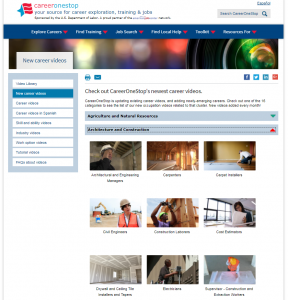
    Newly-created career videos from CareerOneStop give career explorers, students, and job searchers a portrait of life in hundreds of careers—from Actor to Zoologist. The videos, part of a collection depicting more than 800 careers, bring to life the responsibilities, work settings, and employment trends for a broad range of occupations. The new videos provide updated information and context for career explorers navigating today’s employment world. All career details are based on authoritative occupation and labor market information from the U.S. Department of Labor’s Occupational Information Network (O*NET) program and the Bureau of Labor Statistics (BLS). Check out the entire collection at CareerOneStop.org/Videos, where you can browse videos organized by career cluster, or select “New career videos” to see only the updated collection. Essential facts are shown on screen—including current wages, employment outlook, and education requirements—to give viewers an immediate snapshot of the field. Video transcripts are also available in Spanish.
    Benefits and Uses
    The CareerOneStop video collections provides short clips for a adult learners looking to start or change their careers and search thousands of job listings in your area or across the country. Adult Learners can learn about fields in high demand, take an assessment, looks at the different career options, and make a career plan. The site also allows learners to find out about High School Diplomas, certifications, licenses, schools, financial aid, and scholarships. Adults are able to customize the results to find local information to meet their needs. Teachers of adult learners can use this site to provide students a starting point to explore and learn about workforce opportunities.
    Resource Notice
    This site includes links to information created by other public and private organizations. These links are provided for the user’s convenience. The U.S. Department of Education does not control or guarantee the accuracy, relevance, timeliness, or completeness of this non-ED information. The inclusion of these links is not intended to reflect their importance, nor is it intended to endorse views expressed, or products or services offered, on these non-ED sites. Please note that privacy policies on non-ED sites may differ from ED’s privacy policy. When you visit lincs.ed.gov, no personal information is collected unless you choose to provide that information to us. We do not give, share, sell, or transfer any personal information to a third party. We recommend that you read the privacy policy of non-ED websites that you visit. We invite you to read our privacy policy.
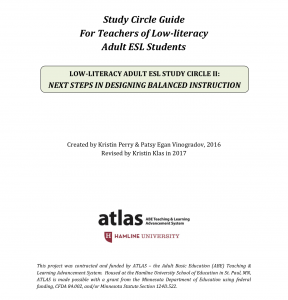
    Low-Literacy Adult ESL Study Circle II: Next Steps in Designing Balanced Instruction
    Author: Kristin Perry, Patsy Egan Vinogradov, and Kristin Klas
    Subject Area: ESL/ELL, LINCS Resources
    Program Level: Professional Development
    Material Type: Collection
    Language: English
    License: (CC BY-NC-ND 4.0) For license summary click here

    Abstract:

    This study circle is a professional learning activity for teachers of low-literacy adult ESL students.
    Publication Year
    2017
    This study circle is a professional learning activity for teachers of low-literacy adult ESL students, i.e., learners with little or no first-language literacy. With a special focus on balancing instruction to meet the complex needs of these learners, teachers explore relevant research and its implications for best practices in the classroom. Participants engage in at-home reading and reflective classroom tasks that inform and deepen discussions and allow for maximum professional growth. The study circle is designed to be delivered in a total of nine hours, delivered through three, 3-hour meetings spread over six to eight weeks. The study circle objectives are that participants will:
    1. Identify the varied roles teachers play in order to cover the wide range of content taught in low-literacy adult ESL classrooms.
    2. Become familiar with frameworks and strategies for building balanced instruction into big picture planning and daily lessons.
    3. Become familiar with frameworks and strategies for building balanced instruction into big picture planning and daily lessons.
    Clear objectives are also identified for each topic. Additionally, ways in which the study circle exemplifies the core featrures of effecrive professional develop are presented as well as the expectations of the facilitator and participants.
    What the experts say
    This resource is designed to be a professional development guide for teachers of low-literacy adult language learners, an often overlooked segment of the adult learner population. It provides practical guidance for facilitators with multiple activities for participants. These activities include a review of research and practice, practical application in classrooms, and reflection and discussion. Step-by-step guidance is provided for establishing and running a study circles as well as discussion questions and processes. The guide relies on, and is informed by, evidence-based practice and research in the areas of balanced literacy instruction for both children and adults. Explicit links to research and practice provide the foundation for the activities. It is a model that facilitators could use with other topics. While it is designed for facilitators, it also provides sufficient materials and readings suggestions for work and study to be undertaken independently.
    Resource Notice
    This site includes links to information created by other public and private organizations. These links are provided for the user’s convenience. The U.S. Department of Education does not control or guarantee the accuracy, relevance, timeliness, or completeness of this non-ED information. The inclusion of these links is not intended to reflect their importance, nor is it intended to endorse views expressed, or products or services offered, on these non-ED sites. Please note that privacy policies on non-ED sites may differ from ED’s privacy policy. When you visit lincs.ed.gov, no personal information is collected unless you choose to provide that information to us. We do not give, share, sell, or transfer any personal information to a third party. We recommend that you read the privacy policy of non-ED websites that you visit. We invite you to read our privacy policy.
    Investing in Quality: A BluePrint for Adult Literacy Programs and Funders
    Author: Sierra Stoneman-Bess and Ira Yankwitt
    Program Level: Professional Development
    Material Type: Collection
    Language: English
    License: (CC BY-NC-ND 4.0) For license summary click here

    Abstract:

    This report details 14 "Building Blocks" of a comprehensive, community-based adult literacy program, identifies the resources needed to fully implement the Building Blocks, and includes an operating budget for a local program implementing this model. Resource URL https://www.lacnyc.org/investing-in-quality.html Publication Year 2017 Investing in Quality was created as a tool for programs and funders to use in a variety of ways: (a) to inform new program design or development; (b) to spur program reflection and continuous improvement; (c) to understand and articulate quality program practices; (d) to identify key areas for professional development; (e) to delineate and benchmark program costs; and (f) to pave the way for funding levels that fully support sustainable, comprehensive, quality adult literacy programs and adult literacy infrastructure. The report is divided into four main sections plus an Introduction that provides the background and context for the project. The first section summarizes the "14 Building Blocks for a Quality Adult Literacy Program" for easy reference. The second section describes each "Building Block" in detail. The third section, "Key Elements for Investment," outlines the critical areas that programs need to invest in to create high-quality, sustainable adult literacy services. Finally, the "Defining Costs" section presents a sample operating budget for a hypothetical mid-size adult literacy program that incorporates all of the Building Blocks and Key Elements for Investment. What the experts say This report outlines a robust cost model of a hypothetical adult education program based on research from the question “What are the defining features of a quality literacy program and what does it cost to run one?” The authors conducted a review of the literature going back more than 20 years, and collected feedback from experts, providers, and students to identify the key features of successful adult education programs and develop the 14 Building Blocks. Adult education programs can use the sample operating budgets to compare and consider the cost of their programs. The blueprint is intended to be used by programs and funders in a variety of ways including informing program development and continuous improvement; understanding quality practice; identifying areas for professional development; and outlining program costs. Rather than use to predict future outcomes, the authors suggest a better use would be to use the "Building Blocks" and "Key Elements" to analyze what is needed now. Although the report is focused on New York City, its content is relevant to adult education programs in general because it is not a rigid prescription for a program; rather, the report presents a wide variety of elements from which to choose. The “blueprint” outlined in the report is flexible and adaptable based on the needs and abilities of each program, and provides a roadmap for continuous improvement. Resource Notice This site includes links to information created by other public and private organizations. These links are provided for the user’s convenience. The U.S. Department of Education does not control or guarantee the accuracy, relevance, timeliness, or completeness of this non-ED information. The inclusion of these links is not intended to reflect their importance, nor is it intended to endorse views expressed, or products or services offered, on these non-ED sites. Please note that privacy policies on non-ED sites may differ from ED’s privacy policy. When you visit lincs.ed.gov, no personal information is collected unless you choose to provide that information to us. We do not give, share, sell, or transfer any personal information to a third party. We recommend that you read the privacy policy of non-ED websites that you visit. We invite you to read our privacy policy.
    Introduction to the English Language Proficiency Standards for Adult Education – Module One
    Author: American Institutes for Research
    Subject Area: ESL/ELL, LINCS Resources
    Program Level: Professional Development
    Material Type: Collection
    Language: English
    License: (CC BY-NC-ND 4.0) For license summary click here

    Abstract:

    This module introduces the English Language Proficiency Standards for Adult Education and provides an understanding of why and how the standards were selected and how they are organized.
    Publication Year
    2017
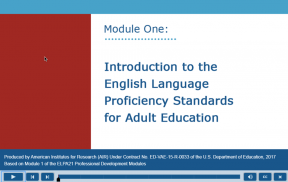
    Module One, “Introduction to the English Language Proficiency (ELP) Standards for Adult Education” is the first in a series of three professional development modules about the ELP Standards for Adult Education. These training modules are intended for instructors, program administrators, professional development staff and other key stakeholders. Module One answers the question: what should every adult educator working with adult English language learners (ELLs) know about the new ELP Standards for Adult Education?
    Specifically, online training addresses the following questions:
    • Why were ELP standards identified for adult education? Who identified them?
    • How were the ELP Standards for Adult Education identified? Who is their audience?
    • What do the ELP standards entail and why?
    • How do the ELP standards correspond to states’ academic content standards?
    • How can adult educators begin to use them?
    Benefits and Uses
    By the end of Module One, participants should be able to:
    • Understand the rationale and history behind the selection of the ELP Standards for Adult Education;
    • Recognize how the new ELP standards relate to states’ academic content standards;
    • Recognize how the ELP standards may differ from previous sets of language standards;
    • Identify the goals, guiding principles, essential components, and language used in the ELP Standards for Adult Education; and
    • Navigate the ELP Standards for Adult Education.
      These understandings will guide the use of the ELP Standards in support of ELLs’ engagement with academic content. With the necessary support that the ELP Standards can provide, programs can now expand their capabilities to implement academic content standards in English language acquisition programs as well as in adult basic education programs and career pathways programs. The new ELP standards include clear expectations of student language use, progressions or competencies. They provide an understanding of the steps that ELLs must take to acquire the language and skills necessary to engage in the linguistic practices. Moreover, they give concrete examples of what ELLs language production might look at the various stages of language acquisition. The running time of the module is 50 minutes. Additional time should be allotted for discussion with others in response to questions posed in the module or, if completing the module independently, self-reflection on those questions. This course was tested for accessibility using Internet Explorer v.11 and JAWS. Note: You may work through this training module on your own, of course. But, if at all possible, explore these lessons with colleagues, preferably within the context of a professional development or as part of a professional learning community. Tips for getting the most out of this module: 
    • Download and print the module’s resources (which appear in the Resources tab beginning on slide 4) before you begin the training.
    • Please turn off pop-up blockers in your browser for this module.
    • Use the following instructions for navigating through this module using your keyboard and using JAWS assistive technology:
      • Use the Tab key to move forward through each screen’s content. Press Shift + Tab to move backwards. A box surrounds the object that is currently selected.
      • To select the skip navigation button and the navigation buttons that appear at the bottom of the screen (Play, Pause, Forward, Back, Volume, Closed Captions and Exit buttons), use the spacebar key.
      • Press Shift + Enter to select a navigation button at the top of the screen or a hyperlink.
      • For closed captioning select the cc button.
    Required Training
    None. An understanding of your state’s academic content standards is helpful.
    Resource Notice
    This site includes links to information created by other public and private organizations. These links are provided for the user’s convenience. The U.S. Department of Education does not control or guarantee the accuracy, relevance, timeliness, or completeness of this non-ED information. The inclusion of these links is not intended to reflect their importance, nor is it intended to endorse views expressed, or products or services offered, on these non-ED sites. Please note that privacy policies on non-ED sites may differ from ED’s privacy policy. When you visit lincs.ed.gov, no personal information is collected unless you choose to provide that information to us. We do not give, share, sell, or transfer any personal information to a third party. We recommend that you read the privacy policy of non-ED websites that you visit. We invite you to read our privacy policy.