Realizing Opportunities for English Language Learners (ELLs) Through State Academic Content Standards Webinar
    Author: StandardsWork, Inc.
    Program Level: Professional Development
    Material Type: Collection
    Language: English
    License: (CC BY-NC-ND 4.0) For license summary click here

    Abstract:

    Archive of September 14, 2016 webinar.
    Publication Year
    2016
    Realizing Opportunities for English Language Learners (ELLs) Through State Academic Content Standards was produced by StandardsWork, Inc. as part of the CCR Standards-in-Action (CCR SIA) project. Facilitated by Susan Pimentel, lead CCR SIA content expert, the webinar concentrates on meeting the needs of English-language learners (ELLs). It discusses the necessary shifting away from traditional teaching theories that encourage language instruction in isolation from other academic disciplines. Specifically, the webinar showcases research-tested strategies on how ELLs can realize opportunities through new state-level academic standards in reading, writing, speaking and listening, and language. The webinar highlights a series of research findings on how best to realize opportunities for ELLs in reading, writing, speaking and listening, and language. Ms. Pimentel discusses pedagogical shifts for language acquisition and ten steps adult educators can take to re-envision ELL education in their programs. In the final portion of the webinar, she responds to attendees’ questions.
    Benefits and Uses
    This Webinar was created for College and Career Readiness Standards In Action (CCR SIA) project for adult educators from 12 states, who requested information on how CCR standards can be implemented for ELLs. This Webinar responds to their questions. The Webinar content, demonstration video, and links to further resources all provide essential information for you to use as you re-envision ELL education in your states. Use this resource to help plan ways to implement CCR academic content in classrooms with ELLs. View it individually, as part of a professional learning community, or a professional development workshop. In addition to providing essential information about teaching ELLs, it could fuel a discussion of different strategies and approaches to implementing CCR standards. The webinar includes a classroom video demonstration that is particularly useful in conjunction with Ms. Pimentel’s summary of research on reading, writing, speaking and listening, and language (slides 17-28). The slides which articulate the pedagogical shifts in teaching ELLs (slides 29-30) provide a concise statement of the new direction for ELL instruction afforded by the CCR standards. The PowerPoint slides are available a stand-alone resource.
    Required Training
    A fundamental awareness of the CCR Standards for English Language Arts/Literacy is recommended.
    Resource Notice
    This site includes links to information created by other public and private organizations. These links are provided for the user’s convenience. The U.S. Department of Education does not control or guarantee the accuracy, relevance, timeliness, or completeness of this non-ED information. The inclusion of these links is not intended to reflect their importance, nor is it intended to endorse views expressed, or products or services offered, on these non-ED sites. Please note that privacy policies on non-ED sites may differ from ED’s privacy policy. When you visit lincs.ed.gov, no personal information is collected unless you choose to provide that information to us. We do not give, share, sell, or transfer any personal information to a third party. We recommend that you read the privacy policy of non-ED websites that you visit. We invite you to read our privacy policy.
    Purdue Online Writing Lab (OWL)
    Author: Purdue University
    Subject Area: ESL/ELL, LINCS Resources, Writing
    Program Level: Professional Development
    Material Type: Collection
    Language: English
    License: (CC BY-NC-ND 4.0) For license summary click here

    Abstract:

    The Online Writing Lab (OWL) at Purdue University houses writing resources and instructional material, which teachers and trainers may use for in-class and out-of-class instruction.
    Publication Year
    2016
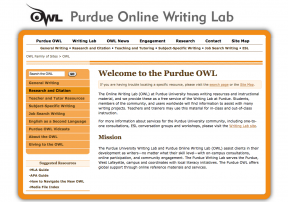
    The Online Writing Lab (OWL) website was developed at Purdue University as a free service of the Writing Lab at Purdue.  OWL houses writing resources and instructional material. Students—no matter their skill level— and members of the education community will find information to assist with many writing projects. Teachers and trainers may use this material for in-class and out-of-class instruction. The site is organized into the following sections:
    • General Writing
    • Research and Citation
    • Teacher and Tutor Resources
    • Subject-Specific Writing
    • Job Search Writing
    • English as a Second Language
    • Purdue OWL Video-casts
    Benefits and Uses
    OWL is a collection of resources that support writing instruction created for college-aged students—no matter their skill level—and their instructors and tutors. These materials are relevant to ABE and ESL students and relatively simple to adapt for the purposes of adult educators. OWL resources support instruction aligned to College and Career Readiness (CCR) Standards for writing and language, though CCR standards are not specifically named. For example, the sections on academic writing address expository, argumentative, and narrative writing—CCR Writing Standards 1-3.  The resources also support development of the writing process—CCR Writing Standard 5; the need for evidence to support claims—CCR Writing Standard 9 and Key Advance 2; and correct methods for citing resources—CCR Writing Standard 8. Conducting research is also addressed—CCR Writing Standard 7 as are mechanics, punctuation, and grammar—CCR Language Standards 1-2. OWL provides writing resources and instructional materials to support students as well as educators.  Resources present clear guidelines and expectations for academic writing. Teachers can use the site’s resources to develop lessons, assignments, and classroom resources. Students will find hands-on exercises and printable resources that support their continuing development as writers. OWL provides a wealth of materials that address a variety of topics about writing, topics that are also addressed by CCR writing and language standards. The site is well-organized by topics and subtopics. The Site Map provides a good overview of the site’s scope and sequence.  
    Resource Notice
    This site includes links to information created by other public and private organizations. These links are provided for the user’s convenience. The U.S. Department of Education does not control or guarantee the accuracy, relevance, timeliness, or completeness of this non-ED information. The inclusion of these links is not intended to reflect their importance, nor is it intended to endorse views expressed, or products or services offered, on these non-ED sites. Please note that privacy policies on non-ED sites may differ from ED’s privacy policy. When you visit lincs.ed.gov, no personal information is collected unless you choose to provide that information to us. We do not give, share, sell, or transfer any personal information to a third party. We recommend that you read the privacy policy of non-ED websites that you visit. We invite you to read our privacy policy.
    Preparing English Learners for Work and Career Pathways: Companion Learning Resource
    Author: Jayme Adelson-Goldstein
    Subject Area: ESL/ELL, LINCS Resources
    Program Level: Professional Development
    Material Type: Collection
    Language: English
    License: (CC BY-NC-ND 4.0) For license summary click here

    Abstract:

    This Companion Learning resource, Preparing English Learners for Work and Career Pathways, provides teachers and administrators with instructional tools, strategies, and resources that support career-focused, contextualized English language acquisition instruction.
    Publication Year
    2016
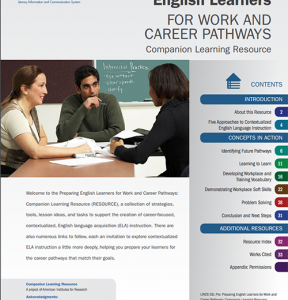
    This Companion Learning Resource provides an update to several seminal resources from the adult English language learner (ELL) resource collection.  It also extends and expands upon these resources by offering many practical ideas and concrete classroom examples that practitioners can use and adapt in order to better integrate language development and career and postsecondary preparation in adult ELA classes. Highlights of key concepts and practical strategies include:
    • How to prepare adult learners effectively for career training and postsecondary education, including related language demands
    • Effective instructional models of integrating career training with academic instruction
    • Key concepts in integrating academic skill development across many ELL levels to assist with learners’ transitions to postsecondary education, in preparation for work
    Although this Companion Learning Resource can be used as a stand-alone document, it also complements the other resources in the suite of materials, “Preparing English Learners for Work and Career Pathways.”  Other resources in this suite are the Issue Brief, and the Professional Development Modules.
    Benefits and Uses
    This practice-oriented resource examines language demands of the workforce, postsecondary transitions for adult ELLs, and effective preparation of adult learners for career training and postsecondary education. It illustrates effective instructional models for integrating career training with academic instruction and demonstrates key concepts in integrating academic skill development across many ELL levels to assist with learners’ transitions to postsecondary education, in preparation for work. Concrete classroom examples come from across a range of levels and teaching contexts. Formatted as a digital magazine, this clickable PDF contains embedded resources and links to websites that encourage users to delve deeply into the areas of greatest relevance. Through the resource, practitioners are able to link to concrete examples taken from each of the seminal resources and, where relevant, additional examples drawn from other relevant contexts (e.g., K–12 education).
    Resource Notice
    This site includes links to information created by other public and private organizations. These links are provided for the user’s convenience. The U.S. Department of Education does not control or guarantee the accuracy, relevance, timeliness, or completeness of this non-ED information. The inclusion of these links is not intended to reflect their importance, nor is it intended to endorse views expressed, or products or services offered, on these non-ED sites. Please note that privacy policies on non-ED sites may differ from ED’s privacy policy. When you visit lincs.ed.gov, no personal information is collected unless you choose to provide that information to us. We do not give, share, sell, or transfer any personal information to a third party. We recommend that you read the privacy policy of non-ED websites that you visit. We invite you to read our privacy policy.
    Newsela
    Author: Newsela
    Subject Area: LINCS Resources, Reading
    Program Level: Professional Development
    Material Type: Collection
    Language: English
    License: (CC BY-NC-ND 4.0) For license summary click here

    Abstract:

    Newsela builds reading comprehension through leveled articles, real-time assessments, and actionable insights.
    Publication Year
    2016
    Newsela builds reading comprehension through leveled articles, real-time assessments, and actionable insights.  Launched in June 2013, Newsela publishes high-interest news articles daily at five levels of complexity for grades 2-12 using Newsela’s proprietary, rapid text-leveling process. The resources are designed to help develop nonfiction fluency and critical-thinking skills necessary for students to master the Common Core standards for informational text. The original version of each text originates from a published news source including the Associated Press, The Guardian, and The Washington Post. In addition to the original version,Newsela presents each text at different Lexile levels which correspond to College and Career Readiness (CCR) standards Levels B-E.  These texts are organized by topics including war & peace, science, and health. Registration (free) is required.
    Benefits and Uses
    Newsela aligns to the CCR standards Key Advance 1 (Regular practice with complex text and its academic language) and Key Advance 3 (Building knowledge through content-rich nonfiction). The contemporary informational texts provided on this website will be useful in working with students to meet the level-specific expectations of the CCR standards for reading. Use this site to:
    • Find appropriately complex non-fiction texts accompanied by multiple choice quiz and sample writing prompts
    • Build content knowledge on current events
    • Supplement existing curriculum resources
    • Connect historical or scientific topics with current events
    • Create your own text sets by pulling together multiple articles on the same topic
    • Access text sets created by other educators.
    Most useful features:
    • High-interest texts appropriate for adult learners.
    • This site is particularly appropriate for instructors who are planning and implementing instruction in multi-leveled classrooms. Because each article is provided at all its varying Lexile levels, this site helps to ensure all students can build their knowledge about the same content.
    • After signing up to use the site, begin with the “Overview” section.
    Resource Notice
    This site includes links to information created by other public and private organizations. These links are provided for the user’s convenience. The U.S. Department of Education does not control or guarantee the accuracy, relevance, timeliness, or completeness of this non-ED information. The inclusion of these links is not intended to reflect their importance, nor is it intended to endorse views expressed, or products or services offered, on these non-ED sites. Please note that privacy policies on non-ED sites may differ from ED’s privacy policy. When you visit lincs.ed.gov, no personal information is collected unless you choose to provide that information to us. We do not give, share, sell, or transfer any personal information to a third party. We recommend that you read the privacy policy of non-ED websites that you visit. We invite you to read our privacy policy.
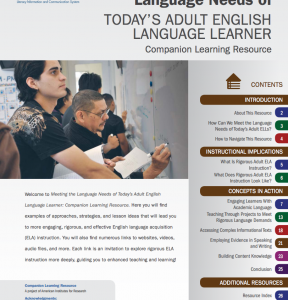
    Meeting the Language Needs of Today’s Adult English Language Learner: Companion Learning Resource
    Author: Patsy Egan Vinogradov
    Subject Area: ESL/ELL, LINCS Resources
    Program Level: Professional Development
    Material Type: Collection
    Language: English
    License: (CC BY-NC-ND 4.0) For license summary click here

    Abstract:

    This Companion Learning Resource, Meeting the Language Needs of Today’s Adult English Language Learner, presents numerous examples of instructional models, strategies, tools, and tasks for increasing the rigor of adult English language instruction.
    Publication Year
    2016
    This Companion Learning Resource provides a synthesis of the main ideas in several seminal resources from the adult English language learner (ELL) resource collection. It also extends and expands upon these resources by offering many practical ideas and techniques that practitioners can use and adapt in order to increase rigor in adult ELA classes. Highlights of key concepts and practical strategies include:
    • The need for instruction and accompanying professional development that support the language demands of rigorous college- and career-focused content
    • Engaging learners in increasingly complex texts, especially informational texts, while building students’ content knowledge
    • Expanding project-based learning into academic subjects
    • Enhancing the rigor of reading instruction for adult English language learners
    Although this Companion Learning Resource can be used as a stand-alone document, it also complements the other resources in the suite of materials, “Meeting the Language Needs of Today’s Adult English Language Learner.”  Other resources in this suite are the Issue Brief, and the Professional Development Modules.
    What the experts say
    This practice-oriented Companion Learning Resource helps adult ELL instructors to better understand and meet the language demands of rigorous college- and career-focused content. A variety of instructional strategies and supports are included, such as nurturing academic conversations in the classroom, engaging learners with increasingly complex texts while building content knowledge, expanding project-based learning into academic subjects, and building teachers’ knowledge and skills around reading instruction. Formatted as a digital magazine, this clickable PDF contains embedded resources and links to websites, encouraging users to delve deeply into the areas of greatest relevance. Through the resource, practitioners are able to link to concrete examples taken from each of the seminal resources and, where relevant, additional examples drawn from other relevant contexts (e.g., K–12 education).
    Resource Notice
    This site includes links to information created by other public and private organizations. These links are provided for the user’s convenience. The U.S. Department of Education does not control or guarantee the accuracy, relevance, timeliness, or completeness of this non-ED information. The inclusion of these links is not intended to reflect their importance, nor is it intended to endorse views expressed, or products or services offered, on these non-ED sites. Please note that privacy policies on non-ED sites may differ from ED’s privacy policy. When you visit lincs.ed.gov, no personal information is collected unless you choose to provide that information to us. We do not give, share, sell, or transfer any personal information to a third party. We recommend that you read the privacy policy of non-ED websites that you visit. We invite you to read our privacy policy.
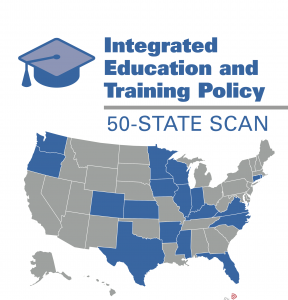
    Integrated Education and Training Policy: 50-STATE SCAN
    Author: Amanda Bergson-Shilcock
    Subject Area: LINCS Resources, Workforce
    Program Level: Professional Development
    Material Type: Collection
    Language: English
    License: (CC BY-NC-ND 4.0) For license summary click here

    Abstract:

    A survey of all 50 states and the District of Columbia found that eighteen states have adopted at least one form of integrated education and training policy.
    Publication Year
    2016
    Integrated education and training (IET) policies address the challenge of helping individuals who have basic skill gaps to qualify for middle-skill jobs. These policies encourage the adoption of program models that allow people to develop or refresh basic skills such as math, reading, or spoken English while simultaneously training for a in-demand occupation or industry. These policies are organized into three types:
    • Funding. States can provide funding to local IET programs or partnerships through grants or formula funds, using state or federal resources.
    • Program Initiatives. States can authorize the provision of IET via program initiatives that are part of a state adult education and workforce strategy.
    • Program Requirements. States can go beyond merely authorizing IET by actively requiring the provision of IET.
    To assess the extent to which these policies are being implemented, this scan:
    • Reviewed state adult education, community college, and/or workforce board websites;
    • Reviewed relevant sections of state code; and
    • Conducted follow-up calls and emails with key informants to answer questions and confirm findings.
    Key findings are:
    • At least 12 state provide funding for IET.
    • At least 18 states have launched program initiatives using an IET model.
    • No state has established policies requiring IET, although several states have longstanding initiatives that function as de facto requirements.
    What the experts say
    Integrated Education and Training Policy: 50-State Scan is highly relevant to adult education. It is a practical resource that summarizes the how academic skills and job-related training can be combined (integrated) and what the states are doing in this regard. The report consists mostly of easy-to-read diagrams summarizing the accomplishments of each state in integrating instruction. It could be used in a study circle of program developers, state education and training directors, and program administrators. This report is a good overview of the status of Integrated Education and Training Policy as of December 2016. It may be useful for a variety of individuals interested in adult education and the workforce including local leaders who are developing procedures and programs and want to see what other states are providing. Legislators could review this report to understand the status of neighboring and other states for policy development and federal policymakers could consider this information in identifying funding priorities. Certainly, adult education students doing research may have an interest in this report. The map and chart are the most useful features in that both provide information about the states at a glance. Adult education state leaders, program managers, curriculum writers, and professional developers might use this scan to identify states that have adopted IET systems, but they would need to reach out to their counterparts in those states to learn about how those IET programs were/are created, funded, supported, and organized. The descriptions of what is actually happening in the states are brief and do not describe the substance or quality of the programs. This resource would be more useful if it included model programs and provided more detail on the funding, structure, curricula, instructor training, and other components.
    Resource Notice
    This site includes links to information created by other public and private organizations. These links are provided for the user’s convenience. The U.S. Department of Education does not control or guarantee the accuracy, relevance, timeliness, or completeness of this non-ED information. The inclusion of these links is not intended to reflect their importance, nor is it intended to endorse views expressed, or products or services offered, on these non-ED sites. Please note that privacy policies on non-ED sites may differ from ED’s privacy policy. When you visit lincs.ed.gov, no personal information is collected unless you choose to provide that information to us. We do not give, share, sell, or transfer any personal information to a third party. We recommend that you read the privacy policy of non-ED websites that you visit. We invite you to read our privacy policy.
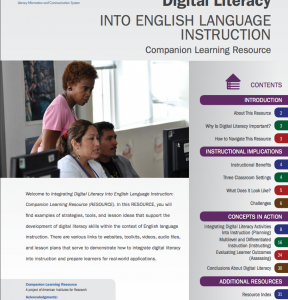
    Integrating Digital Literacy Into English Language Instruction: Companion Learning Resource
    Author: Rob Jenkins
    Program Level: Professional Development
    Material Type: Collection
    Language: English
    License: (CC BY-NC-ND 4.0) For license summary click here

    Abstract:

    This companion learning resource, Integrating Digital Literacy into English Language Instruction, provides numerous examples of instructional models, strategies, tools, and tasks for integrating digital literacy into English language acquisition instruction.
    Publication Year
    2016
    This Companion Learning Resource provides a synthesis of the main ideas and practices in several existing seminal resources from the adult English language learner (ELL) resource collection. It also extends and expands upon these resources by offering many hands-on ideas and techniques to help practitioners integrate digital literacy instruction into adult ELA classes.  . Highlights of key concepts and practical strategies include:
    • The variety of technology integration options in ESL instruction
    • The role of digital literacy instruction in reducing the digital divide
    • The role technology can play in problem-based learning
    • The benefits of using technology to support learner-centered instruction at all levels of ESL and in various learning environments
    Although this Companion Learning Resource can be used as a stand-alone document, it also complements the other resources in the suite of materials, “Integrating Digital Literacy into Adult English Language Instruction.” Other resources in this suite are the Issue Brief, and the Professional Development Modules.
    Benefits and Uses
    Formatted as a digital magazine, this clickable PDF contains embedded resources and links to websites that encourage users to delve deeply into the areas of greatest relevance. It includes task-based lesson plans, problem scenarios, open educational resources, and digital literacy tasks that integrate language development, information literacy, and technology integration. Practitioners are able to link to concrete examples taken from multiple sources including, where relevant, from other contexts (e.g., K–12 education).
    Resource Notice
    This site includes links to information created by other public and private organizations. These links are provided for the user’s convenience. The U.S. Department of Education does not control or guarantee the accuracy, relevance, timeliness, or completeness of this non-ED information. The inclusion of these links is not intended to reflect their importance, nor is it intended to endorse views expressed, or products or services offered, on these non-ED sites. Please note that privacy policies on non-ED sites may differ from ED’s privacy policy. When you visit lincs.ed.gov, no personal information is collected unless you choose to provide that information to us. We do not give, share, sell, or transfer any personal information to a third party. We recommend that you read the privacy policy of non-ED websites that you visit. We invite you to read our privacy policy.
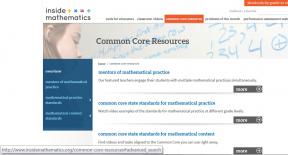
    Inside Mathematics
    Author: The Silicon Valley Mathematics Initiative The Shell Centre for Mathematical Education Publications Ltd. The Charles A. Dana Center at The University of Texas at Austin The Collaborative for Academic, Social, and Emotional Learning
    Program Level: Professional Development
    Material Type: Collection
    Language: English
    License: (CC BY-NC-ND 4.0) For license summary click here

    Abstract:

    Inside Mathematics provides a resource for educators (teachers and administrators) who strive to provide the best mathematics instruction they can for their students.
    Publication Year
    2016
    Inside Mathematics provides a resource for educators (teachers and administrators) who strive to provide the best mathematics instruction they can for their students.  According to their website, “Inside Mathematics opens doors:
    • to tested Public Lessons presented to children and groups of observing teachers;
    • to guided tours of reflective mathematics practice, identifying what makes teaching, learning, and improving instruction in mathematics a difficult enterprise;
    • resources for teachers to improve their practice;
    • to mathematics teaching and learning tools and resources to support the daily practices of classroom teachers, math coaches, and administrators; and
    • to a professional learning community in which you are invited to open your own classroom and engage in conversation about teaching and learning.
    The Inside Mathematics website is organized by:
    • Tools for educators;
    • Classroom videos;
    • Common core resources;
    • Problems of the month; and
    • Performance assessment tasks.
    Benefits and Uses
    Although K-12 educators are the site’s targeted audience, Inside Mathematics provides resources that adult educators can use to support the implantation of CCR aligned instruction. To adapt these resources for adult learners, first read the “Permissions” section (under “About”), located at: http://www.insidemathematics.org/about/. Use the variety of classroom-ready resources with ABE and ASE mathematics students. Search for relevant content by grade level as well as by mathematical strand. Also, watch videos of some of these classroom lessons. The performance assessment tasks include student work samples and a teacher discussion of these samples. These can provide valuable insights into student thinking in relation to the task. Each “problem of the month” is divided into five levels giving access into different aspects of the problem and stretching students out into mathematical complexity. These different levels of complexity provide useful scaffolding and differentiation tools for teachers of multi-level classes. Note: When using this feature, attend to the grade level for the problems and determine its appropriateness for your students.    
    Resource Notice
    This site includes links to information created by other public and private organizations. These links are provided for the user’s convenience. The U.S. Department of Education does not control or guarantee the accuracy, relevance, timeliness, or completeness of this non-ED information. The inclusion of these links is not intended to reflect their importance, nor is it intended to endorse views expressed, or products or services offered, on these non-ED sites. Please note that privacy policies on non-ED sites may differ from ED’s privacy policy. When you visit lincs.ed.gov, no personal information is collected unless you choose to provide that information to us. We do not give, share, sell, or transfer any personal information to a third party. We recommend that you read the privacy policy of non-ED websites that you visit. We invite you to read our privacy policy.