Teaching the Core
    Author: Teachingthecore.org
    Program Level: Professional Development
    Material Type: Collection
    Language: English
    License: (CC BY-NC-ND 4.0) For license summary click here

    Abstract:

    A collection of classroom videos and associated lesson materials to implement the instructional shifts required by the Common Core State Standards.
    Publication Year
    2016
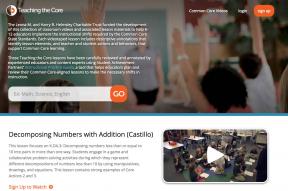
    The Leona M. and Harry B. Helmsley Charitable Trust funded the development of this collection of classroom videos and associated lesson materials to help K-12 educators implement the instructional shifts required by the Common Core State Standards. Each videotaped lesson includes descriptive annotations that identify lesson elements, and teacher and student actions and behaviors, that support Common Core learning. These Teaching the Core lessons have been carefully reviewed and annotated by experienced educators and content experts using Student Achievement Partners’ Instructional Practice Guide, a tool that helps educators plan and review their Common Core-aligned lessons to make the necessary shifts in instruction.
    Benefits and Uses
    The Teaching the Core video lessons demonstrate standards-based instruction at different grade levels. After opening a free account, use the search feature to find videos by subject and/or grade level. Each video is accompanied by a teacher interview, lesson plan, instructional materials, and student work. The lessons are K-12, so some adjustments and contextualization would need to be made for adult learners. The higher grade levels will be most appropriate for adult educators. Use the Teaching the Core videos for independent study or as part of a professional learning community or professional development program. The most useful feature of the actual videos is the timestamp feature, which allows viewers to go to certain sections of each video and watch for specific teacher and student moves. You may find the following ELA Teaching the Core videos very helpful: “Author’s Message with Multiple Texts” (10th grade) http://www.teachingthecore.org/view/51 and “Connotation & Exile” (9th grade) http://www.teachingthecore.org/view/20.
    Resource Notice
    This site includes links to information created by other public and private organizations. These links are provided for the user’s convenience. The U.S. Department of Education does not control or guarantee the accuracy, relevance, timeliness, or completeness of this non-ED information. The inclusion of these links is not intended to reflect their importance, nor is it intended to endorse views expressed, or products or services offered, on these non-ED sites. Please note that privacy policies on non-ED sites may differ from ED’s privacy policy. When you visit lincs.ed.gov, no personal information is collected unless you choose to provide that information to us. We do not give, share, sell, or transfer any personal information to a third party. We recommend that you read the privacy policy of non-ED websites that you visit. We invite you to read our privacy policy.

    Standards-in-Action: English Language Arts/Literacy Foundational Units to Fulfill the Instructional Shifts
    Author: StandardsWork, Inc.
    Program Level: Professional Development
    Material Type: Collection
    Language: English
    License: (CC BY-NC-ND 4.0) For license summary click here

    Abstract:

    These foundational-level Standards-in-Action (SIA) resources and professional development provide educators with practical knowledge about the key shifts in instruction required to align with college and career readiness standards in English language arts (ELA)/literacy.
    Author(s)
    StandardsWork, Inc.
    Author(s) Organizational Affiliation
    StandardsWork, Inc.
    Publication Year
    2016
    Resource Type
    Informational Material
    Abstract
    The College and Career Readiness (CCR) Standards ELA/Literacy Foundational Units 1-4 were produced by StandardsWork Inc. as part of the Implementing CCR Standards in Adult Education project, under contract to the U.S. Department of Education (Contract # ED-VAE-13-C-0066). The activities that make up Units 1 – 4 will help participants explore what it means to implement CCR standards for ELA/literacy in adult education. Participants will receive a practical and transferable understanding of the fundamental shifts in instruction embedded in CCR standards—including in your state standards—crucial to preparing adult students to meet the real-world demands of college and careers. At the heart of the instructional shifts is carefully examining the texts that students read and the questions students should address as they write and speak about them.
    • Foundational Unit 1 Connecting CCR Standards to Key Advances explores the fundamental elements, structure, and meaning of the CCR standards.
    • Foundational Unit 2 Selecting Texts Worth Reading introduces text complexity, its central role in the CCR standards, and the complex texts students need to read.
    • Foundational Unit 3, Identifying Questions Worth Answering focuses on the value of building students’ ability to draw evidence from texts and teachers’ ability to use text-based questions.
    • Foundational Unit 4 Creating High-Quality Prompts teaches instructors how to build a culminating writing assignment that assesses student knowledge.
    Each ready-to-use unit includes a facilitator’s guide, an annotated PowerPoint presentation, and participant materials. While training is not required before using this resource, fundamental awareness of the CCR standards for ELA/literacy is recommended. Experienced SIA trainers are available to provide this training to states and programs. For more information, please email the LINCS Technical Assistance Center at training@lincs.ed.gov.
    Benefits and Uses
    This resource supports state and program efforts to implement adult education content standards aligned with college and career readiness to support rigorous and high-quality instruction. Usage of the ELA/Literacy Foundational Units 1-4 will strengthen the capacity of adult educators to implement CCR standards to better prepare adult students for success in college and careers. These activities provide the field with opportunities to dig into the CCR standards and explore what it means to adopt CCR-aligned standards in classrooms and how to do so sustainably. Understanding how CCR standards differ from previous sets of standards—and the necessary shifts or advances they call for—is essential to implementing CCR standards well. Engagement in these four units of activities will enable adult educators to identify the most significant elements of CCR standards for ELA/literacy and to determine how best to integrate them into instruction and curriculum. The goal of Units 1 - 4 is for participants to leave with specific ideas, resources, and actions they can implement immediately. Designed primarily for group use, these units also support independent study. The four units should be worked through sequentially. The units can be facilitated during a single daylong training or multiple trainings over several weeks or months. Each ready-to-use unit contains all the materials required to facilitate these training activities, including a facilitator’s guide, an annotated PowerPoint Presentation, and a packet of participant materials. The participant materials include directions, charts, worksheets, answer keys, and other resource materials that guide the use of each unit. The PowerPoint presentations are a digital aid for presenters/facilitators who lead CCR ELA/literacy training activities. Notes are provided within the PowerPoint presentations to help you prepare for each session. This information accompanies the information offered in the facilitator guides—including the research base, rationale, advice, and other guidelines—to provide the support and guidance you may require.
    Resource Notice
    This site includes links to information created by other public and private organizations. These links are provided for the user’s convenience. The U.S. Department of Education does not control or guarantee the accuracy, relevance, timeliness, or completeness of this non-ED information. The inclusion of these links is not intended to reflect their importance, nor is it intended to endorse views expressed, or products or services offered, on these non-ED sites. Please note that privacy policies on non-ED sites may differ from ED’s privacy policy. When you visit lincs.ed.gov, no personal information is collected unless you choose to provide that information to us. We do not give, share, sell, or transfer any personal information to a third party. We recommend that you read the privacy policy of non-ED websites that you visit. We invite you to read our privacy policy.
    Realizing Opportunities for English Language Learners (ELLs) Through State Academic Content Standards Webinar
    Author: StandardsWork, Inc.
    Program Level: Professional Development
    Material Type: Collection
    Language: English
    License: (CC BY-NC-ND 4.0) For license summary click here

    Abstract:

    Archive of September 14, 2016 webinar.
    Publication Year
    2016
    Realizing Opportunities for English Language Learners (ELLs) Through State Academic Content Standards was produced by StandardsWork, Inc. as part of the CCR Standards-in-Action (CCR SIA) project. Facilitated by Susan Pimentel, lead CCR SIA content expert, the webinar concentrates on meeting the needs of English-language learners (ELLs). It discusses the necessary shifting away from traditional teaching theories that encourage language instruction in isolation from other academic disciplines. Specifically, the webinar showcases research-tested strategies on how ELLs can realize opportunities through new state-level academic standards in reading, writing, speaking and listening, and language. The webinar highlights a series of research findings on how best to realize opportunities for ELLs in reading, writing, speaking and listening, and language. Ms. Pimentel discusses pedagogical shifts for language acquisition and ten steps adult educators can take to re-envision ELL education in their programs. In the final portion of the webinar, she responds to attendees’ questions.
    Benefits and Uses
    This Webinar was created for College and Career Readiness Standards In Action (CCR SIA) project for adult educators from 12 states, who requested information on how CCR standards can be implemented for ELLs. This Webinar responds to their questions. The Webinar content, demonstration video, and links to further resources all provide essential information for you to use as you re-envision ELL education in your states. Use this resource to help plan ways to implement CCR academic content in classrooms with ELLs. View it individually, as part of a professional learning community, or a professional development workshop. In addition to providing essential information about teaching ELLs, it could fuel a discussion of different strategies and approaches to implementing CCR standards. The webinar includes a classroom video demonstration that is particularly useful in conjunction with Ms. Pimentel’s summary of research on reading, writing, speaking and listening, and language (slides 17-28). The slides which articulate the pedagogical shifts in teaching ELLs (slides 29-30) provide a concise statement of the new direction for ELL instruction afforded by the CCR standards. The PowerPoint slides are available a stand-alone resource.
    Required Training
    A fundamental awareness of the CCR Standards for English Language Arts/Literacy is recommended.
    Resource Notice
    This site includes links to information created by other public and private organizations. These links are provided for the user’s convenience. The U.S. Department of Education does not control or guarantee the accuracy, relevance, timeliness, or completeness of this non-ED information. The inclusion of these links is not intended to reflect their importance, nor is it intended to endorse views expressed, or products or services offered, on these non-ED sites. Please note that privacy policies on non-ED sites may differ from ED’s privacy policy. When you visit lincs.ed.gov, no personal information is collected unless you choose to provide that information to us. We do not give, share, sell, or transfer any personal information to a third party. We recommend that you read the privacy policy of non-ED websites that you visit. We invite you to read our privacy policy.
    CLASP Webinar: Integrated Education and Training Practice and Policy
    Author: Judy Mortrude, Anson Green, Sue Liu, Sara Hastings, Andy Nash, Carol Clymer, Blaire Toso, Amanda Bergson-Shilcock
    Program Level: Professional Development
    Material Type: Collection
    Language: English
    License: (CC BY-NC-ND 4.0) For license summary click here

    Abstract:

    This webinar recording features a panel of leading experts from around the country who discuss how IET models are being implemented and provide real examples of the opportunities (and lessons learned) for administrators and practitioners to develop quality IET models.
    Publication Year
    2016
    CLASP recorded a webinar on Integrated Education and Training (IET). Experts from around the country discussed how IET is being implemented and opportunities for practitioners to develop quality IET models.
    Benefits and Uses
    IETs are a core educational strategy for career pathways jointly developed between WIOA partners. This webinar highlights the many ways that states and individual programs have interpreted the definition and core elements of IETs and in turn used them to develop IETs as a strategy across all levels of service delivery in Title II of the Adult Education and Family Literacy Act (AEFLA). The panel, comprised of nationally recognized leaders in their field, provides easy-to-understand information starting with what an IET is to the ways data is collected and reported, and how partnerships can be formed.
    Resource Notice
    This site includes links to information created by other public and private organizations. These links are provided for the user’s convenience. The U.S. Department of Education does not control or guarantee the accuracy, relevance, timeliness, or completeness of this non-ED information. The inclusion of these links is not intended to reflect their importance, nor is it intended to endorse views expressed, or products or services offered, on these non-ED sites. Please note that privacy policies on non-ED sites may differ from ED’s privacy policy. When you visit lincs.ed.gov, no personal information is collected unless you choose to provide that information to us. We do not give, share, sell, or transfer any personal information to a third party. We recommend that you read the privacy policy of non-ED websites that you visit. We invite you to read our privacy policy.
    Career Pathways Toolkit: An Enhanced Guide and Workbook for System Development
    Author: Bonnie Elsey, Laura Lanier, and Jessie Stadd
    Program Level: Professional Development
    Material Type: Collection
    Language: English
    License: (CC BY-NC-ND 4.0) For license summary click here

    Abstract:

    The newest revision to the Career Pathways Toolkits includes writeable worksheets that can help State and program teams develop, maintain, and enhance career pathways systems and programs.
    Publication Year
    2016
    The Department of Labor’s Employment and Training Administration (DOLETA) is excited to release the Career Pathways Toolkit: An Enhanced Guide and Workbook for System Development. The new Toolkit will be especially helpful for State offices and partners required to develop a Unified Plan as well as staff members supporting State Workforce Development Boards. DOLETA revised the Career Pathways Toolkit to align with the new vision, definition, and requirements of the Workforce Innovation and Opportunity Act (WIOA). It also reflects major advancements and emerging promising practices in the field over the past five years. The enhanced Toolkit features the Six Key Elements of Career Pathways. Each element now includes embedded – and writeable – worksheets to help State and local teams with implementation. Users can type directly into the worksheet fields and save and print as they go along.
    Benefits and Uses
    Under WIOA, which was signed into law in July 2014, States and localities collaborate with adult education, postsecondary education and other partners to establish career pathways systems to make it easier for all Americans to attain necessary skills and credentials to secure meaningful jobs in their regional economies. The Career Pathways Toolkit will help stakeholders develop more comprehensive and combined systems for workforce development.
    Resource Notice
    This site includes links to information created by other public and private organizations. These links are provided for the user’s convenience. The U.S. Department of Education does not control or guarantee the accuracy, relevance, timeliness, or completeness of this non-ED information. The inclusion of these links is not intended to reflect their importance, nor is it intended to endorse views expressed, or products or services offered, on these non-ED sites. Please note that privacy policies on non-ED sites may differ from ED’s privacy policy. When you visit lincs.ed.gov, no personal information is collected unless you choose to provide that information to us. We do not give, share, sell, or transfer any personal information to a third party. We recommend that you read the privacy policy of non-ED websites that you visit. We invite you to read our privacy policy.
    Building Career Pathways Systems for Education, Training, and Employment
    Author: Judith A. Alamprese
    Program Level: Professional Development
    Material Type: Collection
    Language: English
    License: (CC BY-NC-ND 4.0) For license summary click here

    Abstract:

    This brief discusses the implementation of career pathways under the Workforce Innovation and Opportunity Act (WIOA) and considerations for state adult education staff in developing career pathways systems to support individuals in their pursuit of education and employment.
    Publication Year
    2016
    Crucial to the nation’s economic growth and individuals’ social and personal well-being is the availability of education and training that enables adults to learn new skills, obtain higher paying jobs, and build careers. The primary federal legislation supporting education, training services, and workforce development for adults – the Workforce Innovation and Opportunity Act (WIOA) of 2014– is a catalyst for delivering the types of education, training, and employment services that facilitate adults’ economic and career success. WIOA emphasizes the building and alignment of workforce investment, education, and economic development systems that deliver comprehensive employment, education, and supportive services. These services are expected to enable individuals, particularly those with barriers to employment, to obtain the skills and credentials needed to secure jobs with family-sustaining wages, as well as to provide employers with the skilled workforce needed to succeed in a global economy. WIOA aims to strengthen the U.S. workforce development system by aligning employment, training, and education programs and improving their quality through innovative approaches that address the needs of adults and youth. Career pathways, consistently referenced in WIOA Titles I and II, is an approach that includes innovative policies and practices to facilitate individuals’ education and employment success. The use of a career pathways approach calls for aligned workforce investment, education, and economic development systems at the state and local levels. To obtain this alignment, state and local partners must work together to organize and support the high-quality, coordinated workforce, education, and training services that underlie a career pathways approach. Thus, to assess services that undergird a career pathways approach, state staff must examine the implementation of career pathways; determine professional development services involved; and leverage data to inform new strategic thinking.
    Benefits and Uses
    This policy brief is best used by state adult education staff in understanding career pathways implementation under WIOA, developing career pathways systems of their own, and leveraging data related to career pathways services. State staff can leverage the career pathways framework included in the brief to assess not only the extent to which adult education providers are implementing career pathways as defined in WIOA, but also to identify gaps that need to be addressed. Additionally, state staff can use the model to communicate to adult education providers the state’s expectations for the types of partnerships that local programs should have in place. State staff may also gather information about current professional development efforts. This data will inform state staff in selecting the types of professional development that can support local career pathways services. Lastly, the brief can be used to determine how to collect and use local data related to career pathways. Data on implementation of program services and quality of professional development can assist state staff in planning more effective professional development and technical assistance to support a local career pathways system. Ultimately, this policy brief informs state adult education staff on how to conduct coordinated education and training services that are aligned with the needs of employers, education, and training that is designed to facilitate individuals’ attainment of skills and credentials that can facilitate their economic well-being and employment in a career pathway.
    Resource Notice
    This site includes links to information created by other public and private organizations. These links are provided for the user’s convenience. The U.S. Department of Education does not control or guarantee the accuracy, relevance, timeliness, or completeness of this non-ED information. The inclusion of these links is not intended to reflect their importance, nor is it intended to endorse views expressed, or products or services offered, on these non-ED sites. Please note that privacy policies on non-ED sites may differ from ED’s privacy policy. When you visit lincs.ed.gov, no personal information is collected unless you choose to provide that information to us. We do not give, share, sell, or transfer any personal information to a third party. We recommend that you read the privacy policy of non-ED websites that you visit. We invite you to read our privacy policy.
    Supplement to the Handbook for Sustaining Standards-Based Education in Adult Education: Checklists for Assessing Effective Implementation
    Author: StandardsWork, Inc.
    Program Level: Professional Development
    Material Type: Collection
    Language: English
    License: (CC BY-NC-ND 4.0) For license summary click here

    Abstract:

    A resource for state and local program leaders looking to support the effective implementation of state academic content standards.
    Publication Year
    2017
    This document is designed as a resource for state and local program leaders looking to support the effective implementation of state academic content standards. At the center of this supplement are two checklists. One is the State Leadership Checklist. State staff can use this as a self-assessment to gauge the effectiveness of their state’s implementation of and support for academic standards grounded in research. A second checklist is the Program Leadership Checklist. It is designed for use by both state and local program leaders to help guide the implementation of high-quality standards at the local and regional levels.
    Benefits and Uses
    This document is designed as a resource for state and local program leaders looking to support the effective implementation of state academic content standards. At the center of this supplement are two checklists. One is the State Leadership Checklist. State staff can use this as a self-assessment to gauge the effectiveness of their state’s implementation of and support for academic standards grounded in research. It identifies the actions needed to sustain an effective college and career readiness (CCR) standards implementation initiative at the state level. The State Leadership Checklist includes eight core components of effective implementation. A second checklist is the Program Leadership Checklist. It is designed for use by both state and local program leaders to help guide the implementation of high-quality standards at the local and regional levels. It includes six Sustainability Steps that programs need to take. The second checklist is a tool some states may wish to integrate into their monitoring of local providers. Both checklists also can be used in conjunction with the Handbook for Sustaining Standards-Based Education in Adult Education: https://lincs.ed.gov/publications/pdf/SustainingStandards-BasedEd.pdf The handbook has additional guidance regarding several sustainability elements. Considered together, the checklists and the handbook can assist state and local programs in developing a long-range, step-by-step standards implementation plan.
    Resource Notice
    This site includes links to information created by other public and private organizations. These links are provided for the user’s convenience. The U.S. Department of Education does not control or guarantee the accuracy, relevance, timeliness, or completeness of this non-ED information. The inclusion of these links is not intended to reflect their importance, nor is it intended to endorse views expressed, or products or services offered, on these non-ED sites. Please note that privacy policies on non-ED sites may differ from ED’s privacy policy. When you visit lincs.ed.gov, no personal information is collected unless you choose to provide that information to us. We do not give, share, sell, or transfer any personal information to a third party. We recommend that you read the privacy policy of non-ED websites that you visit. We invite you to read our privacy policy.
    New CareerOneStop Videos
    Author: CareerOneStop U.S. Department of Labor, Employment and Training Administration
    Program Level: Professional Development
    Material Type: Collection
    Language: English
    License: (CC BY-NC-ND 4.0) For license summary click here

    Abstract:

    CareerOneStop added more career videos and added newly-emerging careers related to the 16 career clusters.
    Publication Year
    2017
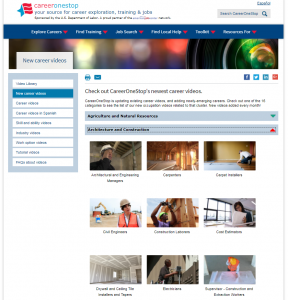
    Newly-created career videos from CareerOneStop give career explorers, students, and job searchers a portrait of life in hundreds of careers—from Actor to Zoologist. The videos, part of a collection depicting more than 800 careers, bring to life the responsibilities, work settings, and employment trends for a broad range of occupations. The new videos provide updated information and context for career explorers navigating today’s employment world. All career details are based on authoritative occupation and labor market information from the U.S. Department of Labor’s Occupational Information Network (O*NET) program and the Bureau of Labor Statistics (BLS). Check out the entire collection at CareerOneStop.org/Videos, where you can browse videos organized by career cluster, or select “New career videos” to see only the updated collection. Essential facts are shown on screen—including current wages, employment outlook, and education requirements—to give viewers an immediate snapshot of the field. Video transcripts are also available in Spanish.
    Benefits and Uses
    The CareerOneStop video collections provides short clips for a adult learners looking to start or change their careers and search thousands of job listings in your area or across the country. Adult Learners can learn about fields in high demand, take an assessment, looks at the different career options, and make a career plan. The site also allows learners to find out about High School Diplomas, certifications, licenses, schools, financial aid, and scholarships. Adults are able to customize the results to find local information to meet their needs. Teachers of adult learners can use this site to provide students a starting point to explore and learn about workforce opportunities.
    Resource Notice
    This site includes links to information created by other public and private organizations. These links are provided for the user’s convenience. The U.S. Department of Education does not control or guarantee the accuracy, relevance, timeliness, or completeness of this non-ED information. The inclusion of these links is not intended to reflect their importance, nor is it intended to endorse views expressed, or products or services offered, on these non-ED sites. Please note that privacy policies on non-ED sites may differ from ED’s privacy policy. When you visit lincs.ed.gov, no personal information is collected unless you choose to provide that information to us. We do not give, share, sell, or transfer any personal information to a third party. We recommend that you read the privacy policy of non-ED websites that you visit. We invite you to read our privacy policy.